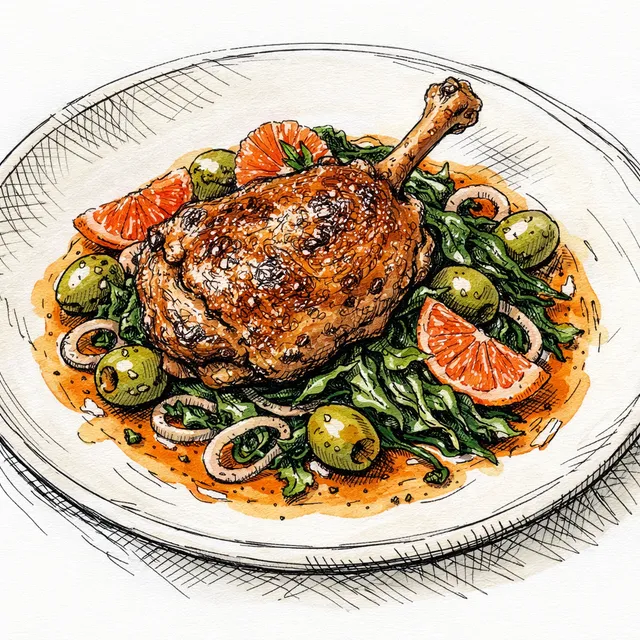
Duck Confit for People Who Don’t Own a Vat of Fat
I fell in love with duck confit in Paris the way you fall for a wool coat in December: instantly, obsessively, and slightly impractically. The first one I ever ate was in a tiny bistro near Canal Saint-Martin—crackly skin, melting meat, a glass of something red and a little wild. Back then, I thought confit required a saint’s patience and a bathtub of duck fat.
California cured me of that drama. Here, winter still smells like citrus, and my farmers’ market bags are heavy with Cara Caras, bitter greens, and briny green olives. So I made my own “confit”: duck legs gently slow-cooked with citrus peel, garlic, and thyme—luxuriously tender without the full commitment—then blasted in a hot oven for that glassy, shattering skin.
What makes this dish special to me is the contrast: deep French comfort, but brightened until it feels almost cheeky. The Cara Cara–shallot jus is my favorite part—sweet, sharp, glossy, and ridiculously flattering to duck.
Make it your own: swap olives for capers, tuck in rosemary instead of thyme, or finish the greens with a spoon of Dijon and extra lemon. And yes—be opinionated about butter in the jus. I am.
Featured Recipe
Citrus & Green Olive Duck “Confit” with Crispy Skin, Wilted Winter Greens, and Cara Cara–Shallot Jus
This is my bistro-winter centerpiece when I want duck confit comfort without the full vat-of-fat commitment: duck legs slow-cooked gently with citrus peel, garlic, and thyme, then blasted in the oven for that glassy, shattering skin. I serve it California-light over a tumble of lemony greens with green olives and a glossy Cara Cara–shallot jus that tastes like you invited the sun to dinner.
Save a copy to your collection for editing
Ingredients
- 4 Duck legs (bone-in, skin-on)(about 10–12 oz each)
- 2 1/2 tsp Kosher salt
- 1 tsp Freshly ground black pepper
- 6 sprigs Fresh thyme
- 6 cloves Garlic(lightly smashed)
- 1 Bay leaf
- 1 Meyer lemon(zest peeled in wide strips (use a peeler), plus 1 tsp juice reserved)
- 1 Orange (Cara Cara or navel)(zest peeled in wide strips, plus 1/2 cup juice (from 1–2 oranges total))
- 2 tbsp Extra-virgin olive oil(for the greens + finishing)
- 1/2 cup Duck fat (rendered)(from the legs as they cook; supplement with olive oil if needed)
- 1/2 cup Dry white wine(I like something crisp; natural wine welcome)
- 3/4 cup Chicken stock (low-sodium)
- 2 Shallots(thinly sliced)
- 1/2 cup Castelvetrano green olives, pitted(halved)
- 1 tsp Dijon mustard
- 2 tsp Champagne vinegar (or white wine vinegar)
- 1 1/2 tbsp Unsalted butter(yes, butter—don’t make me be modest)
- 8 cups Winter greens (mix of escarole, dino kale, and/or chard)(roughly chopped; about 8–10 oz)
- 1/4 cup Fennel fronds or flat-leaf parsley(roughly chopped)
- 1 pinch Flaky salt(to finish)
- 1 tsp Lemon juice (Meyer lemon juice)(From 1 Meyer lemon juice as per jus (noted in steps))
- 2 tbsp Orange juice(Added with stock in jus (not specified in ingredients))
- 1–2 tbsp Water(Splash of water when wilting greens)
Instructions
- 1
Dry-brine the duck: Pat 4 Duck legs (bone-in, skin-on) very dry. Season all over with 2 1/2 tsp Kosher salt and 1 tsp Freshly ground black pepper. Tuck 6 sprigs Fresh thyme, 6 cloves Garlic, 1 Bay leaf, and the citrus zest strips around (not under) the duck in a shallow dish. Cover and refrigerate at least 8 hours, ideally overnight.
10 min
Tip: Dry skin is the secret to a truly crisp finish later. If you’re in a hurry, do 2 hours—still worth it.
- 2
Set up your confit-style slow cook: Heat oven to 275°F (135°C). Arrange duck legs skin-side up in a snug baking dish or Dutch oven. Add the aromatics from the dish (thyme/garlic/zest), then pour in 1/2 cup Duck fat (rendered). You’re not trying to fully submerge the legs like classic confit—aim for the fat to come about 1/3 to halfway up the sides. Cover tightly with a lid or foil.
10 min
Tip: If you’re short on duck fat, top up with olive oil. This is California, we improvise.
- 3
Slow-cook until melting-tender: Bake 2 to 2 1/2 hours, until the meat yields easily when you tug at it and the connective tissue feels relaxed, not stubborn.
150 min
Tip: You want spoon-tender but not falling apart. Start checking at 2 hours.
- 4
Chill briefly for maximum crisp (optional but powerful): Carefully transfer duck legs to a tray, skin-side up. Refrigerate 30–45 minutes while you make the jus. (You can also do this earlier in the day.)
35 min
Tip: Cold skin + hot oven = crackling. This little pause is a chef’s cheat code.
- 5
Make the Cara Cara–shallot jus: Spoon off (or pour) 2 tbsp of the cooking fat into a small saucepan. Add 2 Shallots and cook over medium heat until soft and just starting to caramelize, 6–8 minutes. Add 1/2 cup Dry white wine; reduce by about half. Add 2 tbsp Orange juice and 3/4 cup Chicken stock (low-sodium); simmer until slightly syrupy, 8–12 minutes. Stir in 1 tsp Dijon mustard, 2 tsp Champagne vinegar (or white wine vinegar), and 1 tsp Lemon juice (Meyer lemon juice). Off heat, whisk in 1 1/2 tbsp Unsalted butter until glossy, then fold in 1/2 cup Castelvetrano green olives, pitted. Taste and adjust with salt/acid.
25 min
Tip: Keep it bright: if it tastes “heavy,” add a few drops more vinegar. If it tastes sharp, add a tiny knob more butter.
- 6
Crisp-finish the duck: Heat oven to 450°F (232°C). Place duck legs on a rack over a sheet pan (or directly on a parchment-lined pan). Roast 12–18 minutes until the skin is deeply golden and audibly crisp. Rest 5 minutes.
20 min
Tip: If your oven runs weak, finish with 1–2 minutes under the broiler—watch like a hawk.
- 7
Wilt the greens, bistro-style: While duck roasts, heat 2 tbsp Extra-virgin olive oil in a large skillet over medium-high. Add 8 cups Winter greens (mix of escarole, dino kale, and/or chard) with 1 pinch Flaky salt and 1–2 tbsp Water; toss until just wilted but still lively, 2–4 minutes. Finish with chopped 1/4 cup Fennel fronds or flat-leaf parsley.
5 min
Tip: I want the greens bright and a little squeaky—this is the ‘California-light’ counterpoint to rich duck.
- 8
Plate like a (relaxed) bistro: Divide greens among plates, top with a duck leg, spoon over the citrus-olive jus, and finish with 1 pinch Flaky salt and 1 tsp Freshly ground black pepper.
5 min
Tip: Serve with roasted new potatoes or a hunk of good bread to swipe the jus. Non-negotiable.
Chef's Notes
This dish is my love letter to that moment when a Paris bistro door swings open to a cold night—except I’m doing it with California citrus and a lighter hand. Classic confit is glorious, but at home I like this ‘confit-style’ method: enough fat to baste and perfume, slow heat to tenderize, then a hot oven to get the crackle. Natural wine pairing: a bright, chillable red (Gamay, Poulsard) or a textured skin-contact white if you’re feeling playful.

Marguerite Lavigne
French soul, California sun
I grew up in a small village outside Lyon, where my grandmother taught me that the best meals come from respecting your ingredients. After training at Le Cordon Bleu and spending years in Parisian kitchens, I moved to San Francisco and fell in love with California's farmers markets and wine country. Now I cook the food I wish my grandmother could taste—French technique with California abundance, where a perfect roast chicken might come with Meyer lemon and wild fennel instead of tarragon.