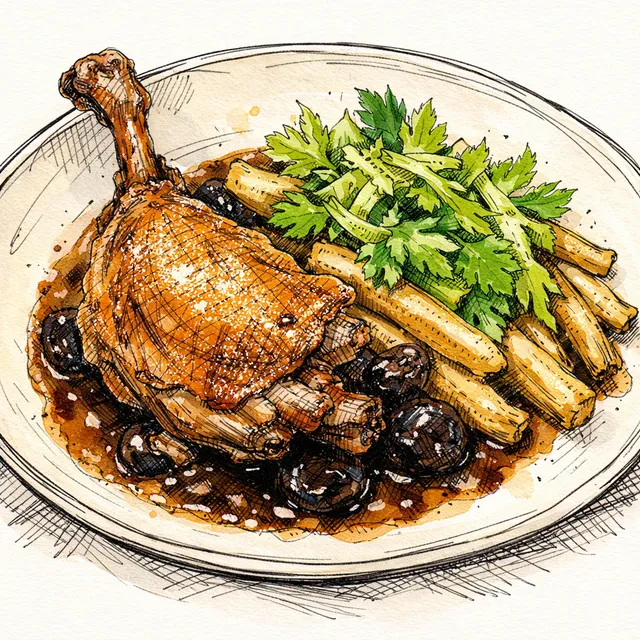
Crisp-Braised Duck Legs with Prune–Armagnac Jus (and the California Side I Can’t Quit)
I fell for this dish the way you fall for a dimly lit bistro in January—half hungry, half homesick, entirely ready to believe in small miracles. The inspiration is very Gascony-meets-California: classic duck legs, braised until lush, then crisped hard; a prune–Armagnac pan jus that’s deep and silky without wandering into dessert; and salsify browned in butter until the edges go nutty and fierce.
My first real memory of prunes in savory sauce was in a Paris kitchen where the chef insisted, "not sweet—round." He was right. Prunes don’t have to taste sugary; they can taste like bass notes. Now I make this when the evenings get early and I want dinner to feel like a wool coat.
What makes it special to me is the contrast: crackly skin, glossy sauce, then that celery-leaf salad—bright, herbal, almost cheeky—like opening a window.
Make it yours: swap Armagnac for Cognac or a good brandy; add orange zest to the jus if you want more lift; and don’t fear the butter for the salsify. It’s doing important work.
Featured Recipe
Crisp-Braised Duck Legs with Prune–Armagnac Pan Jus + Butter-Basted Salsify & Celery-Leaf Salad
This is my winter-bistro love language: duck legs with shatter-crisp skin, a silky pan sauce that tastes like a tiny Parisian miracle, and one elegant vegetable side that feels very California—bright, herbal, and not at all heavy. Prunes and Armagnac make the jus glossy and deep without turning it sweet; salsify gets crisp edges in butter like it’s auditioning for the best part of the plate.
Save a copy to your collection for editing
Ingredients
- 4 Duck legs (bone-in, skin-on)(about 10–12 oz each)
- 2 1/2 tsp Kosher salt(plus more as needed)
- 1 tsp Freshly ground black pepper
- 3 Garlic cloves(smashed)
- 6 Thyme sprigs(or a mix of thyme + rosemary)
- 1 Bay leaf
- 2 Shallots(finely sliced)
- 1/2 cup Dry white wine(or dry vermouth)
- 1 cup Chicken stock(low-sodium)
- 3 tbsp Armagnac (or Cognac/brandy)(optional but very bistro)
- 6 Pitted prunes(roughly chopped)
- 1 tsp Dijon mustard
- 2 tbsp Unsalted butter(for finishing the sauce)
- 1 tbsp Neutral oil(grapeseed/avocado/sunflower)
- 1 1/2 lb Salsify(peeled; substitute parsnips if you can’t find it)
- 1 Lemon(half for acidulated water, half for dressing)
- 2 tbsp More unsalted butter(for salsify)
- 1 tsp Honey(optional, helps caramelization)
- 1 packed cup Celery leaves (tender)(from a bunch of celery)
- 1/2 cup Flat-leaf parsley(loosely packed)
- 2 tbsp Extra-virgin olive oil
- 1 1/2 tbsp Sherry vinegar (or champagne vinegar)
- 1 pinch Flaky salt(to finish)
Instructions
- 1
Dry-brine the duck for better crisp edges: pat 4 Duck legs (bone-in, skin-on) very dry. Season all over with 2 1/2 tsp Kosher salt and 1 tsp Freshly ground black pepper. Nestle with 3 Garlic cloves, 6 Thyme sprigs, and 1 Bay leaf in a dish, cover, and refrigerate at least 4 hours (overnight is my favorite).
10 min
Tip: Dry skin is the whole game. If you only have 1 hour, do it uncovered in the fridge and call it good.
- 2
Heat the oven to 325°F. Pull the duck from the fridge 20–30 minutes before cooking and wipe off any wet bits of thyme / garlic stuck to the skin (they can burn in the sear).
5 min
Tip: I leave the aromatics in the dish—just keep the skin clean.
- 3
Sear: set a large, heavy oven-safe skillet (cast iron is perfect) over medium heat. Add 1 tbsp Neutral oil. Place 4 Duck legs (bone-in, skin-on) skin-side down and cook until the fat renders and the skin is deep golden, 10–14 minutes. Flip and cook 2 minutes on the flesh side.
16 min
Tip: No rushing. You’re rendering, not frying. If it’s spitting aggressively, lower the heat.
- 4
Pour off excess duck fat, leaving about 2 tablespoons in the pan. Add 2 Shallots and cook until soft and glossy, 2–3 minutes. Add 6 Pitted prunes and stir 30 seconds.
4 min
Tip: Save the extra duck fat—it’s the best roasted potato insurance policy on earth.
- 5
Deglaze: add 3 tbsp Armagnac (or Cognac/brandy) (if using) and let it bubble 30 seconds. Add 1/2 cup Dry white wine and scrape up the browned bits. Add 1 cup Chicken stock and 1 tsp Dijon mustard; bring to a simmer.
4 min
Tip: Those browned bits are your sauce’s résumé. Get them all.
- 6
Crisp-braise: return 4 Duck legs (bone-in, skin-on) to the skillet, skin-side up (keep the skin above the liquid). Tuck in thyme and bay leaf if you’d like. Transfer to the oven and braise until the meat is very tender, 65–85 minutes.
75 min
Tip: Skin-side up is non-negotiable for crisp edges. Liquid should come about 1/3 up the legs.
- 7
While the duck braises, prep the salsify: fill a bowl with cold water and squeeze in 1/2 Lemon. Peel 1 1/2 lb Salsify and cut into 3–4 inch batons, dropping them into the lemon water as you go (it prevents browning).
15 min
Tip: Salsify is the unsung bistro vegetable—like artichoke’s quieter cousin.
- 8
Cook the salsify: drain and pat dry. In a large skillet over medium-high heat, melt 2 tbsp Unsalted butter. Add 1 1/2 lb Salsify, season with salt, and cook until browned in spots, 6–8 minutes. Add a splash of water (2–3 tbsp), cover, and steam 4 minutes. Uncover, add 1 tsp Honey (optional), and cook 1–2 minutes more for crisp edges.
14 min
Tip: You want tender centers with caramelized corners—like the best roast potatoes, but elegant.
- 9
Make the bright herb finish: toss 1 packed cup Celery leaves (tender) and 1/2 cup Flat-leaf parsley with 2 tbsp Extra-virgin olive oil, 1 1/2 tbsp Sherry vinegar (or champagne vinegar), and the juice from the remaining 1/2 Lemon. Season to taste with salt and pepper. Keep it fluffy—not packed down.
5 min
Tip: This little salad is my California sunbeam against the duck’s winter mood.
- 10
Finish the pan sauce: remove 4 Duck legs (bone-in, skin-on) to a plate. Place the skillet over medium heat and simmer the braising liquid until slightly reduced and glossy, 3–6 minutes. Off heat, whisk in 2 tbsp cold Unsalted butter to make it silky.
6 min
Tip: Cold butter, off heat. That’s your quick bistro ‘monté au beurre’ moment without being precious about it.
- 11
Re-crisp (optional but satisfying): if you want extra crackle, slide the duck legs under the broiler 1–3 minutes, watching like a hawk. Spoon a little sauce over the meat (not the skin).
3 min
Tip: Sauce goes around and under; skin stays dry and proud.
- 12
Serve: plate 4 Duck legs (bone-in, skin-on) with a puddle of prune–Armagnac jus. Add butter-basted 1 1/2 lb Salsify on the side and crown it with the celery-leaf salad. Finish with 1 pinch Flaky salt.
3 min
Tip: A glass of chilled, lightly funky red (Gamay, Poulsard) makes this feel like a tiny Tuesday-night vacation.
Chef's Notes
This dish is my love letter to the old-school bistro prune situation—except I keep it sharp, not sticky. Prunes give body to the sauce (almost like a natural thickener), Armagnac brings that warm ‘I’m sitting near a radiator in Paris’ glow, and celery leaves keep everything awake. If you can’t find salsify, parsnips work—just cut them a touch thicker so they don’t go mushy.

Marguerite Lavigne
French soul, California sun
I grew up in a small village outside Lyon, where my grandmother taught me that the best meals come from respecting your ingredients. After training at Le Cordon Bleu and spending years in Parisian kitchens, I moved to San Francisco and fell in love with California's farmers markets and wine country. Now I cook the food I wish my grandmother could taste—French technique with California abundance, where a perfect roast chicken might come with Meyer lemon and wild fennel instead of tarragon.