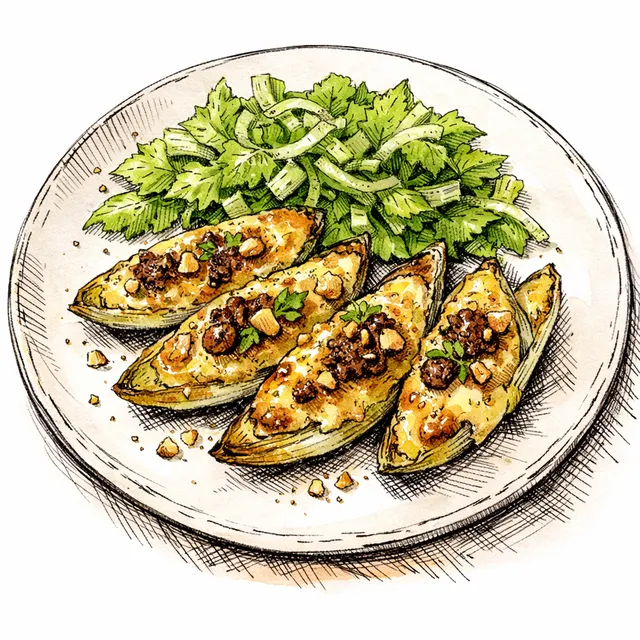
Endive & Comté Barquettes: My Winter Bistro Boats, California-Style
I started making these Endive & Comté “Barquettes” Gratinées after one too many winter apéros where everyone wanted something warm, but I didn’t want to babysit a whole soufflé like it’s 1978. In Paris, I loved anything “gratinée”—that moment when cheese goes bubbly and a little insolent. In California, I also want crunch, bitterness, brightness. So: endive boats, not toast.
The hazelnut–date butter happened the way good things do—by accident, late at night, with a jar of dates that needed attention and a bag of toasted hazelnuts whispering, “use me.” It’s smoky-sweet, a little sticky, and absolutely obsessed with Comté.
My favorite memory: a rainy January get-together where everyone pretended they’d have “just one,” then quietly stood at the broiler tray like seagulls at the beach.
To make it yours: swap dates for dried figs or apricots, add a scrape of lemon zest, or spike the butter with a pinch of Espelette. And don’t skip the celery-leaf salad—it keeps the whole thing bright, crisp, and dangerously snackable with Jura blanc or a juicy Beaujolais.
Featured Recipe
Endive & Comté “Barquettes” Gratinées with Hazelnut–Date Butter + Quick Celery-Leaf Salad
These are my winter-gathering secret weapon: crisp endive leaves turned into little bistro boats, stuffed with a smoky-sweet hazelnut–date butter and showered with Comté until it bubbles and bronzes under the broiler. You get warm, melty, salty cheese against cool, bitter endive—then a quick dressed salad on the side to keep it bright and dangerously snackable with a glass of Jura white or Beaujolais.
Save a copy to your collection for editing
Ingredients
- 5 heads Belgian endive (tight, firm heads)(you’ll use the leaves as “boats”)
- 170 g Comté cheese, finely grated(about 1 1/2 cups; Gruyère also works)
- 75 g Hazelnuts, toasted(roughly chopped; plus extra for garnish if you’re feeling fancy)
- 85 g Unsalted butter, softened(6 Tbsp)
- 80 g Pitted dates (Medjool preferred)(about 6 large dates)
- 1 Shallot, minced(small)
- 0.5 tsp Smoked paprika(or piment d’Espelette for a cleaner heat)
- 1 tsp Dijon mustard
- 1 tsp Lemon zest(from 1 lemon)
- 2 tbsp Lemon juice(divided)
- 1 tsp Kosher salt(plus more to taste)
- 0.5 tsp Black pepper(freshly ground)
- 3 tbsp Extra-virgin olive oil(for the quick salad)
- 1 tbsp Rice vinegar or white wine vinegar(for the quick salad)
- 2 cups Celery leaves (or tender inner celery), roughly torn(the bright, green counterpoint)
- 0.5 cup Fennel fronds or flat-leaf parsley, roughly torn(optional but very California-bistro)
- 1 pinch Flaky salt(to finish)
- 1 Tbsp Water(to moisten dates while blending)
Instructions
- 1
Heat the broiler to high and set an oven rack about 6 inches from the flame/element. Line a sheet pan with foil (cheese will misbehave; let it).
5 min
Tip: If your broiler runs hot, use the middle rack and just broil a touch longer.
- 2
Prep the endive “boats”: separate 5 heads Belgian endive leaves, keeping the nicest spoon-shaped ones. Trim the tough little nub at the base of each leaf if needed. Arrange leaves in a single layer on the sheet pan, slightly overlapping is fine.
10 min
Tip: Choose medium-to-large leaves for stuffing; save tiny inner leaves for the salad if you like.
- 3
Make my hazelnut–date butter: in a food processor, blitz 80 g Pitted dates (Medjool preferred) with 1 Tbsp Water and 1 Shallot, minced until a thick paste forms. Add 85 g Unsalted butter, softened, 1 tsp Dijon mustard, 0.5 tsp Smoked paprika, 1 tsp Lemon zest, 1 Tbsp lemon juice, 1 tsp Kosher salt, and 0.5 tsp Black pepper. Pulse until smooth-ish (I like a little texture). Fold in 75 g Hazelnuts, toasted by hand.
8 min
Tip: No processor? Chop dates very fine and mash everything together with a fork—rustic and charming.
- 4
Stuff and cheese: spoon about 1 to 1 1/2 tsp of the date-hazelnut butter into each endive leaf. Top generously with 170 g Comté cheese, finely grated (don’t be shy; gratinée is the assignment).
10 min
Tip: Aim for a little mound of cheese—when it melts, it blankets the filling and clings to the endive like it was born there.
- 5
Gratinée under the broiler until the cheese is bubbling and deeply golden in spots, 2–4 minutes. Pull the tray and let it cool for 2 minutes so the cheese sets slightly (and doesn’t remove the roof of your mouth).
5 min
Tip: Watch like a hawk—broilers go from “Paris” to “campfire” fast.
- 6
While the endive boats broil, toss the quick salad: in a bowl whisk 3 tbsp Extra-virgin olive oil, 1 tbsp Rice vinegar or white wine vinegar, remaining 1 Tbsp lemon juice, a pinch of salt and pepper. Add 2 cups Celery leaves (or tender inner celery), roughly torn and 0.5 cup Fennel fronds or flat-leaf parsley, roughly torn; toss lightly and taste. It should be bright and a little sharp.
5 min
Tip: This salad is your palate reset—keep it crisp and unapologetically acidic.
- 7
Serve: plate the hot gratinée endive boats with the cool celery-leaf salad alongside. Finish everything with 1 pinch Flaky salt and, if you want, a few extra 75 g Hazelnuts, toasted.
2 min
Tip: Best eaten standing up in the kitchen with a glass of chilled Savagnin or a juicy Gamay—my favorite winter party posture.
Chef's Notes
This dish is basically my love letter to endive: bitter, crisp, and much more interesting than it gets credit for. The date-hazelnut butter is a little nod to the dried-fruit-and-nuts bowls that always appeared at my grandmother’s winter apéros—except I’ve gone full bistro and tucked it under Comté. If you’re prepping ahead: make the butter up to 3 days in advance, grate the cheese, and keep the endive wrapped in a towel in the fridge. Stuff and broil right before guests arrive so you get that melty, bronzed moment on cue.

Marguerite Lavigne
French soul, California sun
I grew up in a small village outside Lyon, where my grandmother taught me that the best meals come from respecting your ingredients. After training at Le Cordon Bleu and spending years in Parisian kitchens, I moved to San Francisco and fell in love with California's farmers markets and wine country. Now I cook the food I wish my grandmother could taste—French technique with California abundance, where a perfect roast chicken might come with Meyer lemon and wild fennel instead of tarragon.