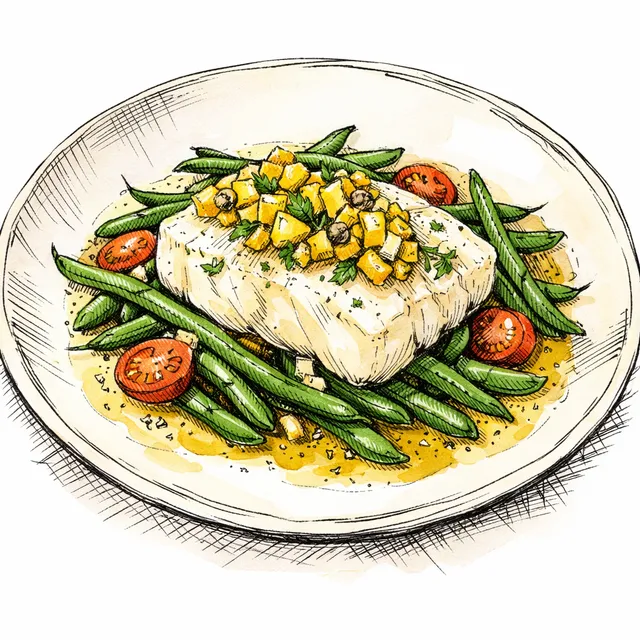
A Sunny California Poach: Olive Oil Halibut with Meyer Lemon Relish
Forget everything you know about dry, overcooked fish. We are coaxing these beautiful cuts of halibut into buttery submission through a gentle olive oil and white wine poach. This technique takes me straight back to a tiny, humid kitchen in Marseille, where an old mentor taught me that fish should be treated with utmost patience and an absurd amount of very good olive oil. But here in California, I simply could not resist giving it my own West Coast spin. Enter Meyer lemons from my neighbor's overflowing tree. Combined with briny olives, they make a punchy, salty relish that cuts right through the richness of the poached fish. Paired with perfectly tender-crisp haricots verts, this dish is exactly what I want to eat on a sunny afternoon with a chilled glass of slightly funky, natural Chenin Blanc. It is so special to me because it bridges my two culinary worlds effortlessly. Want to make it your own? If you don't have halibut, a thick cut of cod works beautifully. Can't find Meyer lemons? Use regular lemons with a tiny pinch of sugar. Just promise me you will not rush the poach. Let the oil do its quiet, luxurious work.
Featured Recipe
Gentle Olive Oil-Poached Halibut with Warm Haricots Verts & Meyer Lemon Relish
Forget everything you know about dry, overcooked fish. We are coaxing these beautiful cuts of halibut into buttery submission through a gentle olive oil and white wine poach. Paired with perfectly tender-crisp haricots verts and a punchy, salty Meyer lemon and olive relish, this is exactly what I want to eat on a sunny California afternoon with a chilled glass of natural Chenin Blanc.
Save a copy to your collection for editing
Timeline
Ingredients
- 2 (6 oz) fillets Halibut fillets, skinless and about 1-inch thick(Ask your fishmonger for center-cut pieces so they cook evenly)
- 8 oz Haricots verts(Trimmed)
- 1 cup + 2 tbsp Extra virgin olive oil(Divided use; use the good, grassy stuff here)
- 1/2 cup Dry white wine(Something bright like a Vermentino or Sauvignon Blanc)
- 2 medium Shallots(One minced for relish, one thinly sliced for poaching)
- 1 whole Meyer lemon(If using a regular lemon, just use the zest and juice instead of dicing the peel)
- 1/4 cup Castelvetrano olives(Pitted and roughly chopped)
- 2 sprigs Fresh tarragon(Plus a few extra leaves for garnish if you like)
- 2 cloves Garlic(Gently smashed with the side of a knife)
- 1 tsp Flaky sea salt(Divided use)
- 1 piece baguette(for serving)
Instructions
- 1
Bring a medium pot of generously salted water to a rolling boil. Meanwhile, mince 1 medium shallot and thinly slice the remaining 1 medium shallot. Finely dice half of the 1 whole Meyer lemon (peel and all, but remove the seeds), and cut the other half into wedges for serving. Trim the ends of your 8 oz haricots verts.
10 min
Tip: Meyer lemon peels are thin and sweet enough to eat, which is why we dice the whole thing. It adds incredible floral depth.
- 2
In a small bowl, stir together the minced shallot, the diced Meyer lemon, the chopped 1/4 cup Castelvetrano olives, and 2 tbsp extra virgin olive oil. Season with a generous pinch of your 1 tsp flaky sea salt and set aside to let those beautiful flavors marry.
5 min
Tip: This relish only gets better as it sits. You can make it up to a day in advance.
- 3
In a deep skillet or sauté pan, combine the sliced shallot, the remaining 1 cup extra virgin olive oil, 1/2 cup dry white wine, the smashed 2 cloves garlic, and 2 sprigs fresh tarragon. Place over medium-low heat until the liquid just begins to tremble and shimmer. We are looking for a bare whisper of a simmer, around 160 degrees F.
5 min
Tip: Patience is a virtue here. If the oil boils, it will fry the fish instead of gently coaxing it to tenderness.
- 4
Season the 2 (6 oz) halibut fillets with the remaining 1 tsp flaky sea salt. Gently slide them into the warm oil bath. Let them poach slowly, spooning the aromatic oil over the top occasionally, until the flesh turns opaque white and yields easily to a gentle prod with a fork.
12 min
Tip: The fish should feel almost custardy. Do not flip it; just baste the top.
- 5
While the halibut is poaching in its luxurious bath, drop the trimmed 8 oz haricots verts into your boiling water. Blanch them just until they turn a vibrant, bright green and are tender-crisp.
4 min
Tip: I like my beans with a tiny bit of snap left to contrast the buttery fish.
- 6
Drain the haricots verts well and transfer them to a warm mixing bowl. Squeeze a bit of juice from the reserved Meyer lemon wedges over them, toss gently, and taste for seasoning.
2 min
Tip: If you want to be decadent, spoon a tablespoon of the poaching oil over the warm beans.
- 7
Divide the warm haricots verts between two shallow bistro bowls or plates. Carefully lift the halibut from the poaching liquid using a slotted spatula, letting the excess oil drip off for a moment, and rest it gently over the beans. Spoon the bright olive and lemon relish generously over the top of the fish. Pour the wine, tear off some good baguette, and serve immediately.
3 min
Tip: Save that remaining poaching oil! Strain it, keep it in a jar in the fridge, and use it to make a brilliant vinaigrette tomorrow.
Chef's Notes
People are often intimidated by poaching in oil, but it is actually the most forgiving way to cook white fish! Because the temperature is so low, your window for perfectly cooked fish expands dramatically. Just keep an eye on your heat and let the olive oil do the heavy lifting.

Marguerite Lavigne
French soul, California sun
I grew up in a small village outside Lyon, where my grandmother taught me that the best meals come from respecting your ingredients. After training at Le Cordon Bleu and spending years in Parisian kitchens, I moved to San Francisco and fell in love with California's farmers markets and wine country. Now I cook the food I wish my grandmother could taste—French technique with California abundance, where a perfect roast chicken might come with Meyer lemon and wild fennel instead of tarragon.