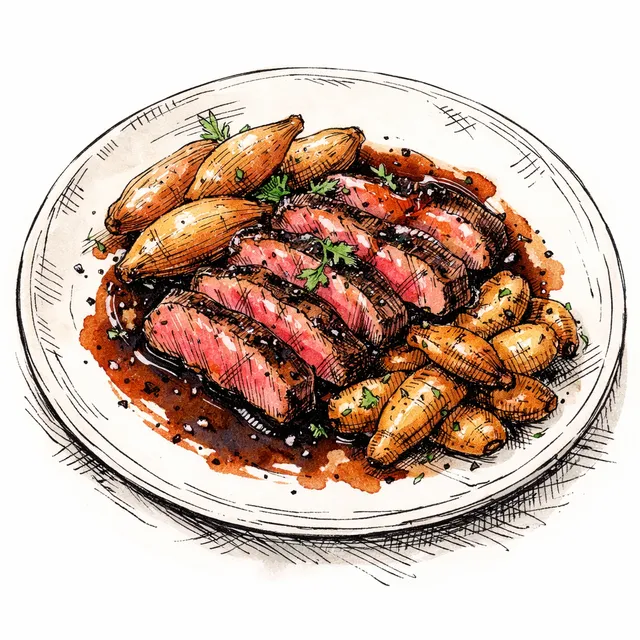
Pan-Roasted Bistro Bavette Steak with Melting Torpedo Shallots, Crispy Fingerlings & Cabernet Pan Jus
There is a little bistro in the 11th arrondissement where the bavette à l'échalote practically defines the evening. When I first moved to California, I craved that rich, beefy cut, but I wanted to marry it with our sun-drenched local produce. That is how this dish was born—a true love letter to the Parisian butcher cut, paired with sweet torpedo shallots and golden fingerlings from my favorite farmer at the Santa Monica market. Bavette is coarse-grained and drinks up flavor, so we sear it hard in cast iron, baste it generously in foaming butter, and let it rest while we build a pan jus with a glug of chilled Cabernet Franc. My golden rule here? Do not skimp on the butter or the shallots. Let those torpedo onions melt down until they are practically jammy. Pour yourself a glass of chilled natural red, throw on some Edith Piaf, and treat your kitchen like a corner of Paris. You've got this!
Featured Recipe
Pan-Roasted Bistro Bavette Steak with Melting Torpedo Shallots, Crispy Fingerlings & Cabernet Pan Jus
A love letter to the Parisian butcher cut: coarse-grained, richly beefy bavette steak seared hard in cast iron, basted in foaming butter, and served alongside golden crispy fingerlings and sweet, caramelized torpedo shallots glazed in Cabernet Franc.
Save a copy to your collection for editing
Timeline
Ingredients
- 1.5 lbs bavette steak(also sold as flap steak, trimmed and brought to room temperature)
- 1.5 tsp kosher salt(plus flaky Maldon salt for finishing)
- 1 tsp freshly cracked black pepper(coarsely ground)
- 1 lb fingerling potatoes(halved lengthwise)
- 2 tbsp olive oil(divided)
- 4 tbsp unsalted European butter(cold, cut into tablespoons and divided)
- 4 large torpedo shallots(peeled and sliced thickly lengthwise; French grey shallots also work beautifully)
- 3 garlic cloves(unpeeled, lightly smashed)
- 4 sprigs fresh thyme sprigs
- 0.5 cup dry red wine(preferably a Loire or Santa Barbara County Cabernet Franc)
- 0.33 cup rich beef bone broth(or unsalted beef stock)
- 2 cups fresh watercress(tender sprigs, washed and dried)
- 1 tsp Meyer lemon juice
- pinch salt(Mentioned in step 7 for dressing watercress)
Instructions
- 1
Bring a medium saucepan of salted water to a boil. Drop in 1 lb fingerling potatoes and simmer gently until tender when pierced with the tip of a paring knife, about 10 minutes. Drain well and let them steam dry on a clean kitchen towel.
12 min
Tip: Getting the steam out ensures they crisp up deeply in the skillet later instead of turning soggy.
- 2
While the potatoes cook, pat 1.5 lbs bavette steak completely dry with paper towels. Season both sides generously with 1.5 tsp kosher salt and 1 tsp freshly cracked black pepper. Let it sit at room temperature to take the chill off.
5 min
Tip: Never throw cold steak into a hot pan—it drops the heat instantly and steams instead of giving you that gorgeous caramelized crust.
- 3
Set a large, heavy cast iron skillet over medium-high heat until wisps of smoke just begin to appear. Swirl in 1 tbsp olive oil, then carefully lay in the seasoned bavette. Sear undisturbed for 3 to 4 minutes until a deep mahogany crust forms. Flip the steak, immediately toss in 2 tbsp unsalted European butter, 3 garlic cloves, and 4 sprigs fresh thyme sprigs. Tilt the pan and spoon the foaming butter over the meat continuously for another 3 to 4 minutes for medium-rare.
8 min
Tip: Bavette has coarse grain that loves high heat, but pull it at 130°F—it gets chewy if pushed past medium.
- 4
Transfer the bavette to a warm cutting board or rimmed plate. Loosely tent with a piece of foil and let it rest for 8 to 10 minutes so all those magnificent juices redistribute throughout the muscle fibers.
8 min
Tip: Resist cutting into it early, or every drop of flavor will end up on the cutting board instead of on your fork.
- 5
Pour off any excess blackened fat from the cast iron skillet, leaving about a tablespoon of beef drippings behind. Drop in 1 tbsp unsalted European butter, the sliced 4 large torpedo shallots, and the steamed fingerling potatoes, cut-side down. Pan-roast over medium heat for 6 to 7 minutes, stirring the shallots occasionally while letting the potato cut-sides develop a crisp, deep golden crust.
7 min
Tip: Let the shallots soften slowly around the potatoes so they become tender and sweet without scorching.
- 6
Transfer the crispy potatoes and melting shallots to a serving platter. Return the skillet to medium-high heat, pour in 0.5 cup dry red wine, and use a wooden spoon to scrape up all the delicious browned bits stuck to the bottom. Simmer vigorously until reduced by two-thirds, about 3 minutes. Pour in 0.33 cup rich beef bone broth and any accumulated resting juices from the steak; simmer until glossy and lightly thickened, about 2 minutes. Pull the pan off the heat and vigorously swirl in the final cold 1 tbsp unsalted European butter to mount the sauce.
5 min
Tip: Taking the pan off the heat before swirling in cold butter creates an emulsified, velvety bistro pan sauce without breaking it.
- 7
In a small bowl, quickly toss 2 cups fresh watercress with 1 tbsp olive oil, 1 tsp Meyer lemon juice, and a pinch of salt. Slice the rested bavette against its prominent grain into 1/2-inch thick slices. Fan the steak over the crispy potatoes and shallots, spoon the glossy Cabernet pan jus over the beef, and scatter the dressed watercress over top.
3 min
Tip: Always look closely at bavette: the grain runs diagonally. Cutting perpendicular to those muscle fibers is the secret to melt-in-your-mouth tenderness.
Chef's Notes
If you walk into any proper Parisian neighborhood bistro, you won't find filet mignon on the chalkboards—you'll see bavette d'aloyau. It’s the butcher’s secret cut, prized for its deeply beefy flavor and loose texture that drinks up sauces like a sponge. Out here in California, I pair it with sweet torpedo shallots from the farmers' market and a quick splash of peppery Cabernet Franc. Don't skip resting the meat, and always slice strictly against the grain!

Marguerite Lavigne
French soul, California sun
I grew up in a small village outside Lyon, where my grandmother taught me that the best meals come from respecting your ingredients. After training at Le Cordon Bleu and spending years in Parisian kitchens, I moved to San Francisco and fell in love with California's farmers markets and wine country. Now I cook the food I wish my grandmother could taste—French technique with California abundance, where a perfect roast chicken might come with Meyer lemon and wild fennel instead of tarragon.