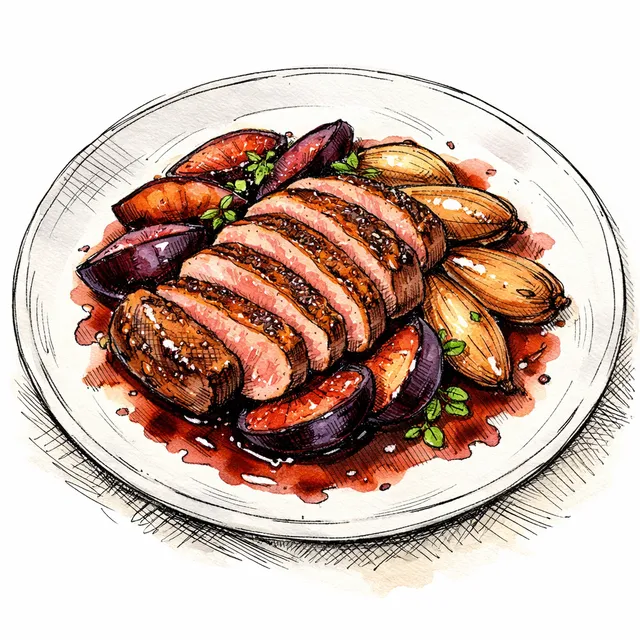
Pan-Roasted Duck Breast with Late-Harvest Plums, Shallots & Pinot Noir Pan Jus
There is something utterly magical about the moment California's stone fruit season crashes into the crisp, sweater-weather vibe of autumn. I was walking through the Santa Monica farmers market last month when Miguel, my favorite stone fruit grower, handed me a bruised, incredibly fragrant late-harvest plum. One bite and I knew it was destined for duck. This dish is my love letter to Paris bistros, where rich meets tart, but with a decidedly sun-drenched West Coast twist. I remember testing this for a dinner party with dear friends, sipping a chilled skin-contact Grenache while the shallots sizzled in duck fat, filling the kitchen with pure comfort. The secret to this recipe is patience in rendering that skin until it shatters like glass, then letting the plums collapse just enough into the pan juices. Don't be shy with the butter at the end—a glossy monte au beurre is non-negotiable in my kitchen. Swap the plums for figs or even tart apples if the season calls for it, but whatever you do, pour yourself a glass of Pinot Noir and enjoy the sizzle.
Featured Recipe
Pan-Roasted Duck Breast with Late-Harvest Plums, Shallots & Pinot Noir Pan Jus
Crispy-skinned duck breast meets the sultry sweetness of late-season California plums bathed in a glossy, butter-mounted Pinot Noir reduction. It is everything I adore about a Paris autumn bistro supper, made bright and vibrant with West Coast fruit.
Save a copy to your collection for editing
Timeline
Ingredients
- 2 boneless duck breasts (skin-on, preferably Pekin or Moulard)(about 12 to 14 oz each, patted bone-dry)
- 1 tsp kosher salt(split between meat and seasoning)
- 1/2 tsp freshly ground black pepper
- 4 fresh plums (Italian prune plums or black plums)(pitted and cut into quarters)
- 2 shallots(finely sliced into rings)
- 3 sprigs fresh thyme sprigs
- 1/2 cup dry Pinot Noir(a lively California natural Pinot or light Cru Beaujolais)
- 1 tbsp aged balsamic vinegar
- 1 tsp wildflower honey
- 2 tbsp cold unsalted cultured butter(cubed, kept refrigerator-cold)
- 1/4 tsp flaky sea salt(such as Maldon, for finishing)
Instructions
- 1
Use a sharp paring knife to score 2 boneless duck breasts (skin-on, preferably Pekin or Moulard) in a tight diamond crosshatch pattern, slicing gently through the fat layer without puncturing the red flesh underneath. Season both sides generously with 1 tsp kosher salt and 1/2 tsp freshly ground black pepper.
5 min
Tip: Scoring allows that rich, gorgeous fat cap to melt and turn shatteringly crisp instead of soggy.
- 2
Place the scored duck breasts skin-side down in a cold, dry, heavy stainless steel or cast-iron skillet with no added oil. Set heat to medium-low. Let the skin render slowly without rushing, pouring off excess rendered liquid fat into a small ramekin every few minutes, until the skin is a deep mahogany and crisp.
12 min
Tip: Starting in a completely cold skillet is the classical French secret—it pulls the fat out gently before the meat can seize up.
- 3
While the duck is gently rendering on low heat, slice 2 shallots into thin rings and quarter 4 fresh plums (Italian prune plums or black plums), discarding their pits. Keep 3 sprigs fresh thyme sprigs handy.
5 min
Tip: Firm-ripe plums hold their shape beautifully in hot rendered duck fat without melting into jam.
- 4
Once the skin is ultra-crisp, raise heat to medium and flip the duck breasts onto their flesh side. Sear for 3 to 4 minutes until the meat registers 130°F on an instant-read thermometer for a luscious, rosy medium-rare.
4 min
Tip: Duck breasts should be treated like a prime steak—overcooking into grey territory is a bistro sin!
- 5
Transfer the duck breasts skin-side up to a warm cutting board to rest, leaving them uncovered so the crackling skin remains crisp.
8 min
Tip: Resting lets the juices settle back into the tender meat so every slice is velvet.
- 6
Pour off all but 1 tablespoon of duck fat from the skillet. Return skillet to medium heat and toss in 2 shallots and 3 sprigs fresh thyme sprigs. Cook for 2 minutes until softened, then add 4 fresh plums (Italian prune plums or black plums) cut-side down, searing for 2 minutes until lightly caramelized at the edges.
4 min
Tip: Do not stir too aggressively; let the plums get a quick golden sizzle in the hot duck fat.
- 7
Pour in 1/2 cup dry Pinot Noir, 1 tbsp aged balsamic vinegar, and 1 tsp wildflower honey, scraping up all the golden browned fond stuck to the bottom of the pan. Simmer briskly for 2 to 3 minutes until reduced by half into a syrupy jus. Remove from heat, discard thyme stems, and swirl in 2 tbsp cold unsalted cultured butter one cube at a time until silky and glossy.
4 min
Tip: Always swirl butter off the heat; emulsifying cold butter into hot sauce creates that velvety bistro gloss.
- 8
Slice each rested duck breast diagonally into 1/3-inch thick slices. Fan the rosy slices over warm plates, spoon the caramelized plums alongside, drape the glossy Pinot Noir reduction generously over the meat, and sprinkle the crispy skin with 1/4 tsp flaky sea salt.
2 min
Tip: Serve immediately alongside a glass of chilled, low-intervention Pinot Noir or Gamay.
Chef's Notes
Save every drop of the strained rendered duck fat you pour off during cooking! Keep it sealed in a jar in your fridge—it is pure culinary gold for pan-roasting baby fingerling potatoes later in the week. If Italian prune plums are out of season, late black plums or even ripe mission figs make a gorgeous stand-in.

Marguerite Lavigne
French soul, California sun
I grew up in a small village outside Lyon, where my grandmother taught me that the best meals come from respecting your ingredients. After training at Le Cordon Bleu and spending years in Parisian kitchens, I moved to San Francisco and fell in love with California's farmers markets and wine country. Now I cook the food I wish my grandmother could taste—French technique with California abundance, where a perfect roast chicken might come with Meyer lemon and wild fennel instead of tarragon.