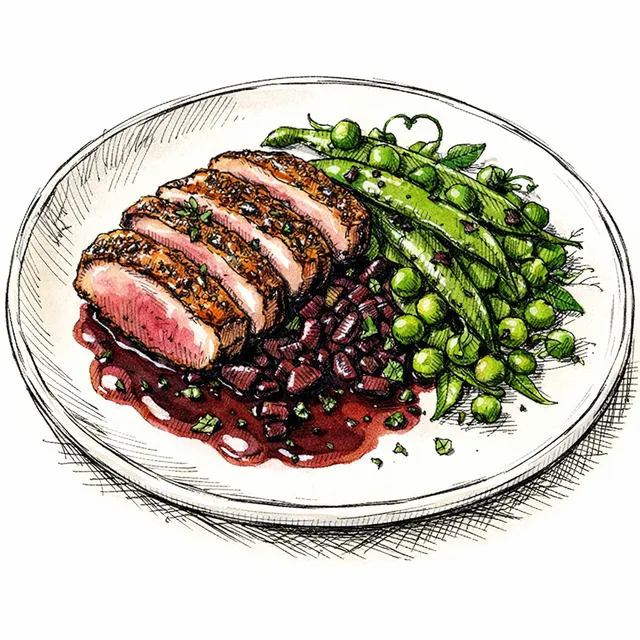
Pan-Seared Duck Breast with Gamay-Shallot Reduction & Blistered Spring Peas
Duck breast has a reputation for being fussy, but darling, it is honestly just a luxurious steak that brings its own cooking fat to the party. The inspiration for this dish hit me during a breezy spring evening back in Paris, sitting at a corner neighborhood bistro sipping a perfectly chilled Gamay. I wanted to capture that exact comforting feeling but give it a serious California tan. I remember my favorite farmer at the Santa Monica market handing me the absolute first snap peas of the season, and I knew exactly what to do. We render the duck skin low and slow until it shatters like a potato chip, then use that liquid gold to blister those sweet spring peas. What makes this recipe so incredibly special to me is the quick pan reduction: juicy natural Gamay, a generous handful of sweet shallots, and a squeeze of Cara Cara orange that cuts right through the richness with bright West Coast sunshine. It is pure bistro magic. To make it your own, please do not be precious about the wine. Use whatever light, chillable red you love to drink. Pour a generous glass for yourself, toss a splash in the pan, and whisk in a cold knob of good cultured butter at the very end. You have absolutely got this.
Featured Recipe
Pan-Seared Duck Breast with Gamay-Shallot Reduction & Blistered Spring Peas
Duck breast has a reputation for being fussy, but it’s honestly just a luxurious steak that brings its own cooking fat to the party. We're rendering the skin low and slow until it shatters like a potato chip, then using that liquid gold to blister sweet spring snap peas. A quick pan reduction of light, juicy Gamay, shallots, and Cara Cara orange cuts right through the richness—it tastes exactly like a breezy spring evening at a Parisian corner bistro, but with a definite California tan.
Save a copy to your collection for editing
Timeline
Ingredients
- 2 duck breasts (about 1 lb total)(Skin on; let them sit at room temperature for 15 minutes before cooking)
- 1 tsp kosher salt(Plus more to taste)
- 0.5 tsp black pepper(Freshly ground)
- 2 medium shallots, finely minced(Don't skimp on these; they form the backbone of the sauce)
- 1 Cara Cara orange, segmented(Save the core for squeezing juice)
- 2 tbsp fresh orange juice(Squeezed from the core of your segmented orange)
- 8 oz sugar snap peas, strings removed
- 0.5 cup Gamay or light Pinot Noir(Use something you actually want to drink)
- 1 tbsp sherry vinegar(For that essential acidic punch)
- 1 tbsp unsalted butter, cold(Cut into a cube)
- 0.25 cup fresh mint leaves, torn
- 1 pinch flaky sea salt(For finishing)
Instructions
- 1
Use a very sharp knife to score the skin of 2 duck breasts (about 1 lb total) in a tight crosshatch pattern, being careful not to cut into the meat itself. Season both sides generously with 1 tsp kosher salt and 0.5 tsp black pepper.
5 min
Tip: Scoring the skin gives the fat a place to escape, ensuring a crispy, potato-chip-like finish.
- 2
Place the duck breasts skin-side down in a cold, large skillet. Turn the heat to medium-low. Let the fat render out slowly until the skin is deeply golden and crispy. This requires patience—don't rush it!
15 min
Tip: Starting in a cold pan is my non-negotiable rule for duck. It gently coaxes the fat out without shocking the meat.
- 3
While the duck is rendering, do your prep: mince your 2 medium shallots, finely minced. Segment your 1 Cara Cara orange, segmented over a bowl to catch any juices, and squeeze 2 tbsp fresh orange juice from the leftover core. Finally, prep your 8 oz sugar snap peas, strings removed.
10 min
Tip: Prepping while the duck renders means you can pour a glass of that Gamay sooner.
- 4
Once the duck skin is beautifully shattered and golden, flip the breasts over and cook the meat side until medium-rare (about 130°F on a thermometer).
4 min
Tip: Duck should be served blushing inside. If you overcook it, we can't be friends.
- 5
Transfer the duck to a cutting board to rest. Don't touch it! Let it relax while we make the magic happen in the pan.
10 min
Tip: Resting is crucial so the juices redistribute instead of pooling on your cutting board.
- 6
Pour off all but about 2 tablespoons of duck fat from the skillet (save the rest in a jar for roasting potatoes!). Turn the heat to medium-high and toss in your 8 oz sugar snap peas, strings removed. Blister them quickly in the residual fat until bright green but still snappy. Transfer them to the bowl with your orange segments.
3 min
Tip: Keep the peas moving; we want char, not mush.
- 7
Lower the heat to medium. Add the 2 medium shallots, finely minced to the skillet and sweat until translucent. Pour in 0.5 cup Gamay or light Pinot Noir, 1 tbsp sherry vinegar, and the 2 tbsp fresh orange juice. Scrape up all those beautiful brown fond bits and let it bubble fiercely, reducing by half until syrupy.
5 min
Tip: This pan sauce is essentially a quick, vibrant gastrique.
- 8
Turn off the heat entirely and vigorously swirl in the 1 tbsp unsalted butter, cold until the sauce is glossy and coats the back of a spoon. Taste and adjust seasoning if necessary.
1 min
Tip: Cold butter is the secret to a velvety emulsion that won't break.
- 9
Slice the rested duck breasts. Toss the blistered peas and orange segments with 0.25 cup fresh mint leaves, torn. Plate the duck alongside the bright pea salad, spoon that glorious reduction generously over the meat, and finish with 1 pinch flaky sea salt.
3 min
Tip: Serve immediately while the skin is still shatteringly crisp.
Chef's Notes
The secret to perfect duck is starting with a cold pan. Seriously! It gently coaxes the fat out without seizing the meat. And please, pour yourself a glass of that Gamay while you cook. Cooking without wine in your glass is practically a culinary crime in my kitchen.

Marguerite Lavigne
French soul, California sun
I grew up in a small village outside Lyon, where my grandmother taught me that the best meals come from respecting your ingredients. After training at Le Cordon Bleu and spending years in Parisian kitchens, I moved to San Francisco and fell in love with California's farmers markets and wine country. Now I cook the food I wish my grandmother could taste—French technique with California abundance, where a perfect roast chicken might come with Meyer lemon and wild fennel instead of tarragon.