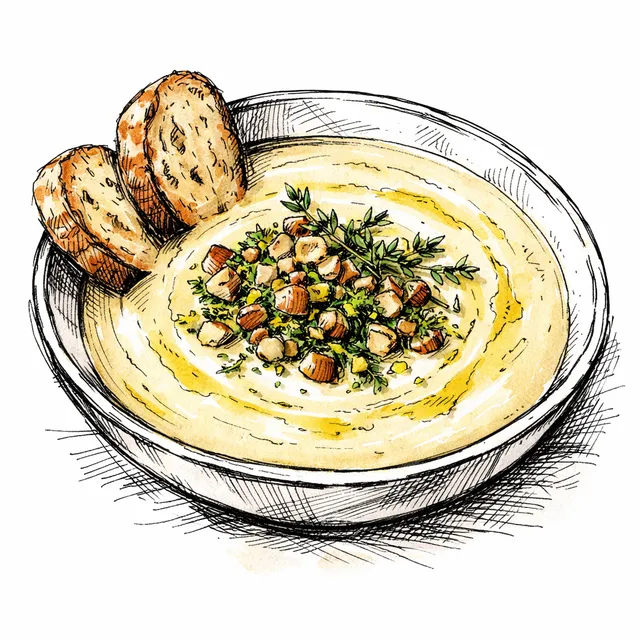
Parsnip–Pear Winter Bistro Soup: My February Trick for Cozy Elegance
February always makes me want two things: something warm enough to soften the edges of the day, and something bright enough to remind me California still exists under the gray. This parsnip–pear soup is my little bistro trick for exactly that.
The inspiration came from a rainy afternoon when my favorite farmer (the one who insists his parsnips are “spicier” than everyone else’s) handed me a bag that smelled like earth and sugar. I went home, found a pear that was one day away from collapsing, and did what I’d do in Paris: simmer, blend, taste, adjust. But instead of cream, I finished it my West Coast way—off the heat—with a thyme beurre monté so it turns glossy like a proper sauce. Indulgent, yes. Heavy, non.
What makes it special to me is the contrast: humble winter roots made silky, then lit up with toasted hazelnut gremolata—crunch, citrusy lift, a blizzard of herbs.
Make it yours: swap pear for apple or quince, add a pinch of chile, or drizzle good olive oil instead of butter (though I will lovingly judge you). Serve with a jammy egg on toast if you want to flirt with perfection.
Featured Recipe
Parsnip–Pear Winter Bistro Soup with Toasted Hazelnut Gremolata + Thyme Beurre Monté
This is my February bistro trick: parsnips for velvety comfort, pear for a quiet sweetness, and a gentle simmer that tastes like you actually had the afternoon off. I finish it like I’d finish a proper sauce—off the heat, with a glossy beurre monté and a blizzard of fresh herbs—so it feels indulgent without being heavy.
Save a copy to your collection for editing
Ingredients
- 1 1/2 lb Parsnips, peeled and cut into 1-inch chunks(about 6 medium)
- 1 Ripe but firm pear (Bosc or Anjou), peeled, cored, diced(adds a soft, wintry sweetness)
- 1 Leek, white and light green parts only, sliced and rinsed(or 2 small leeks)
- 2 Shallots, thinly sliced
- 2 Garlic cloves, smashed
- 1/2 cup Dry white wine(or vermouth—my little bistro cheat)
- 5 cups Vegetable stock (or light chicken stock)(choose something not too salty)
- 6 sprigs Fresh thyme(plus more leaves to finish, optional)
- 1 Bay leaf
- 2 tbsp Olive oil
- 1 1/2 tsp Kosher salt(plus more to taste)
- 1/2 tsp Black pepper(plus more to taste)
- 6 tbsp Unsalted butter, cold and cubed(this becomes the beurre monté)
- 2 tbsp Crème fraîche(optional but lovely; keeps it tangy and light)
- 1 tsp Lemon zest(for lift at the end)
- 1 tbsp Lemon juice(to taste)
- 1/3 cup Flat-leaf parsley, finely chopped(for finishing)
- 2 tbsp Chives, finely sliced(for finishing)
- 1/3 cup Hazelnuts, toasted and chopped(for crunchy, toasty contrast)
- 1 pinch Optional: flaky salt(for the top)
- as needed Optional: good bread(because we’re not animals)
Instructions
- 1
Sweat the aromatics (no browning, very bistro). In a medium soup pot, warm 2 tbsp olive oil over medium-low heat. Add 1 leek, white and light green parts only, sliced and rinsed, 2 shallots, thinly sliced, and 1 1/2 tsp kosher salt. Cook until soft and sweet, 8–10 minutes. Add 2 garlic cloves, smashed and cook 30 seconds.
10 min
Tip: Keep the heat gentle—color is fine, but we’re after silk, not toast.
- 2
Build the base. Add 1 1/2 lb parsnips, peeled and cut into 1-inch chunks, 1 ripe but firm pear, peeled, cored, diced, 6 sprigs fresh thyme, 1 bay leaf, 1/2 tsp black pepper, and remaining salt. Stir to coat, then pour in 1/2 cup dry white wine. Simmer 2 minutes to cook off the sharp edge.
4 min
Tip: The pear is subtle—don’t worry, it won’t turn the soup into dessert.
- 3
Gentle simmer. Add 5 cups vegetable stock, bring just to a low simmer (small lazy bubbles), then partially cover and cook until parsnips are very tender, 20–25 minutes.
25 min
Tip: A hard boil makes vegetables taste tired. A gentle simmer keeps it clean and sweet.
- 4
Blend until velvety. Remove 6 sprigs fresh thyme and 1 bay leaf. Blend the soup until completely smooth (immersion blender or countertop blender in batches). Return to the pot over low heat.
6 min
Tip: If using a countertop blender, vent the lid and drape with a towel—hot soup has opinions.
- 5
Finish with beurre monté (the glossy, indulgent part). Turn the heat to the lowest setting or off. Whisk in 6 tbsp unsalted butter, cold and cubed, one cube at a time, until the soup turns shiny and a little thicker. Whisk in 2 tbsp crème fraîche (if using).
5 min
Tip: Do not boil after adding butter—you’ll break the emulsion. Think sauce-making energy.
- 6
Brighten and herb it up. Add 1 tsp lemon zest and 1 tbsp lemon juice to taste. Stir in 1/3 cup flat-leaf parsley and 2 tbsp chives.
2 min
Tip: Lemon is your California sunbeam—use it to wake up the parsnips.
- 7
Make the quick hazelnut gremolata. In a small bowl, mix 1/3 cup hazelnuts, toasted and chopped with remaining parsley and remaining chives, plus 1 pinch optional: flaky salt and a little extra lemon zest if you like.
2 min
Tip: This topping is the whole point: crunch + herbs against velvety soup.
- 8
Serve. Ladle into warm bowls, shower with hazelnut gremolata, and add a final grind of pepper. Serve with as needed optional: good bread for dunking.
3 min
Tip: If you want a restaurant finish: a tiny knob of cold butter on top right before serving. Shameless and correct.
Chef's Notes
This soup is inspired by a rainy-market February in Northern California when a parsnip farmer (mud on boots, perfect smile) told me: “Treat them like they’re delicate.” He was right—gentle simmer, no aggressive boiling. The pear is my quiet twist: it rounds the parsnip’s earthiness the way a good natural Chenin rounds a salty cheese plate. Pair with a bright, mineral white (Loire Chenin, or a California skin-contact if you’re feeling playful).

Marguerite Lavigne
French soul, California sun
I grew up in a small village outside Lyon, where my grandmother taught me that the best meals come from respecting your ingredients. After training at Le Cordon Bleu and spending years in Parisian kitchens, I moved to San Francisco and fell in love with California's farmers markets and wine country. Now I cook the food I wish my grandmother could taste—French technique with California abundance, where a perfect roast chicken might come with Meyer lemon and wild fennel instead of tarragon.