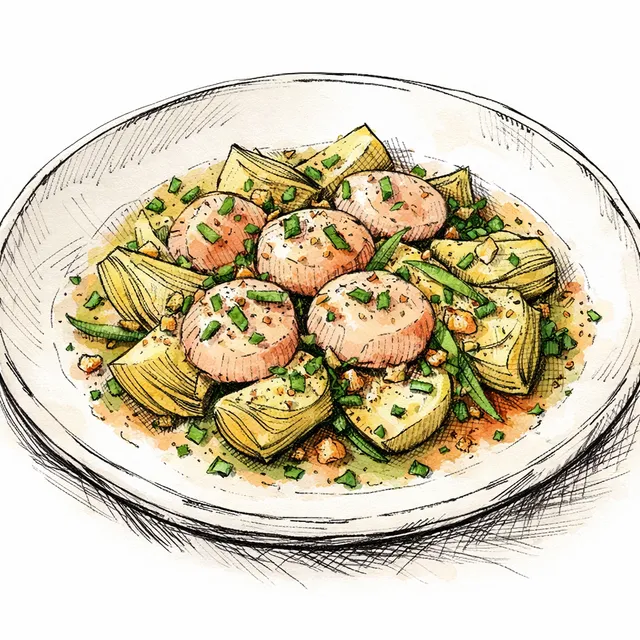
Rosé-Poached Scallops: A Bistro First Course That Wears Sunglasses
I came up with these Rosé-Poached Scallops with Warm Artichoke Hearts + Tarragon–Chive Vinaigrette because I wanted a bistro first course that didn’t feel like it needed a blazer. Paris technique, California mood. Think: scallops that taste like the ocean had a spa day, tucked next to artichoke hearts warmed in good olive oil, then absolutely drenched in herbs.
The spark was a late spring farmers’ market in Santa Barbara—armfuls of tarragon and chives, the kind that perfume your entire tote. That night, a friend popped a pale rosé “just for cooking,” which is the culinary lie we tell ourselves. I made a quick rosé court-bouillon, poached scallops gently (no drama, no rubber), and suddenly it felt like a tiny vacation on a plate.
What makes it special to me is the contrast: silk + snap. The scallops are tender, the vinaigrette is bright and green, and that little celery-salt crunch is my wink—like finishing salt’s mischievous cousin.
Make it yours: swap in mint or basil, add grapefruit zest, or slide in avocado if you’re feeling unapologetically West Coast. And please—keep the poaching liquid below a simmer. Scallops hate a hot tub.
Featured Recipe
Rosé-Poached Scallops with Warm Artichoke Hearts + Tarragon–Chive Vinaigrette (and a Little Celery Salt Crunch)
This is my idea of a bistro first course that wears sunglasses: silky, gently poached scallops nestled with warm artichoke hearts, then showered in a shamelessly green tarragon–chive vinaigrette. The poaching liquid is a quick rosé court-bouillon—light, aromatic, and the kind of thing that makes you feel like you’re cooking with a glass in your hand (you are).
Save a copy to your collection for editing
Timeline
Ingredients
- 12 Dry sea scallops (large, about U10–U15), side muscle removed(patted very dry)
- 1 cup Dry rosé wine(crisp, not sweet)
- 1 cup Water
- 1 Shallot(thinly sliced)
- 1/2 cup Fennel fronds (or 1/4 small fennel bulb, thinly sliced)(optional but lovely)
- 1 Bay leaf
- 1 tsp Black peppercorns
- 2 strips Lemon zest(peeled in wide strips (avoid white pith))
- 1 1/2 tsp Kosher salt(divided, plus more to taste)
- 12 oz Jarred artichoke hearts (in water)(drained well; quarter if large)
- 6 tbsp Extra-virgin olive oil(divided)
- 1 1/2 tbsp White wine vinegar
- 1 tsp Dijon mustard
- 2 tbsp Fresh tarragon(finely chopped)
- 2 tbsp Fresh chives(finely sliced)
- 2 tbsp Fresh parsley(finely chopped)
- 2 tbsp Capers(drained and chopped)
- 1 Celery stalk(very thinly sliced (a mandoline is great))
- 1 pinch Flaky sea salt(for finishing)
- 1/4 tsp Celery salt(optional, for the crunch/sprinkle)
- 1/4 tsp Cracked black pepper(to finish)
Instructions
- 1
Set up your scallop station: pat 12 Dry sea scallops (large, about U10–U15), side muscle removed very dry, remove any side muscle, and keep them chilled on a plate while you build the poaching liquid. Dry scallops poach cleanly—wet scallops sulk and leak.
6 min
Tip: If your scallops are very thick, plan to poach closer to 5 minutes; if smaller, 2–3 minutes is plenty.
- 2
Make a quick rosé court-bouillon: in a wide skillet or sauté pan (big enough for scallops in one layer), combine 1 cup Dry rosé wine, 1 cup Water, 1 Shallot, 1/2 cup Fennel fronds (or 1/4 small fennel bulb, thinly sliced), 1 Bay leaf, 1 tsp Black peppercorns, 2 strips Lemon zest, and 1 tsp Kosher salt. Bring to a gentle simmer over medium heat.
7 min
Tip: A wide pan = shallow poaching liquid = more even, gentle cooking.
- 3
While the liquid comes up, make the herb-forward vinaigrette. In a bowl, whisk 1 1/2 tbsp White wine vinegar, 1 tsp Dijon mustard, 1/2 tsp Kosher salt, and 4 tbsp Extra-virgin olive oil until glossy. Stir in 2 tbsp Fresh tarragon, 2 tbsp Fresh chives, 2 tbsp Fresh parsley, and 2 tbsp Capers. Taste: it should be bright and green and slightly briny.
6 min
Tip: If it tastes ‘sharp,’ good—that’s what wakes up sweet scallops. You can mellow it later with a drizzle more oil.
- 4
Warm the artichokes: heat 1 tbsp olive oil in a small pan over medium. Add 12 oz Jarred artichoke hearts (in water) and 1/4 tsp Celery salt. Warm, turning occasionally, until hot and lightly golden at the edges.
6 min
Tip: No heavy browning needed—this is a first course, not a demolition derby.
- 5
Strain the poaching liquid into a clean wide pan (or just fish out the aromatics if you’re feeling rustic). Lower the heat so the liquid is at a bare simmer—tiny bubbles, not a boil.
3 min
Tip: Boiling is how scallops get tough and sad. Bare simmer is the whole point.
- 6
Poach the scallops: slide scallops into the bare-simmering liquid in a single layer. Poach gently until just opaque on the outside and slightly translucent in the center, 3–5 minutes depending on size. Remove with a slotted spoon to a paper-towel-lined plate.
5 min
Tip: I start checking at 3 minutes. The carryover heat finishes them—overcooking happens fast.
- 7
Make the quick celery crunch: toss 1 Celery stalk slices with 1 tbsp olive oil, 1/4 tsp Cracked black pepper, and 1/4 tsp Celery salt. Let it sit 1 minute to soften just slightly while staying snappy.
2 min
Tip: This is my California little ‘salad’ without making a whole salad.
- 8
Plate like a bistro: divide warm artichokes among plates, nestle scallops on top, spoon herb vinaigrette generously over everything (don’t be shy), and finish with celery crunch, 1 pinch Flaky sea salt, and cracked pepper.
4 min
Tip: If you want it extra glossy, warm 1 tbsp of the poaching liquid and whisk it into the vinaigrette right before spooning.
Chef's Notes
This dish is basically my love letter to gentle heat. The first time I made a rosé poach was on a February evening when the farmer I buy herbs from showed up with tarragon that smelled like licorice and sunshine—completely unfair. Pour yourself the rosé you’re poaching with (quality control), and serve this with a hunk of good bread to mop up the vinaigrette like you’re sitting at the bar of a little Paris bistro—except your window view is probably a palm tree.

Marguerite Lavigne
French soul, California sun
I grew up in a small village outside Lyon, where my grandmother taught me that the best meals come from respecting your ingredients. After training at Le Cordon Bleu and spending years in Parisian kitchens, I moved to San Francisco and fell in love with California's farmers markets and wine country. Now I cook the food I wish my grandmother could taste—French technique with California abundance, where a perfect roast chicken might come with Meyer lemon and wild fennel instead of tarragon.