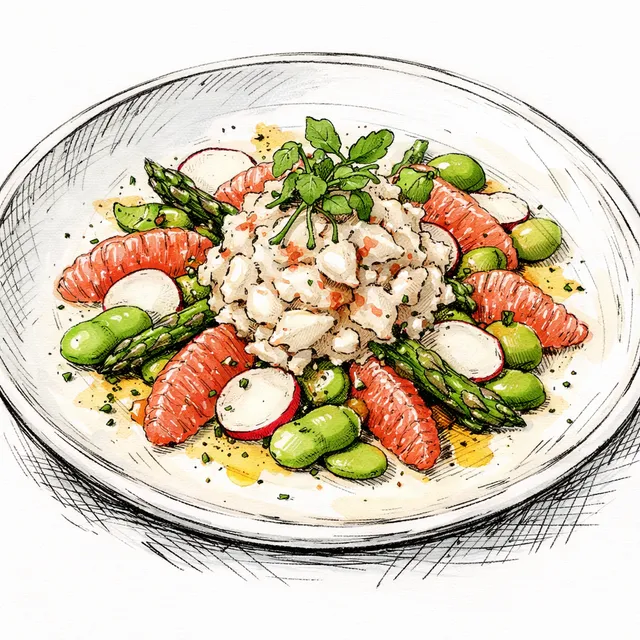
Spring Terrace Salade de Crabe: A West Coast Love Letter to Paris
Picture yourself at a tiny zinc table in April, a chilled glass of Chenin Blanc in hand. That is exactly where my head was when I created this Spring Terrace Salade de Crabe. I was sitting on my patio in Santa Monica, shelling fava beans from my favorite farmer, Julian, and craving the elegant salades composées of my Parisian youth. But instead of the heavy mayonnaise you might find in a traditional French crab preparation, I wanted sunshine. So, I swapped it for the creamy California perfection of avocado and whipped up a quick, bright grapefruit vinaigrette. The delicate sweetness of fresh lump crab marries beautifully with the tart citrus, creating a dish that feels both classically French and effortlessly West Coast. It is light, deeply flavorful, and completely unapologetic. Make this recipe your own by adding a handful of peppery radishes or perhaps a perfectly jammy egg on top. Just promise me you will use the good, grassy olive oil for the vinaigrette. Grab a fork, pour that natural wine, and let the afternoon melt away. Bon appétit, mes amis!
Featured Recipe
Spring Terrace Salade de Crabe with Fava Beans & Grapefruit Vinaigrette
Picture yourself at a tiny zinc table in April, a chilled glass of Chenin Blanc in hand. This elegant salade composée marries the delicate sweetness of fresh lump crab with the creamy California sunshine of avocado and a bright, quick-emulsified grapefruit vinaigrette. It is light, deeply flavorful, and completely unapologetic about mixing classic French technique with vibrant West Coast produce.
Save a copy to your collection for editing
Timeline
Ingredients
- 8 oz Fresh lump crab meat(Picked over gently for shells, keeping lumps intact)
- 1 cup Fresh fava beans(Shelled from the pod (requires about 1 lb of pods))
- 1 Ruby red grapefruit(Segmented, juice reserved)
- 1 small Shallot(Very finely minced)
- 1 tsp Dijon mustard(A good French mustard, please)
- 3 tbsp Extra virgin olive oil(The best quality you have)
- 1 tbsp Fresh tarragon(Finely chopped)
- 2 large Eggs(Cold from the fridge)
- 1 ripe Avocado(Halved and sliced)
- 2 heads Little Gem lettuce(Leaves separated, washed and dried)
- 1 tsp Flaky sea salt(Divided use)
- 1 pinch Black pepper(Freshly cracked)
Instructions
- 1
Bring a medium saucepan of water to a rolling boil. Meanwhile, take 1 ruby red grapefruit and carefully segment it over a bowl to catch the juices. Once the segments are free, squeeze the leftover membranes tightly to extract all that glorious citrus juice—we need at least 2 tablespoons for our dressing.
5 min
Tip: Segmenting (or 'suprêming') citrus removes the bitter pith and leaves only the delicate flesh. It feels very fancy, but it just takes a sharp knife and a little patience.
- 2
Gently lower 2 large eggs into the boiling water using a slotted spoon. Set a timer for exactly 6 and a half minutes. I am quite stubborn about my eggs—this precise timing guarantees whites that are set and a yolk that is perfectly jammy and spreadable.
7 min
Tip: Keep the water at a gentle boil, not a violent one, so the eggs don't crack against each other.
- 3
While the eggs cook, let's make a quick vinaigrette. I never buy bottled dressing, and once you master this emulsion, neither will you! In a small bowl, combine 1 small shallot, 1 tsp Dijon mustard, and 2 tablespoons of the reserved grapefruit juice. Whisk constantly while slowly drizzling in 3 tbsp extra virgin olive oil until the mixture becomes creamy, opaque, and perfectly emulsified. Stir in 1 tbsp fresh tarragon, half of your 1 tsp flaky sea salt, and a pinch of 1 pinch black pepper.
4 min
Tip: The mustard acts as a magical stabilizer here, holding the oil and acid together in a tight, glossy embrace.
- 4
When the egg timer goes off, scoop the eggs into a bowl of ice water, but keep the pot of water boiling! Drop 1 cup fresh fava beans into the boiling water and blanch them for just 2 minutes until they turn a vibrant, electric green.
3 min
Tip: Having your ice bath ready before the eggs finish is the secret to a stress-free kitchen.
- 5
Use a slotted spoon to transfer the fava beans directly into the ice bath with the eggs. Once cool enough to handle, use your thumbnail to pierce the opaque outer skin of each bean and pop out the bright green inner fava. It is a little labor of love, but 'double-peeling' favas is completely worth it for their sweet, tender texture.
5 min
Tip: Pour yourself a splash of wine while you peel the favas. It makes the task feel like a Parisian meditation rather than a chore.
- 6
Peel the cooled eggs and slice them in half lengthwise. Halve and thinly slice 1 ripe avocado. Finally, take 8 oz fresh lump crab meat and look it over for any rogue shells, keeping those luscious lumps as intact as possible.
4 min
Tip: Never aggressively stir lump crab meat; treat it gently so you don't break up the beautiful pieces.
- 7
Time to compose our terrace masterpiece. Scatter the leaves from 2 heads Little Gem lettuce across a large, shallow serving platter. Artfully arrange the crab lumps, bright fava beans, avocado slices, and grapefruit segments over the greens. Nestle the jammy eggs into the salad. Drizzle generously with your beautifully emulsified vinaigrette and finish with the remaining half of your 1 tsp flaky sea salt.
4 min
Tip: A salade composée isn't tossed; it's arranged. Let each ingredient have its moment in the sun.
Chef's Notes
If you cannot find fresh fava beans at the farmers market, edamame makes a wonderful, albeit slightly less traditional, substitute. The key to this dish is the contrast between the rich, sweet crab and the sharp, bright pop of the grapefruit vinaigrette. Serve with a crusty baguette to mop up every last drop of the dressing.

Marguerite Lavigne
French soul, California sun
I grew up in a small village outside Lyon, where my grandmother taught me that the best meals come from respecting your ingredients. After training at Le Cordon Bleu and spending years in Parisian kitchens, I moved to San Francisco and fell in love with California's farmers markets and wine country. Now I cook the food I wish my grandmother could taste—French technique with California abundance, where a perfect roast chicken might come with Meyer lemon and wild fennel instead of tarragon.