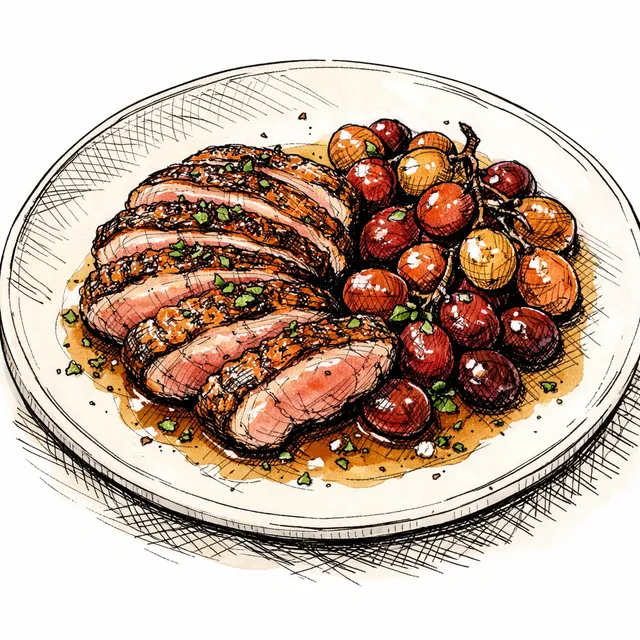
Pan-Roasted Bistro Duck Breast with Blistered Autumn Grapes & Verjus Pan Sauce
Crisp-skinned, tender duck breast meets the sun-drenched sweetness of blistered autumn grapes in this quintessential French bistro centerpiece. Balanced with sharp shallots, fragrant thyme, and a bright splash of California verjus, this pan-roasted classic delivers high elegance with surprisingly effortless technique. Pour a glass of chilled, slightly funky Gamay and let the pan do all the hard work.

Save a copy to your collection for editing
Timeline
Ingredients
- 2 Moulard or Magret duck breasts(about 12 to 14 oz each, patted thoroughly dry and brought to room temperature)
- 1.5 tsp kosher salt(plus more to taste)
- 1 tsp freshly cracked black pepper(coarsely ground)
- 2 shallots(finely minced)
- 1.5 cups seedless red or Thomcord grapes(left on small cluster stems or stemmed)
- 4 sprigs fresh thyme
- 0.33 cup verjus(or substitute dry white vermouth with a squeeze of fresh lemon)
- 2 tbsp unsalted French cultured butter(cold and cubed)
- 2 cups wild watercress(tender tops only, for serving)
- 0.5 tsp Maldon flaky sea salt(for finishing)
Instructions
- 1
Using a very sharp chef's knife, score the fat cap of 2 duck breasts in a tight crosshatch diamond pattern, taking care to slice through the fat without cutting into the flesh below. Season both sides generously with 1.5 tsp kosher salt and 1 tsp freshly cracked black pepper. Let them sit on a cutting board skin-side up for 10 minutes to take the chill off.
10 min
Tip: Scoring allows the fat to render out evenly and ensures impossibly crisp, crackly skin. If your knife drags, pop the duck in the freezer for 5 minutes first to firm up the fat.
- 2
Mince the 2 shallots and rinse and dry the 1.5 cups seedless red or Thomcord grapes and 4 sprigs fresh thyme while the duck rests.
5 min
Tip: Keep the aromatics right by the stove; pan sauces happen in a flash once the duck comes out of the skillet.
- 3
Place the 2 duck breasts skin-side down into a cold, dry 10- or 12-inch cast-iron skillet. Set the burner to medium-low. Allow the skin to render gently and sizzle without rushing, spooning off rendered liquid duck fat as it pools into a clean heatproof jar, until the skin turns deep golden-brown and paper-thin, about 12 to 14 minutes.
14 min
Tip: Starting in a cold pan is the golden rule of French bistro duck cookery. Never blast it with high heat right away or the skin will tighten and trap unrendered fat.
- 4
Increase the heat to medium. Flip the duck breasts to flesh-side down and cook for 3 to 4 minutes more, until an instant-read thermometer inserted into the thickest center registers 130°F for a perfect rosy medium-rare. Transfer the duck to a warm plate or cutting board to rest, loosely tented with foil.
4 min
Tip: Duck continues to cook slightly as it rests. Resting for at least 8 to 10 minutes allows the luscious juices to settle back into the meat.
- 5
Pour off all but 1 tablespoon of duck fat from the skillet (save that liquid gold for roast potatoes tomorrow!). Set the pan over medium heat and add the 2 minced shallots, 1.5 cups seedless red or Thomcord grapes, and 4 sprigs fresh thyme. Sauté for 3 minutes, tossing occasionally, until the shallots soften and the grape skins begin to split and blister.
3 min
Tip: Blistering the grapes concentrates their floral sugars, creating the ultimate counterpoint to the rich duck.
- 6
Pour in 0.33 cup verjus, scraping up all the sticky, caramelized fond from the bottom of the pan with a wooden spoon. Let the liquid bubble vigorously and reduce by half, about 2 minutes. Remove the pan from the heat, fish out the thyme sprigs, and swirl in 2 tbsp cold unsalted French cultured butter one cube at a time until emulsified into a glossy, velvety pan sauce.
3 min
Tip: Off-heat swirling is essential for a silky beurre monté finish—if the pan is boiling hot, the butter will break into oily pools.
- 7
Carve the rested duck breasts on a slight bias into 1/2-inch-thick slices. Arrange a handful of 2 cups wild watercress onto two warmed dinner plates. Fan the sliced duck over the greens, spoon the warm blistered grapes and glossy pan jus generously across the meat, and finish with a pinch of 0.5 tsp Maldon flaky sea salt.
3 min
Tip: The peppery watercress wilts gently under the hot verjus pan sauce, adding fresh bitterness that cuts right through the richness.
Chef's Notes
Whenever grapes flood the farmers market here in California, my mind immediately jumps to canard aux raisins, but I skip the heavy stock reductions in favor of tart verjus and cold butter. Verjus brings that bright, singing acidity of unripened wine grapes without overwhelming the palate. Be sure to save the rendered duck fat you pour off during cooking—keep it sealed in a jar in your fridge for roasting fingerling potatoes or sautéing greens later in the week.
Frequently Asked Questions
How long does Pan-Roasted Bistro Duck Breast with Blistered Autumn Grapes & Verjus Pan Sauce take to make?
Pan-Roasted Bistro Duck Breast with Blistered Autumn Grapes & Verjus Pan Sauce takes about 37 minutes total. That includes 10 minutes of prep and 27 minutes of cooking.
How many servings does this recipe make?
This recipe makes 2 servings.
What skill level is needed for Pan-Roasted Bistro Duck Breast with Blistered Autumn Grapes & Verjus Pan Sauce?
This recipe is rated medium — it's intermediate, requiring some cooking experience.
What ingredients do I need for Pan-Roasted Bistro Duck Breast with Blistered Autumn Grapes & Verjus Pan Sauce?
The main ingredients are: Moulard or Magret duck breasts, kosher salt, freshly cracked black pepper, shallots, seedless red or Thomcord grapes, fresh thyme, verjus, unsalted French cultured butter, wild watercress, Maldon flaky sea salt.
What type of meal is Pan-Roasted Bistro Duck Breast with Blistered Autumn Grapes & Verjus Pan Sauce?
Pan-Roasted Bistro Duck Breast with Blistered Autumn Grapes & Verjus Pan Sauce is categorized as: dinner.
Ask Marguerite Lavigne a question
Sign in to chat about this recipe, get cooking tips, and ask for substitutions.
Sign in to chat