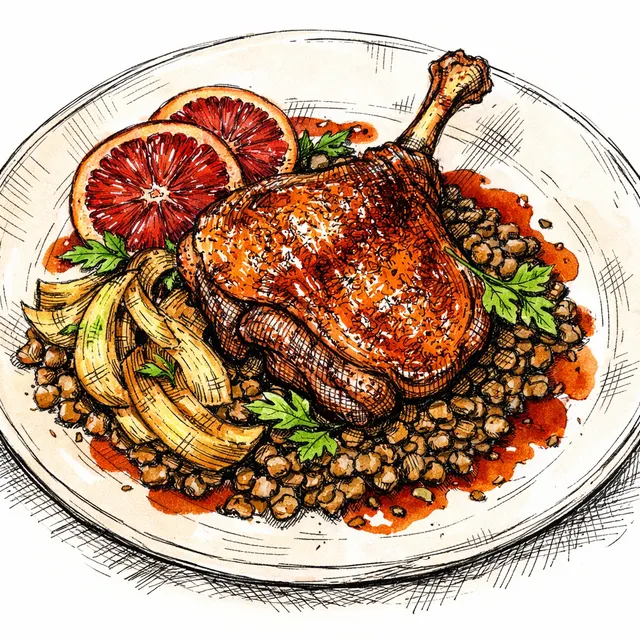
Pan-Roasted Bistro Duck Legs with French Lentils, Caramelized Fennel & Blood Orange Jus
Crispy-skinned, succulent duck legs pan-roasted to bistro perfection, served over tender French green lentils tossed with sweet caramelized fennel and finished with a vibrant, sun-drenched blood orange pan jus.

Save a copy to your collection for editing
Timeline
Ingredients
- 2 legs bone-in, skin-on fresh duck legs(patted thoroughly dry; about 1.25 to 1.5 lbs total)
- 1 1/2 tsp kosher salt(divided)
- 1/2 tsp freshly cracked black pepper(divided)
- 3/4 cup French green lentils (Puy lentils)(rinsed and picked over)
- 2 cups low-sodium chicken stock or water(for simmering lentils)
- 5 sprigs fresh thyme sprigs(divided (3 whole sprigs for lentils, 2 stripped for pan sauce))
- 1 fresh bay leaf(or dried)
- 1 small fennel bulb(trimmed, halved, cored, and thinly sliced; fronds reserved for garnish)
- 2 medium shallots(finely sliced into half-moons)
- 2 cloves garlic cloves(thinly shaved)
- 1/2 cup freshly squeezed blood orange juice(from about 2 ripe California blood oranges; Cara Cara oranges make a wonderful swap)
- 1 tsp blood orange zest(finely grated)
- 1/4 cup dry white vermouth(or a crisp dry French white wine like Muscadet)
- 1 tsp Dijon mustard(smooth French style)
- 2 tbsp cold unsalted French butter(cut into small cubes)
- 2 tbsp fresh flat-leaf parsley(roughly chopped)
- 1/4 tsp flaky sea salt(such as Maldon, to finish)
- 2 tablespoons rendered duck fat(saved from rendering duck skin)
Instructions
- 1
Preheat your oven to 375°F (190°C). Prick the skin of 2 legs bone-in, skin-on fresh duck legs all over with the tip of a paring knife at a shallow angle, being careful not to pierce into the meat. Season both sides generously with 1 tsp kosher salt and 1/4 tsp freshly cracked black pepper.
5 min
Tip: Pricking the skin allows the thick layer of fat underneath to render completely, ensuring golden, crackling bistro skin without drying out the meat.
- 2
Place the duck legs skin-side down in a cold, dry 10- or 12-inch ovenproof cast-iron skillet. Turn the heat to medium-low and let the fat render undisturbed for 15 minutes, listening for a gentle sizzle, until the skin turns a deep, crisp mahogany.
15 min
Tip: Starting in a cold pan is the golden rule of French duck cookery—it coaxing out maximum liquid gold fat without scorching.
- 3
While the duck skin renders, combine 3/4 cup French green lentils (Puy lentils), 2 cups low-sodium chicken stock or water, 3 sprigs fresh thyme sprigs, 1 fresh bay leaf, and 1/4 tsp kosher salt in a small saucepan. Bring to a boil over medium-high heat, then lower the heat to gentle simmer, cover partially, and cook until tender to the bite but holding their shape, about 25 minutes.
25 min
Tip: Do not boil lentils violently or their tender skins will split. Puy lentils maintain an incomparable peppery, mineral bite.
- 4
Once the duck skin is deeply bronzed and crisp, flip the duck legs skin-side up in the skillet. Spoon a tablespoon of the rendered pan fat over each leg, then immediately transfer the entire skillet into the preheated 375°F (190°C) oven to pan-roast until the meat is fork-tender and registers 175°F to 180°F at the thickest part, about 35 minutes.
35 min
Tip: Pan-roasting in the oven cooks the legs through uniformly while maintaining that crackly, shatteringly crisp skin.
- 5
When the lentils are tender, remove from heat, drain any excess liquid, discard the bay leaf and thyme stems, and keep warm. While the duck finishes roasting, prep your aromatics: finely slice 1 small fennel bulb, thinly slice 2 medium shallots, and shave 2 cloves garlic cloves.
10 min
Tip: Save the tender feathery fennel fronds for a light, anise-scented garnish right at the table.
- 6
Remove the duck skillet from the oven and carefully transfer the duck legs to a warm cutting board to rest for 8 minutes. Pour all the rendered duck fat from the skillet into a heatproof jar (save this liquid gold for roasted potatoes later!), leaving behind about 2 tablespoons in the skillet. Return skillet to medium heat and add 1 small fennel bulb and 2 medium shallots with 1/4 tsp kosher salt and 1/4 tsp freshly cracked black pepper. Sauté until the fennel is caramelized and tender, about 6 minutes, then stir in 2 cloves garlic cloves for 1 minute until fragrant.
7 min
Tip: The caramelized duck fat fond left on the bottom of the pan gives the fennel an unimaginable savory depth.
- 7
Fold the warm, cooked lentils directly into the skillet with the caramelized fennel along with 2 tbsp fresh flat-leaf parsley. Toss everything together for 1 minute to absorb the pan juices, taste and adjust seasoning with a pinch of salt if needed, then spoon the lentil mixture onto two warm serving plates.
2 min
Tip: Warming the plates keeps the lentils and roasted duck piping hot at the table.
- 8
Set the empty skillet back over medium heat. Pour in 1/4 cup dry white vermouth and scrape up any caramelized bits with a wooden spoon, simmering for 1 minute until reduced by half. Pour in 1/2 cup freshly squeezed blood orange juice, 1 tsp blood orange zest, 1 tsp Dijon mustard, and leaves stripped from 2 sprigs fresh thyme sprigs. Simmer rapidly until glossy and reduced to about 3 tablespoons, about 3 minutes. Turn off the heat and swirl in 2 tbsp cold unsalted French butter one piece at a time until emulsified and glossy.
5 min
Tip: Taking the pan off the heat before swirling in cold butter prevents the sauce from breaking, giving you a velvety, bistro-standard pan jus.
- 9
Nestle one rested duck leg atop the bed of warm lentils on each plate. Spoon the glossy blood orange pan jus generously around the duck and lentils. Scatter with reserved fennel fronds and 1/4 tsp flaky sea salt over the crispy duck skin. Serve immediately.
2 min
Tip: Pour the sauce around the duck leg rather than directly over the skin to preserve every bit of that hard-earned crispness.
Chef's Notes
In classic Paris bistros, duck legs are almost universally salted into confit, which is divine, but pan-roasting fresh legs in a hot cast-iron skillet yields something with an entirely different kind of soul: deeply roasted, tender meat beneath skin that shatters like parchment. The secret is beginning skin-down in a cold skillet to gently draw out the fat before transferring to the oven. To balance the dark, savory richness of the duck and Puy lentils, I skip heavy pan gravies and whip up a quick, tangy pan jus with California blood oranges and cold French butter. Pour yourself a lightly chilled glass of natural Gamay or Pineau d'Aunis, and dinner is heaven.
Frequently Asked Questions
How long does Pan-Roasted Bistro Duck Legs with French Lentils, Caramelized Fennel & Blood Orange Jus take to make?
Pan-Roasted Bistro Duck Legs with French Lentils, Caramelized Fennel & Blood Orange Jus takes about 1 hour 10 minutes total. That includes 15 minutes of prep and 55 minutes of cooking.
How many servings does this recipe make?
This recipe makes 2 servings.
What skill level is needed for Pan-Roasted Bistro Duck Legs with French Lentils, Caramelized Fennel & Blood Orange Jus?
This recipe is rated medium — it's intermediate, requiring some cooking experience.
What ingredients do I need for Pan-Roasted Bistro Duck Legs with French Lentils, Caramelized Fennel & Blood Orange Jus?
The main ingredients are: bone-in, skin-on fresh duck legs, kosher salt, freshly cracked black pepper, French green lentils (Puy lentils), low-sodium chicken stock or water, fresh thyme sprigs, fresh bay leaf, fennel bulb, shallots, garlic cloves, freshly squeezed blood orange juice, blood orange zest, dry white vermouth, Dijon mustard, cold unsalted French butter, fresh flat-leaf parsley, flaky sea salt, rendered duck fat.
What type of meal is Pan-Roasted Bistro Duck Legs with French Lentils, Caramelized Fennel & Blood Orange Jus?
Pan-Roasted Bistro Duck Legs with French Lentils, Caramelized Fennel & Blood Orange Jus is categorized as: dinner.
Ask Marguerite Lavigne a question
Sign in to chat about this recipe, get cooking tips, and ask for substitutions.
Sign in to chat