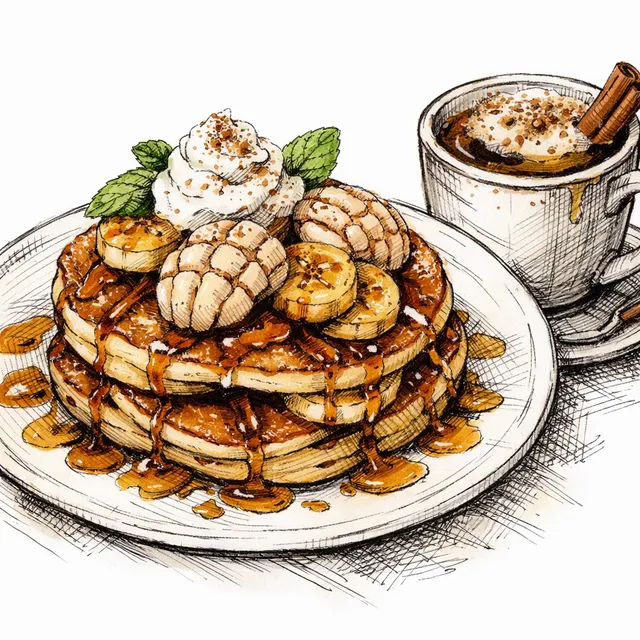
Panadería-Stop Plátano Conchas Pancakes (Blender Batter) + Café Canela Miel
I made these Panadería-Stop Plátano Conchas Pancakes because sometimes you want that concha y cafecito feeling… and it’s a Tuesday, and the group chat is already on fire, and nobody has time to “rest dough.” We’re not suffering for dinner—or breakfast.
The inspo is pure panadería: that sweet, warm smell when you walk in and the glass case is basically whispering, “ándale.” Growing up, a concha with café de olla (extra canela) was my little reset button. Now in Brooklyn, I’m doing mom math: while someone’s finding shoes / before someone asks for a snack, I’m tossing ripe plátanos into the blender.
What makes these special is the plantain—it gives you that plush, naturally sweet crumb without a ton of sugar. Then the finishing move: café-canela miel (or piloncillo). It’s syrupy, a little bitter, a little floral, and it makes the whole kitchen smell like comfort.
Tips to make it yours:
- Heat level: add a pinch of chile (yes) to the drizzle for a grown-up edge.
- Bodega Mode: chocolate chips + a squeeze of lime at the end.
- If you’ve got a Mexican market nearby: swap honey for piloncillo and call it a hug.
Taste it—then decide. Add salt tantito at a time. You’re going to do this.
Featured Recipe
Panadería-Stop Plátano Conchas Pancakes (Blender Batter) + Café Canela Miel
You’re going to get that panadería “concha + cafecito” vibe on a Tuesday morning—without laminating, proofing, or crying. Ripe plantains make the pancakes naturally sweet and plush, and I finish them with a quick café-canela honey (or piloncillo) drizzle that smells like a bakery doorway in Brooklyn winter.
Save a copy to your collection for editing
Ingredients
- 2 Ripe plantains (very spotty black = best)(peeled, sliced)
- 2 Eggs
- 1 cup Milk(dairy or oat milk both work)
- 3 tbsp Unsalted butter (melted)(plus more for the griddle)
- 1 1/2 tsp Vanilla extract
- 1/2 tsp Kosher salt(don’t skip—this is what makes it taste like “bakery,” not baby food)
- 1 1/4 cups All-purpose flour
- 2 tsp Baking powder
- 1 tsp Ground cinnamon(plus more to finish if you want)
- 1/8 tsp Nutmeg(optional but very panadería-energy)
- 1 tsp Instant espresso powder OR very strong coffee(or 2 tbsp strong coffee; for the drizzle)
- 1/4 cup Honey(or maple syrup; see swaps for piloncillo version)
- 1 tbsp Water(to loosen drizzle)
- 1 tsp Lime zest(optional but wakes everything up)
- 1/3 cup Toasted pepitas(optional crunch finish (highly recommended))
- 1 cup Sliced banana or strawberries(optional topping (February-friendly if you do strawberries from the store—no judgment))
Instructions
- 1
Make the café-canela miel (2 minutes, do this first so it’s ready when the pancakes are hot). In a small bowl, whisk 1/4 cup Honey + 1 tsp Instant espresso powder OR very strong coffee + 1 tsp Ground cinnamon + 1 tbsp Water. Taste it—then decide if you want another pinch of salt or cinnamon. Set aside.
2 min
Tip: If your espresso powder clumps, just microwave the mix 10 seconds and whisk again. We’re not suffering for breakfast.
- 2
Blender batter time. Add 2 Ripe plantains (very spotty black = best), 2 Eggs, 1 cup Milk, 3 tbsp Unsalted butter (melted), 1 1/2 tsp Vanilla extract, and 1/2 tsp Kosher salt to the blender. Blend until totally smooth (no little plantain freckles).
2 min
Tip: If your plantains are only yellow with a few spots, blend longer and add 1–2 tsp extra honey. The blacker the plantain, the more “concha-sweet” you get for free.
- 3
Add 1 1/4 cups All-purpose flour, 2 tsp Baking powder, 1 tsp Ground cinnamon, and 1/8 tsp Nutmeg to the blender. Pulse just until combined (10–15 seconds). Let the batter rest 5 minutes while your pan heats—this makes them fluffier.
6 min
Tip: Don’t blend forever after adding flour or you’ll get bready pancakes. Pulse, stop, scrape once, pulse again. Ándale.
- 4
Heat a nonstick skillet or griddle over medium. Butter it lightly (not a puddle). Pour about 1/4 cup batter per pancake. Cook until the edges look set and you see bubbles on top, 2–3 minutes.
8 min
Tip: Medium heat is the move—plantain batter browns faster because of the natural sugars. If it’s getting too dark before the middle sets, lower the heat. Taste it—then decide.
- 5
Flip and cook 1–2 minutes more until springy and cooked through. Keep warm in a low oven (200°F) if you’re batching.
6 min
Tip: Real-life trick: wipe the pan once between batches if you’re getting burnt butter bits—those will make the next pancakes look dramatic in a bad way.
- 6
Serve like you just “stopped by the panadería.” Stack pancakes, drizzle with café-canela miel, and finish with 1 tsp Lime zest and 1/3 cup Toasted pepitas for crunch. Add 1 cup Sliced banana or strawberries if you’ve got it.
2 min
Tip: That lime zest is the little secret—bright + bakery-sweet = balance.
Chef's Notes
Two paths, because real life: Pantry Mode (bodega-friendly): Use honey or maple, skip pepitas, top with a little cinnamon sugar (1 tbsp sugar + 1/2 tsp cinnamon) and a squeeze of lime. Still tastes like you tried. Extra Credit (If you’ve got a Mexican market nearby): Swap the honey drizzle for piloncillo miel—simmer 2 oz piloncillo with 1/4 cup water + cinnamon stick until syrupy, then whisk in espresso/coffee. (This is the smell of my childhood mornings—somebody sweeping the sidewalk, somebody yelling “conchas calientes,” and me pretending I didn’t hear it.) Heat/Flavor options (not spicy, just smart): A tiny pinch of ground anise (or a drop of almond extract) leans even more panadería. And yes—salt the batter. If you skip it, it’ll taste flat and you’ll blame me, and I won’t accept that.

María “Mari” Santiago
Oaxacan comfort, Brooklyn shortcuts, weeknight bright.
María “Mari” Santiago was born in Oaxaca, where her earliest kitchen memories are measured in scent: chiles toasting on a comal, cinnamon and chocolate blooming in mole, and the warm, nutty snap of a tlayuda folded in half for the walk home. She learned by watching—first her tías, then her abuela—picking up the small, practical rules that never made it into written recipes: how to tell when the garlic is *just* right, how to rescue a too-spicy salsa, and why you always taste the broth before you add the salt. Now in Brooklyn, Mari cooks the food she grew up on while raising two little kids and juggling real-life time limits. Her style is “real flavor, real life”: traditional Oaxacan and everyday Mexican dishes—moles, caldos, frijoles, enfrijoladas, salsas, and crispy tlayudas—made weeknight-friendly with smart shortcuts, brighter salsas, and more vegetables without losing the soul of the dish. She’s not precious about rules, she’s big on swaps, and she’s on a mission to prove that you can cook deeply flavorful Mexican food with what you can actually find at a normal grocery store (and still get dinner on the table before a meltdown). Mari’s recipes read like a friend texting you from the produce aisle: clear, funny, and unpretentious, with a side of abuela wisdom. If there’s a hard-to-find ingredient, she gives you a realistic alternative, tells you what will change (and what won’t), and keeps the focus where it belongs—on food that tastes like home, even when home is a small Brooklyn kitchen.