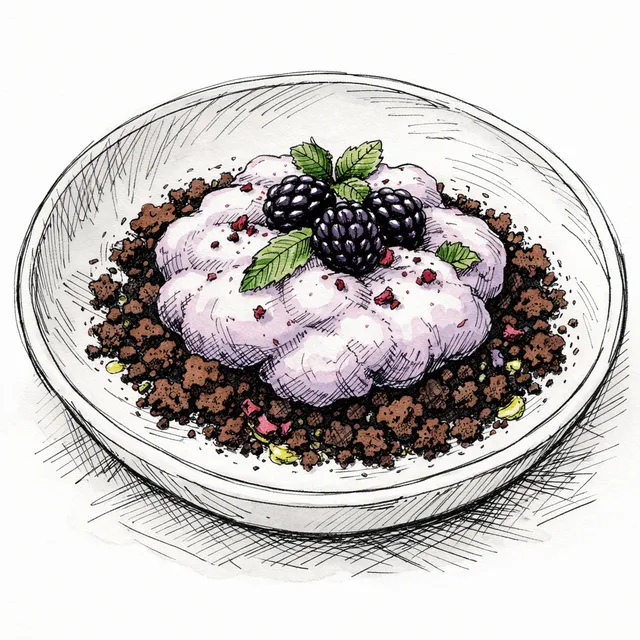
Aerated Blackberry Cloud with Bitter Cocoa-Olive Oil Soil
I used to make a traditional blackberry mousse in my fine-dining days. It looked stunning, but heavy cream blunts acidity. I remember standing in the walk-in fridge, tasting a spoonful of pure puree next to the finished mousse. The cream had completely muted the fruit.\n\nThat is where this Aerated Blackberry Cloud started. We are not adding steps—just improving decisions. By dropping dairy entirely, we mechanically aerate a pure blackberry gel using precise temperature control.\n\n### Why this works\nPrecision is freedom. By chilling the gel to exactly 15°C (59°F) before whipping, we trap air without dulling the blackberry's natural tartness. We pair this weightless cloud with an earthy, bitter cocoa and walnut crumb bound by fruity olive oil. It is the two-texture rule in action: airy and crisp, sharp and bitter.\n\n### Fix it fast\nIf your cloud collapses, your gel was too warm. Wipe the counter, label a fresh bowl with painter's tape, chill it, and try again.\n\n### Make it yours\nSwap the blackberries for yuzu or passionfruit. If you dislike walnuts, 20g of toasted black sesame in the soil adds a brilliant savory edge.\n\nWeigh your ingredients. Respect the temperatures. Let it cool. Future you deserves clean plating and restaurant-level payoff.
Featured Recipe
Aerated Blackberry Cloud with Bitter Cocoa-Olive Oil Soil
Most fruit mousses rely on heavy cream, which mutes acidity and blunts the flavor. We are dropping the dairy entirely and using precise temperature control to mechanically aerate a pure blackberry gel. Paired with an earthy, bitter cocoa and walnut crumb, this is a masterclass in the two-texture rule—maximum contrast, zero unnecessary steps.
Save a copy to your collection for editing
Timeline
Ingredients
- 340g grams fresh blackberries(Divided into 300g for the base and 40g for garnish)
- 100g grams caster sugar(Divided into 60g for the cloud and 40g for the soil)
- 15g grams fresh lemon juice(Filters out the flat sweetness and brightens the blackberry)
- 1 tsp grams powdered gelatin(Approximately 3g)
- 15g grams cold water(For blooming the gelatin)
- 1 pinch kosher salt
- 60g grams toasted walnuts(Cooled completely before processing)
- 40g grams all-purpose flour
- 25g grams dark cocoa powder(Dutch-processed preferred for maximum bitterness)
- 2g grams flaky sea salt(About 1/2 teaspoon)
- 45g grams extra-virgin olive oil(Use a fruity, robust variety for contrast)
- 40g grams grams fresh blackberries(mentioned in step 8 for garnish)
Instructions
- 1
In a small bowl, sprinkle 1 tsp powdered gelatin over 15g cold water. Let it sit undisturbed to hydrate. Precision is freedom here—we need exactly this hydration ratio to build the matrix that will hold our air.
5 min
Tip: Do not stir the gelatin once sprinkled, just let the water absorb naturally.
- 2
In a blender, combine 300g fresh blackberries, 60g caster sugar, 15g fresh lemon juice, and 1 pinch kosher salt. Blend on high until completely smooth. Pass the mixture through a fine-mesh sieve into a clean, wide bowl, pressing with a spatula to extract all liquid. Discard the seeds. We want a perfectly clean lane of flavor.
10 min
Tip: Take your time straining. Seed fragments will disrupt the structure of the aeration later.
- 3
Transfer about one-quarter of the strained blackberry puree to a small saucepan. Heat over medium-low just until steaming. Remove from heat and whisk in the bloomed gelatin until totally dissolved. Pour this back into the cold remaining puree and whisk to combine evenly.
5 min
Tip: Never boil the gelatin, or it will lose its setting power.
- 4
Set the bowl of puree over an ice bath. Stir constantly with a rubber spatula, scraping the sides as the mixture cools. We are looking for the exact moment the puree thickens to the consistency of raw egg whites. This is the crucial temperature management step. If it is too warm, it will not whip. If it sets solid, it will clump.
20 min
Tip: If it sets too hard, do not panic. Warm the bowl over hot water for 10 seconds and whisk until fluid again.
- 5
While the puree chills, preheat your oven to 350°F (175°C). In a food processor, pulse 60g toasted walnuts, 40g all-purpose flour, 25g dark cocoa powder, 40g caster sugar, and 2g flaky sea salt until it resembles coarse sand. Drizzle in 45g extra-virgin olive oil and pulse a few more times until the mixture forms small, damp clumps.
10 min
Tip: Wipe your counter while the oven heats. Working clean keeps the mind clear.
- 6
Spread the cocoa soil evenly across a parchment-lined baking sheet. Bake for 12 minutes until fragrant and slightly darkened. Remove from the oven and let it cool completely on the pan. Let it cool. Future you deserves clean crunch.
12 min
Tip: The soil will crisp up significantly as it comes down to room temperature.
- 7
Once the blackberry puree hits that raw egg white consistency, immediately transfer it to a stand mixer fitted with the whisk attachment. Whip on high speed for 8 to 10 minutes. The mixture will triple in volume, turn a beautiful opaque pastel purple, and hold soft, billowy peaks. We are not adding steps, just improving decisions by letting mechanical aeration do the heavy lifting.
10 min
Tip: Keep an eye on the mixer. Stop when the cloud holds its shape but is still spoonable.
- 8
Divide the aerated blackberry cloud into four chilled glasses or bowls. Transfer to the refrigerator to set for at least 30 minutes. To serve, top generously with the completely cooled cocoa soil and garnish with the remaining 40g fresh blackberries. Contrast is the secret ingredient here—the cold, weightless, acidic foam against the bitter, earthy crunch.
30 min
Tip: These can be made up to a day in advance. Store the soil separately in an airtight container until serving.
Chef's Notes
Why this works: Pure fruit flavor is often masked by dairy fat in traditional mousses. By utilizing gelatin's semi-solid matrix as it cools, we can mechanically whip air directly into the fruit juice. Catching it exactly at the 'raw egg white' stage allows the stand mixer to trap air permanently. Fix it fast: If your pureé will not whip, it is simply too warm—put the bowl in the freezer for 5 minutes and try again. Precision is freedom.

Theo Glass
Modern desserts, minimal fuss, maximum contrast.
Theo Glass—known as “The Minimalist Sweet Tooth”—is a calm, detail-obsessed pastry coach who left the white-tablecloth intensity of fine dining for the reality (and joy) of home kitchens. After years of building plated desserts with tweezers and timers, he realized the real magic wasn’t complicated garnish work—it was contrast, clarity, and control. Theo’s mission now is to help everyday bakers make desserts that feel modern and restaurant-level without turning their kitchen into a war zone. His style is precision with restraint: olive oil cakes that stay plush for days, tahini brownies that walk the line between nutty and bittersweet, miso custards that taste like “caramel’s smarter cousin,” and citrus-forward sorbets that pop without needing an ice-cream machine. Theo teaches fundamentals (emulsions, temperature, texture, salinity) in plain language, with steps that are clean, paced, and confidence-building. If you’ve ever said “I want to mix it up” but don’t want extra dishes, obscure tools, or chaos, Theo’s your person. He’ll show you how to mix it up the minimalist way: a smarter ingredient swap, a sharper contrast, and a clear path to repeatable results.