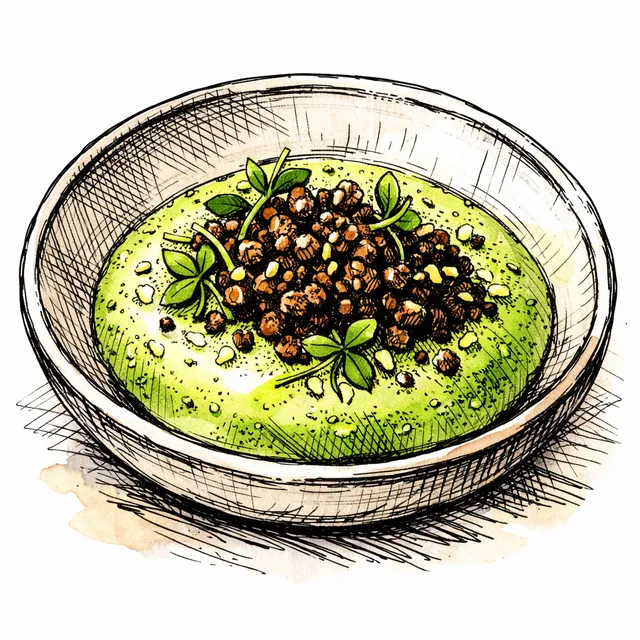
Aerated Matcha-Yuzu Emulsion: The Science of Weightless Flavor
A few years ago, working the line at a fine-dining spot, I watched a pastry chef build a matcha dessert with twelve components. It was exhausting just to look at. I wanted that flavor, but without the fuss. That memory birthed this Aerated Matcha-Yuzu Emulsion. We use the fat in white chocolate (weigh out exactly 150g) to capture the grassy depth of matcha and the floral snap of yuzu. We emulsify, chill strictly to 4°C, and whip it into a weightless cloud. Why this works: White chocolate provides structure, matcha brings the earth, and yuzu delivers the necessary acid. But we need a landing gear. That is where the Buckwheat-Cocoa Crunch comes in. The loud, bitter snap of toasted buckwheat ensures maximum contrast. Remember the two-texture rule: soft needs loud. Fix it fast: If your emulsion splits, your temperature was off. Respect the thermometer. Let it cool. Future you deserves clean textures. Make it yours: Swap the yuzu for lemon zest, or trade the buckwheat for toasted black sesame. We are not adding steps—just improving decisions. Contrast is the secret ingredient, and precision is freedom.
Featured Recipe
Aerated Matcha-Yuzu Emulsion with Buckwheat-Cocoa Crunch
A masterclass in texture engineering and temperature control. We use the fat in white chocolate to capture the grassy depth of matcha and the floral snap of yuzu, emulsifying it before whipping it into a weightless cloud. The loud, bitter crunch of toasted buckwheat ensures every bite has maximum contrast.
Save a copy to your collection for editing
Timeline
Ingredients
- 150 g White chocolate (min 30% cocoa butter), finely chopped(Quality matters here; we are using it purely for its fat structure.)
- 200 g Heavy cream (36% fat)(Divided into 50g hot and 150g cold.)
- 8 g Ceremonial grade matcha powder(Sifted. Do not use culinary grade; we want the vibrant, sweet notes.)
- 15 g Yuzu juice(Lemon juice works if yuzu is unavailable, but yuzu's floral notes are superior here.)
- 50 g Raw buckwheat groats(Provides a toasty, earthy crunch.)
- 20 g Dark cocoa nibs(For measured bitterness.)
- 15 g Fruity olive oil(Bridges the gap between the savory crunch and sweet emulsion.)
- 15 g Maple syrup(For binding and caramelization.)
- 3 g Flaky sea salt(Divided.)
- 2g flaky sea salt(Used in Step 1 but not fully accounted for in the ingredient list (3g listed, 2g + 1g used).)
Instructions
- 1
Preheat your oven to 350°F (175°C). In a small bowl, toss together 50g raw buckwheat groats, 20g dark cocoa nibs, 15g fruity olive oil, 15g maple syrup, and 2g flaky sea salt. We're building a shatteringly crisp garnish that enforces our two-texture rule.
5 min
Tip: Label a sheet pan with parchment. Wipe down your counter while the oven preheats.
- 2
Spread the crunch mixture evenly onto your parchment-lined baking sheet. Bake until the buckwheat is toasted and aromatic.
10 min
Tip: Set a timer. Cocoa nibs can go from toasted to burnt fast.
- 3
While the crunch bakes, heat 50g heavy cream (36% fat) in a small saucepan until just simmering. Remove from heat and vigorously whisk in 8g ceremonial grade matcha powder until fully bloomed and completely smooth.
3 min
Tip: Sift the matcha first. Clumps are the enemy of a smooth mouthfeel.
- 4
Place 150g white chocolate (min 30% cocoa butter), finely chopped in a tall, narrow vessel. Pour the hot matcha cream over the chocolate. Add 15g yuzu juice and 1g flaky sea salt. Blend with an immersion blender until perfectly smooth. This is your emulsification step—forcing fat and water to hold hands.
5 min
Tip: Keep the blender blade fully submerged to avoid incorporating large air bubbles too early.
- 5
With the immersion blender still running on low, stream in the remaining cold 150g heavy cream (36% fat). This instantly drops the temperature and stabilizes our fat network. Place the vessel in an ice bath to chill rapidly.
15 min
Tip: The base must drop below 40°F (4°C) before we attempt aeration, otherwise it will split.
- 6
Pull the baked crunch from the oven. Let it cool completely on the pan. Future you deserves clean, distinct shards, so do not touch it while it cools and hardens.
15 min
Tip: Passive resting is just as important as active cooking.
- 7
Once the matcha emulsion is thoroughly cold, transfer it to a mixing bowl. Use a hand mixer or a large balloon whisk to vigorously beat the mixture until soft, aerated peaks form.
4 min
Tip: Watch it like a hawk. Overwhipping will grain the texture. Stop the moment it holds its shape.
- 8
Spoon the aerated matcha cloud into chilled bowls. Break the cooled buckwheat-cocoa crunch into jagged clusters and scatter them heavily over the top.
3 min
Tip: Serve immediately while the temperature contrast is at its peak.
Chef's Notes
Why this works: White chocolate is essentially a blank canvas of cocoa butter. By emulsifying it with the hot liquid and immediately shocking it with cold cream, we build a highly stable fluid ganache. When whipped, that fat traps air beautifully, creating a weightless foam that carries the grassy, complex notes of matcha without the heaviness of a traditional custard. The loud crunch of the buckwheat provides the mandatory texture contrast. Precision is freedom.

Theo Glass
Modern desserts, minimal fuss, maximum contrast.
Theo Glass—known as “The Minimalist Sweet Tooth”—is a calm, detail-obsessed pastry coach who left the white-tablecloth intensity of fine dining for the reality (and joy) of home kitchens. After years of building plated desserts with tweezers and timers, he realized the real magic wasn’t complicated garnish work—it was contrast, clarity, and control. Theo’s mission now is to help everyday bakers make desserts that feel modern and restaurant-level without turning their kitchen into a war zone. His style is precision with restraint: olive oil cakes that stay plush for days, tahini brownies that walk the line between nutty and bittersweet, miso custards that taste like “caramel’s smarter cousin,” and citrus-forward sorbets that pop without needing an ice-cream machine. Theo teaches fundamentals (emulsions, temperature, texture, salinity) in plain language, with steps that are clean, paced, and confidence-building. If you’ve ever said “I want to mix it up” but don’t want extra dishes, obscure tools, or chaos, Theo’s your person. He’ll show you how to mix it up the minimalist way: a smarter ingredient swap, a sharper contrast, and a clear path to repeatable results.