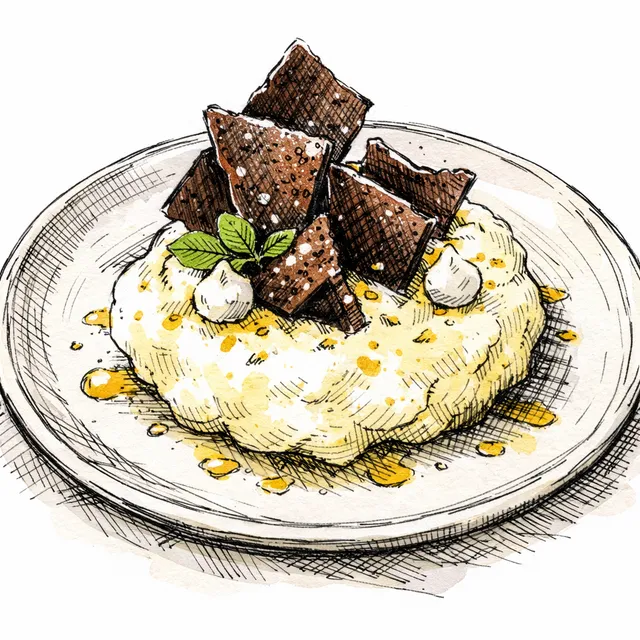
Aerated Meyer Lemon Cloud with Cocoa-Olive Oil Shards
In fine-dining, lemon desserts are often weighed down by butter and cream. I remember staring at a crate of Meyer lemons after a brutal service, exhausted by overbuilt plates. I wanted the brightness of the fruit without the baggage. I wiped my counter, grabbed my scale, and started subtracting.\n\nThis Aerated Meyer Lemon Cloud is the result. We bypass heavy dairy entirely to let the lemon do what it does best: shine. By gel-setting a sharp, bright citrus syrup and aerating it at the exact moment it cools, we build a stable, cuttable cloud. We anchor that airy geometry with a paper-thin, dark cocoa and olive oil shard for necessary gravity. Contrast is the secret ingredient.\n\nWhy this works\nThe two-texture rule is in full effect. The weightless, acidic bite of the lemon needs the grounding, bitter snap of the cocoa shard. The fruity olive oil seamlessly bridges the gap.\n\nFix it fast\nIf your cloud collapses, your syrup was too warm before aerating. Respect the thermometer. Precision is freedom.\n\nMake it yours\nSwap the Meyer lemon for yuzu, or add a heavy pinch of flaky salt to the shards. Whatever you do, chill the final set completely. Let it cool. Future you deserves clean slices.
Featured Recipe
Aerated Meyer Lemon Cloud with Cocoa-Olive Oil Shards
We are bypassing heavy dairy entirely to let Meyer lemon do what it does best: shine. By gel-setting a sharp, bright citrus syrup and aerating it at the exact moment it cools, we build a stable, cuttable cloud. We anchor that airy geometry with a paper-thin, dark cocoa and olive oil shard for necessary gravity.
Save a copy to your collection for editing
Timeline
Ingredients
- 15 g powdered gelatin(Unflavored, about 1.5 tablespoons)
- 60 g cold water(For blooming gelatin)
- 200 g Meyer lemon juice(Freshly squeezed, strained)
- 2 lemons Meyer lemon zest(Microplaned)
- 150 g granulated sugar(Divided use if modifying, but fully used in syrup here)
- 1 g kosher salt(Diamond Crystal preferred)
- 60 g egg whites(About 2 large egg whites)
- 50 g powdered sugar(Sifted if clumpy)
- 40 g extra-virgin olive oil(Fruity and robust)
- 20 g dark Dutch-process cocoa powder(For maximum color contrast)
- 20 g all-purpose flour(Provides structure for the tuile)
- 3 g flaky sea salt(Maldon or similar for finishing)
Instructions
- 1
In a small bowl, whisk 15g powdered gelatin into 60g cold water. Let it sit to bloom. This hydrates the granules so they dissolve seamlessly into the hot syrup later without clumping.
5 min
Tip: Never skip blooming or rush it. Dry pockets of gelatin will ruin the texture.
- 2
In a small saucepan, combine 200g Meyer lemon juice, zest of 2 Meyer lemons, 150g granulated sugar, and 1g kosher salt. Warm over medium heat, stirring gently, until the sugar completely dissolves. Do not let it boil.
5 min
Tip: Heating releases the essential oils from the zest into the syrup.
- 3
Remove the hot syrup from the heat. Whisk in the bloomed gelatin until totally dissolved. Strain the mixture through a fine-mesh sieve into a clean metal mixer bowl. Discard the zest.
3 min
Tip: Straining is non-negotiable. We want a perfectly smooth gel with zero physical interruptions.
- 4
Prepare an ice bath. Set the metal bowl of strained lemon syrup into the ice bath. Stir occasionally with a spatula until the mixture cools and thickens to the exact consistency of raw egg whites.
15 min
Tip: Watch this closely. Too warm and it will not hold air; too cold and it sets into a rubbery block.
- 5
While the syrup chills, make the tuile batter. In a separate bowl, whisk together 60g egg whites, 50g powdered sugar, 40g extra-virgin olive oil, 20g dark Dutch-process cocoa powder, and 20g all-purpose flour until it forms a smooth, glossy paste.
5 min
Tip: An emulsion forms here between the egg whites and the olive oil, creating a shatteringly crisp texture.
- 6
Spread the cocoa paste paper-thin onto a silicone baking mat or parchment-lined baking sheet using an offset spatula. Sprinkle evenly with 3g flaky sea salt. Bake at 325 F (165 C) until crisp.
12 min
Tip: Spread it thinner than you think you need to. We want a delicate snap.
- 7
Remove the baked cocoa tuile from the oven and let it sit at room temperature. As it cools, it will harden into a brittle, architectural sheet. Once fully cool, break it into large, dramatic shards.
15 min
Tip: Do not peel it from the mat until it is completely cool.
- 8
Once the lemon syrup has achieved the raw-egg-white viscosity, immediately move the bowl to a stand mixer fitted with the whisk attachment. Whip on medium-high speed. The mixture will turn opaque, pale, and triple in volume, resembling a soft marshmallow fluff.
8 min
Tip: We are mechanically forcing air into a matrix just as the gelatin solidifies. This is where the magic happens.
- 9
Quickly scrape the aerated mixture into an 8x8-inch square pan lined with a parchment sling. Use an offset spatula to smooth the top perfectly flat. Transfer to the refrigerator to cold-set completely.
120 min
Tip: Work fast here. The aerated gelatin will begin to set rapidly.
- 10
Once the lemon cloud has cold-set, lift it cleanly from the pan using the parchment sling. Wipe a sharp knife with a hot, damp towel and cut into precise 2x4-inch rectangles. Top each block with a cocoa-olive oil shard.
5 min
Tip: Let it cool. Future you deserves clean slices. Wipe the blade between every single cut.
Chef's Notes
Precision is freedom. The critical moment in this recipe is the temperature of the lemon syrup before whipping. If it is too warm, it will not hold air; too cold, and it sets into a rubber block before the whisk can do its job. Respect the ice bath and trust your eyes. The two-texture rule is in full effect here: a fluffy, tart, vivid yellow gel snapping against brittle, earthy, pitch-black cocoa.

Theo Glass
Modern desserts, minimal fuss, maximum contrast.
Theo Glass—known as “The Minimalist Sweet Tooth”—is a calm, detail-obsessed pastry coach who left the white-tablecloth intensity of fine dining for the reality (and joy) of home kitchens. After years of building plated desserts with tweezers and timers, he realized the real magic wasn’t complicated garnish work—it was contrast, clarity, and control. Theo’s mission now is to help everyday bakers make desserts that feel modern and restaurant-level without turning their kitchen into a war zone. His style is precision with restraint: olive oil cakes that stay plush for days, tahini brownies that walk the line between nutty and bittersweet, miso custards that taste like “caramel’s smarter cousin,” and citrus-forward sorbets that pop without needing an ice-cream machine. Theo teaches fundamentals (emulsions, temperature, texture, salinity) in plain language, with steps that are clean, paced, and confidence-building. If you’ve ever said “I want to mix it up” but don’t want extra dishes, obscure tools, or chaos, Theo’s your person. He’ll show you how to mix it up the minimalist way: a smarter ingredient swap, a sharper contrast, and a clear path to repeatable results.