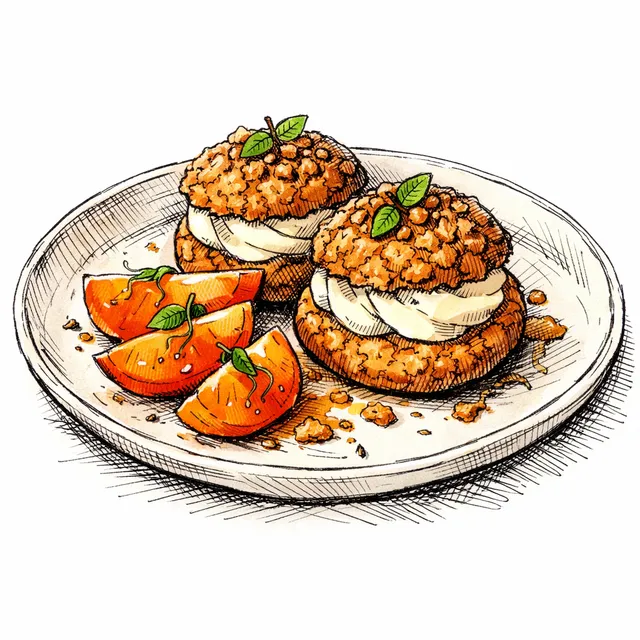
Cold-Infused Bay Leaf Cream Choux au Craquelin with Tart Persimmon
Most people treat bay leaf like a background extra, tossing a dry leaf into a braise and forgetting it. But steep it cold in heavy cream overnight, and it transforms into something floral, savory, and hauntingly complex. That discovery sparked these choux. Years ago, while working a frantic station in a fine-dining kitchen, I needed a dessert that cut through heavy autumn fatigue. I wanted crunch, cold cream, and a sharp hit of fruit without the sugar crash. This recipe is the answer. We use the two-texture rule: a shattering, cookie-topped craquelin shell giving way to pillowy bay leaf ganache and tart, lime-spiked persimmon. Precision is freedom here. Weigh your flour, respect your oven temperatures, and let the cream infuse properly. Contrast is the secret ingredient. Swap the persimmon for crisp pears if you like, but keep that citrus hit to balance the dairy. Let it cool. Future you deserves clean slices and a pastry that feels impossibly fancy yet entirely within reach.
Featured Recipe
Cold-Infused Bay Leaf Cream Choux au Craquelin with Tart Persimmon
Crisp craquelin-capped choux puffs filled with cold-infused bay leaf whipped ganache and bright, lime-spiked Fuyu persimmon. Modern autumn contrast built on the two-texture rule: crunchy caramelized pastry against cold, floral cream and tart fruit. Minimal fuss, exacting temperatures, maximum payoff.
Save a copy to your collection for editing
Timeline
Ingredients
- 300 g Heavy cream(36-40% fat, divided: 100g for melting, 200g cold)
- 4 Fresh bay leaves(whole fresh Turkish bay leaves, lightly bruised)
- 1 tsp Meyer lemon zest(finely microplaned, yellow zest only)
- 110 g White chocolate(32-34% cocoa butter, finely chopped)
- 3.5 g Fine sea salt(divided: 1.5g (1/4 tsp) for ganache, 2g (1/2 tsp) for choux)
- 105 g Unsalted butter(divided: 50g softened for craquelin, 55g cubed cold for choux)
- 60 g Light brown sugar(firmly packed)
- 130 g All-purpose flour(divided: 60g for craquelin, 70g sifted for choux)
- 0.5 tsp Flaky sea salt(divided: 1/4 tsp in craquelin, 1/8 tsp in compote, 1/8 tsp to finish)
- 60 g Whole milk(cold)
- 60 g Water(filtered)
- 30 g Granulated sugar(divided: 5g (1 tsp) for choux, 25g (2 tbsp) for compote)
- 110 g Large eggs(about 2 large eggs, whisked and weighed at room temperature)
- 250 g Fuyu persimmons(about 2 medium firm persimmons, peeled and cut into 4mm dice)
- 20 g Fresh lime juice(strained, about 1 medium lime)
- 0.125 tsp Ground cardamom(freshly ground)
- 110g beaten eggs(This appears to be a quantity of already beaten eggs, not whole eggs.)
- 100g cold-infused heavy cream(This is a specific portion of the total heavy cream, pre-infused.)
- 200g cold-infused heavy cream(This is the remaining portion of the total heavy cream, pre-infused.)
Instructions
- 1
Prep your cold infusion ahead: Steep 4 whole fresh bay leaves and 1 tsp Meyer lemon zest in 300g heavy cream overnight in the fridge. When ready to bake, strain out the aromatics, pressing gently to extract the oils. Heat 100g cold-infused heavy cream in a small saucepan until just steaming. Pour immediately over 110g white chocolate and 1.5g fine sea salt in a medium heatproof bowl. Let stand 60 seconds, then whisk from the center out until glossy and completely emulsified. Whisk in the remaining 200g cold-infused heavy cream. Press plastic wrap directly onto the surface and chill in the refrigerator until thoroughly cold, at least 60 minutes.
10 min
Tip: Do not boil the cream. White chocolate scorches easily above 45°C (113°F). Label the bowl with painter's tape so you know when it hit the fridge.
- 2
Make the craquelin topping: In a small bowl, use a flexible spatula to mash together 50g unsalted butter, 60g light brown sugar, and 1/4 tsp flaky sea salt until uniform. Fold in 60g all-purpose flour until a soft dough forms. Transfer dough between two sheets of parchment paper and roll out evenly to 2mm thickness. Slide onto a baking sheet and transfer to the freezer to firm up.
10 min
Tip: Wipe down your counter before rolling. Even 2mm thickness is the secret to an unbroken, crackly shell that doesn't weigh down the choux bun.
- 3
Preheat your oven to 190°C (375°F) with a rack in the center. In a medium heavy-bottomed saucepan, combine 60g whole milk, 60g water, 55g unsalted butter, 5g granulated sugar, and 2g fine sea salt. Bring to a rolling boil over medium-high heat so the butter melts before the liquid evaporates. Remove from heat, dump in 70g all-purpose flour all at once, and stir vigorously with a wooden spoon until no dry pockets remain. Return pan to medium heat and cook, stirring and pressing the dough against the bottom and sides for 2 minutes, until a glossy skin coats the pan base and the dough registers 75°C (167°F).
12 min
Tip: Drying the panada on the stovetop is non-negotiable. If you don't cook off excess water, your puffs will absorb less egg and fail to hollow out.
- 4
Transfer the warm panada to the bowl of a stand mixer fitted with the paddle attachment (or use a heatproof bowl and hand mixer). Mix on medium-low speed for 2 minutes to vent steam until lukewarm (under 45°C / 113°F). With the mixer running on medium, add 110g beaten eggs in three additions, letting each incorporate fully before adding the next. Stop when the batter is smooth, glossy, and falls from the spatula in an unbroken ribbon that forms a sharp 'V'.
8 min
Tip: Always weigh your eggs. Adding cold or unweighed eggs ruins batter viscosity. If the panada is hotter than 45°C, it will scramble your eggs.
- 5
Line a heavy baking sheet with a silicone mat or parchment paper. Transfer the choux paste to a piping bag fitted with a 12mm round tip. Pipe 6 mounds (approx 35g each, 4.5cm wide), spaced 7cm apart. Retrieve the frozen craquelin from the freezer. Use a 5cm round cutter to stamp out 6 discs. Place one frozen craquelin disc gently atop each piped mound, pressing lightly to level.
10 min
Tip: Keep the piping bag perpendicular to the tray. The craquelin discs melt quickly, so punch them out straight from the freezer.
- 6
Bake at 190°C (375°F) undisturbed for 25 minutes. Do not open the oven door during this rise. Reduce oven temperature to 170°C (340°F) and bake for another 5 minutes to fully dry out the interior structure. Turn off the oven, prop the door open slightly with a wooden spoon handle, and let them rest inside for 5 minutes before transferring to a wire rack to cool completely.
35 min
Tip: Resist the urge to peek during the first 25 minutes. Rushing the oven door drops the internal steam pressure and will collapse your choux.
- 7
While the choux bakes, prepare the persimmon filling: In a small saucepan, combine 250g diced Fuyu persimmons, 25g granulated sugar, 20g fresh lime juice, 0.125 tsp ground cardamom, and 1/8 tsp flaky sea salt. Set over medium heat and simmer gently for 6 minutes, stirring occasionally, until the persimmon softens slightly at the edges but retains a crisp-tender bite and juices form a light glaze. Remove from heat and spread onto a wide plate to cool rapidly, then chill in the fridge.
10 min
Tip: We want texture contrast here, not baby food. Cook just until the raw astringency softens and the lime cuts through the honeyed sweetness.
- 8
Let the baked choux buns and cooked persimmon compote cool completely to room temperature (21°C / 70°F), then transfer compote to the fridge for 10 minutes. A warm bun will instantly melt your whipped cream.
15 min
Tip: Let it cool. Future you deserves clean slices. Use this window to tidy the counter and prep your piping bags.
- 9
Retrieve the chilled bay leaf ganache base from the refrigerator (it must be under 4°C / 40°F). Transfer to a chilled mixing bowl. Using a hand mixer or stand mixer with the whisk attachment, whip on medium-high speed for 2 to 3 minutes until medium-stiff peaks form. Watch closely: whipped ganache turns from silky to grainy in a 15-second window. Transfer into a piping bag fitted with a French star tip.
5 min
Tip: Stop whipping the second the whisk leaves clear trails and the cream holds its peak. Cold temperatures are critical here for clean volume.
- 10
Using a serrated knife, slice the top third off each cooled choux bun with a gentle sawing motion. Spoon 2 generous tablespoons of chilled tart persimmon compote into the hollow base of each bun. Pipe a high, generous swirl of cold-infused bay leaf cream over the fruit, extending just above the rim. Garnish the cream with a micro-pinch of 1/8 tsp flaky sea salt. Gently replace the craquelin caps at an angle. Serve immediately.
8 min
Tip: Saw gently with the serrated knife—do not crush down. The tiny touch of flaky salt directly on the cream bridges the fat and acid.
Chef's Notes
Why this works: Hot-steeping bay leaves often yields medicinal, bitter tannins. Cold-infusing fresh bay leaves and Meyer lemon zest into cold dairy over 12 to 18 hours extracts only volatile, sweet eucalyptus and warm vanilla notes without bitterness. Pairing that velvety herbal fat against firm, lime-cut Fuyu persimmon delivers immediate modern autumn contrast. The two-texture rule reigns here: shatteringly crisp craquelin gives way to cold, yielding cream and juicy fruit. Fix it fast: - Choux dough feels too runny: You under-cooked the panada or added eggs too quickly. If it won't hold a mound, freeze piped discs on parchment for 15 minutes before baking with the craquelin on top. - Ganache looks slightly separated while whipping: You over-whipped by a few seconds. Whisk in 1 tablespoon of unwhipped cold heavy cream with a hand whisk to smooth the emulsion back out. - Contrast is the secret ingredient. We’re not adding steps—just improving decisions.

Theo Glass
Modern desserts, minimal fuss, maximum contrast.
Theo Glass—known as “The Minimalist Sweet Tooth”—is a calm, detail-obsessed pastry coach who left the white-tablecloth intensity of fine dining for the reality (and joy) of home kitchens. After years of building plated desserts with tweezers and timers, he realized the real magic wasn’t complicated garnish work—it was contrast, clarity, and control. Theo’s mission now is to help everyday bakers make desserts that feel modern and restaurant-level without turning their kitchen into a war zone. His style is precision with restraint: olive oil cakes that stay plush for days, tahini brownies that walk the line between nutty and bittersweet, miso custards that taste like “caramel’s smarter cousin,” and citrus-forward sorbets that pop without needing an ice-cream machine. Theo teaches fundamentals (emulsions, temperature, texture, salinity) in plain language, with steps that are clean, paced, and confidence-building. If you’ve ever said “I want to mix it up” but don’t want extra dishes, obscure tools, or chaos, Theo’s your person. He’ll show you how to mix it up the minimalist way: a smarter ingredient swap, a sharper contrast, and a clear path to repeatable results.