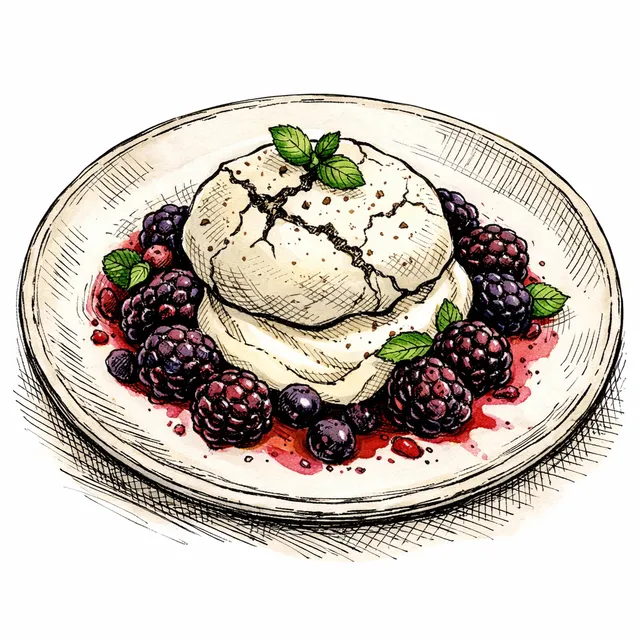
Black Pepper Meringue: The Power of Contrast
I left fine dining because I was tired of overbuilt desserts. I wanted clean flavors and smart contrasts. This Black Pepper Meringue with Cold-Whip Crème Fraîche and Macerated Blackberries was my turning point. The inspiration came during a stifling August service years ago. I watched a line cook toss dark balsamic on warm, bruised berries and realized how acid and deliberate temperature control can rescue almost anything. This recipe is special to me because it proves my favorite rule: we are not adding steps, just improving decisions. Why this works: The sharp, fruity heat of black pepper and dark balsamic vinegar cuts right through the fragile sugar crust of the espresso meringue. We ground that sweetness with an unsweetened, ice-cold whip of crème fraîche. Temperature management is your best tool here. Fix it fast: If your meringue weeps, your sugar was not fully dissolved. Weigh your ingredients in grams, stick a piece of painter's tape on your bowl to label your prep, and set a timer. Make it yours: Swap the blackberries for roasted plums, or finish with a drizzle of fruity olive oil. Remember, contrast is the secret ingredient. Let the meringue cool completely. Future you deserves clean slices.
Featured Recipe
Black Pepper Meringue with Cold-Whip Crème Fraîche & Macerated Blackberries
A masterclass in texture and temperature. The sharp, fruity heat of black pepper and dark balsamic vinegar cut through the fragile sugar crust of the espresso meringue, grounded by an unsweetened, ice-cold whip of crème fraîche.
Save a copy to your collection for editing
Timeline
Ingredients
- 150 g egg whites(About 5 large egg whites, at room temperature for maximum volume.)
- 250 g caster sugar(Superfine sugar dissolves faster, preventing weeping.)
- 1 g kosher salt(Diamond Crystal preferred.)
- 5 g white vinegar(Stabilizes the meringue structure.)
- 5 g cornstarch(Creates that marshmallow-like interior.)
- 2 g instant espresso powder(Adds a measured bitterness to counteract the sugar.)
- 300 g fresh blackberries(Halved lengthways to release their juices.)
- 30 g granulated sugar(For drawing out the fruit juices during maceration.)
- 15 g balsamic vinegar(Use a decent quality one; the acidity is crucial here.)
- 2 g coarse black pepper(Freshly ground. Do not use pre-ground dust. We want small pops of heat.)
- 1 zest lemon(Microplaned right over the berries.)
- 200 g heavy cream(Very cold.)
- 150 g crème fraîche(Very cold. Provides lactic tang to cut the sweetness.)
- 15 g powdered sugar(Just enough to help stabilize the cream.)
- 2 g vanilla bean paste(Can substitute high-quality extract.)
Instructions
- 1
Preheat your oven to 120°C (250°F). Wipe down your counter, then line a heavy baking sheet with parchment paper. Draw an 8-inch circle on the back of the parchment so you have a guide. Precision is freedom.
5 min
Tip: Using a heavy half-sheet pan prevents the bottom of the meringue from scorching.
- 2
In a stand mixer fitted with a perfectly clean whisk attachment, whip 150g egg whites and 1g kosher salt on medium speed until soft peaks form. With the mixer running, gradually rain in 250g caster sugar, a spoonful at a time. Turn speed to high and whip until stiff, glossy peaks form. Gently fold in 5g white vinegar, 5g cornstarch, and 2g instant espresso powder.
10 min
Tip: Any fat in the bowl will ruin the meringue. Wipe your bowl with a splash of vinegar before starting.
- 3
Spoon the meringue onto your parchment, keeping it inside your traced circle. Create a shallow crater in the center to hold the cream later. Bake for 90 minutes without opening the oven door.
90 min
Tip: The oven door is lava. Opening it alters the humidity and causes cracking.
- 4
While the meringue bakes, prep the maceration. In a non-reactive bowl, toss 300g fresh blackberries with 30g granulated sugar, 15g balsamic vinegar, 2g coarse black pepper, and the zest of 1 lemon. Stir gently, then let it sit at room temperature.
5 min
Tip: Macerating for at least an hour pulls the water from the berries, creating a natural, highly concentrated syrup.
- 5
Place a metal mixing bowl and whisk into the freezer. Cold equipment is non-negotiable for a fast, stable cold-whip.
2 min
Tip: We're engineering texture here. Warm dairy churns into butter; cold dairy whips into velvet.
- 6
Once the 90 minutes are up, turn the oven off. Do not open the door. Leave the meringue inside to cool completely for at least 60 minutes.
60 min
Tip: Let it cool. Future you deserves a meringue that shatters perfectly on the outside and stays chewy on the inside.
- 7
Retrieve your chilled bowl. Combine 200g heavy cream, 150g crème fraîche, 15g powdered sugar, and 2g vanilla bean paste. Whip vigorously by hand or on medium speed until it holds soft, pillowy peaks. Do not over-whip.
5 min
Tip: Crème fraîche whips faster than heavy cream alone. Keep an eye on it—it should drape lightly off the whisk.
- 8
To assemble, carefully transfer the cooled meringue to a serving plate. Spoon the cold-whip into the center well. Generously spoon the macerated blackberries over the top, making sure to let the dark, peppery balsamic syrup bleed into the white cream.
5 min
Tip: Assemble just before serving. The contrast between the dry meringue shell, cold fat, and syrupy acid is fleeting and beautiful.
Chef's Notes
Why this works: Meringue is inherently sweet. We're not adding steps here, just improving decisions. We need severe contrast to save the dessert from being cloying. The coarse black pepper provides a fruity, lingering heat, balsamic brings depth and acid, and crème fraîche offers lactic tang. We are adhering firmly to the two-texture rule: the crisp shatter of the meringue against the silk of the cold-whip. Weigh your ingredients, trust your oven, and enjoy the payoff.

Theo Glass
Modern desserts, minimal fuss, maximum contrast.
Theo Glass—known as “The Minimalist Sweet Tooth”—is a calm, detail-obsessed pastry coach who left the white-tablecloth intensity of fine dining for the reality (and joy) of home kitchens. After years of building plated desserts with tweezers and timers, he realized the real magic wasn’t complicated garnish work—it was contrast, clarity, and control. Theo’s mission now is to help everyday bakers make desserts that feel modern and restaurant-level without turning their kitchen into a war zone. His style is precision with restraint: olive oil cakes that stay plush for days, tahini brownies that walk the line between nutty and bittersweet, miso custards that taste like “caramel’s smarter cousin,” and citrus-forward sorbets that pop without needing an ice-cream machine. Theo teaches fundamentals (emulsions, temperature, texture, salinity) in plain language, with steps that are clean, paced, and confidence-building. If you’ve ever said “I want to mix it up” but don’t want extra dishes, obscure tools, or chaos, Theo’s your person. He’ll show you how to mix it up the minimalist way: a smarter ingredient swap, a sharper contrast, and a clear path to repeatable results.