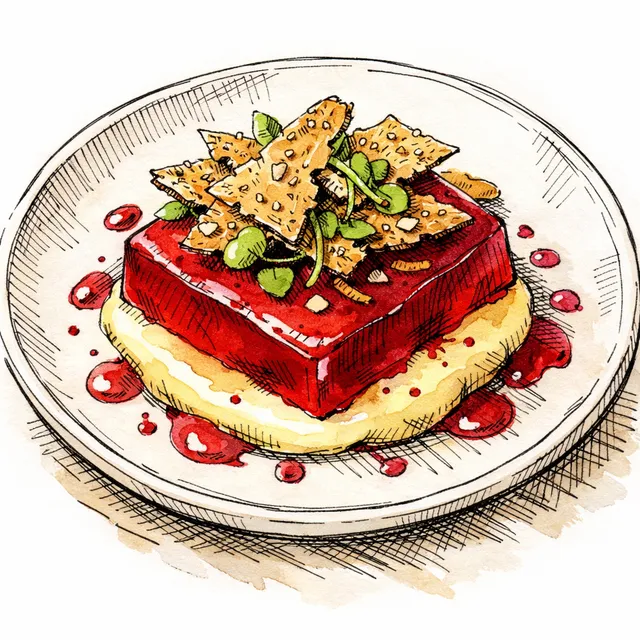
Blood Orange–Campari Gelée with Bay-Bean Custard & Almond–Fennel Shatter
I built this dessert the week I needed a reset—post-holidays, post-rich-everything. I wanted clean flavor lanes and one good contrast. Blood orange was already doing the work, so I just aimed it: Campari for a measured bitter edge, not a cocktail gimmick. Contrast is the secret ingredient.
Where it came from
In fine dining, I used to hide winter citrus under too many “components.” Now I’d rather let it speak, then give it one grown-up shadow. Gelée is my favorite way to do that: cold, precise, and travel-proof.
The memory
I first tested this in a tiny apartment kitchen with a fridge that froze the back shelf. The gelée set perfectly in front, turned slushy in back. I learned the hard way: temperature management isn’t fussy—it’s insurance.
Why this is special
It hits my two-texture rule hard: silky bay-bean custard (think clean cream + quiet aromatics) against shatter that cracks like thin ice. It also slices like a dream. Let it cool. Future you deserves clean slices.
Make it yours
- Swap Campari for Aperol (softer) or a splash of grapefruit + gentian bitters (sharper).
- Add 0.5–1g salt to the custard. It wakes up the dairy.
- Toast the almonds darker for more bitterness, or finish with flaky salt for extra snap.
We’re not adding steps—just improving decisions.
Featured Recipe
Blood Orange–Campari Gelée with Bay-Bean Custard & Almond–Fennel Shatter
This is my winter dessert reset: blood orange pushed brighter with a bitter edge, a cool-set custard that tastes like clean cream and quiet aromatics, and a glassy shatter that cracks like thin ice. It travels well, slices clean, and hits the two-texture rule hard: silky + snappy, with just enough bitterness to keep it adult.
Save a copy to your collection for editing
Ingredients
- 400 g Blood orange juice (freshly squeezed, strained)(About 6–8 blood oranges; strain to remove pulp for a clean gelée)
- 2 tsp Blood orange zest (fine)(From 2 blood oranges)
- 70 g Granulated sugar(For the gelée; adjust ±10 g depending on orange sweetness)
- 60 g Campari (or other bitter aperitif)(Adds a clean bitter edge; substitute 45 g Aperol + 10 g lemon juice for milder bitterness)
- 10 g Fresh lemon juice(Optional but recommended; tightens flavor and helps the citrus read as “fresh”)
- 1 g Fine sea salt(Pinch; bitterness needs salt to feel intentional)
- 7 g Powdered gelatin(One standard packet)
- 35 g Cold water(For blooming gelatin (5x gelatin weight))
- 300 g Whole milk(For the custard base)
- 200 g Heavy cream(Keeps it plush but sliceable)
- 55 g Granulated sugar(For custard)
- 2 g Fine sea salt(Custard needs proper seasoning; don’t skip)
- 6 g Vanilla bean paste (or extract)(About 1 tsp)
- 2 Bay leaves (dried or fresh)(Aromatic, wintry, and not-too-floral)
- 12 g Roasted cacao nibs(This is your bitter edge without going chocolate-forward)
- 4 Egg yolks(About 75–80 g yolks)
- 3 g Powdered gelatin(For a set custard that unmolds/slices cleanly)
- 15 g Cold water(For blooming gelatin)
- 120 g Granulated sugar(For shatter)
- 40 g Light corn syrup (or glucose)(Insurance against crystallization; cleaner glass)
- 35 g Water(For shatter syrup)
- 60 g Whole almonds, toasted(Chopped; toast 8–10 min at 160°C/325°F)
- 2 g Fennel seeds, toasted and lightly crushed(About 1 tsp; ties to citrus with a cool, herbal lift)
- 1 g Flaky salt(A small pinch over the finished shatter)
Instructions
- 1
Set up your pans and labels. Line an 8x8 in (20x20 cm) pan with parchment for the gelée. For the custard, lightly oil 6 small ramekins or silicone molds (or use one loaf pan for sliceable slabs). Put a small plate in the freezer for shatter testing.
10 min
Tip: Precision is freedom: when the gelée is ready, you want zero chaos—just pour and chill.
- 2
Bloom the gelée gelatin: sprinkle 7 g powdered gelatin over 35 g cold water in a small bowl. Let stand until fully hydrated.
5 min
Tip: If you dump gelatin into warm liquid, it clumps. Blooming prevents the classic ‘fish-eye’ lumps.
- 3
Make the blood orange–Campari gelée. In a small saucepan, combine 400 g Blood orange juice (freshly squeezed, strained), 70 g Granulated sugar, 2 tsp Blood orange zest (fine), 1 g Fine sea salt, and 10 g Fresh lemon juice. Warm just to steaming—do not boil. Remove from heat, whisk in bloomed gelatin until dissolved, then whisk in 60 g Campari (or other bitter aperitif).
8 min
Tip: Add alcohol off-heat to keep the aroma bright and the bitterness clean, not cooked.
- 4
Pour gelée into the lined pan. Chill until set and cold all the way through.
180 min
Tip: Let it cool. Future you deserves clean slices. Minimum 3 hours; overnight is best.
- 5
Bloom the custard gelatin: sprinkle 3 g Powdered gelatin over 15 g Cold water. Set aside.
5 min
Tip: This little bit of gelatin gives you a custard that holds its shape without tasting like gelatin.
- 6
Infuse the dairy for the custard. In a saucepan, combine 300 g Whole milk, 200 g Heavy cream, 55 g Granulated sugar, 2 g Fine sea salt, 2 Bay leaves (dried or fresh), and 12 g Roasted cacao nibs. Heat to steaming, then cover and steep 15 minutes.
20 min
Tip: Bay gives wintery lift; cacao nibs bring bitterness without turning this into a chocolate dessert.
- 7
Temper and cook the custard. Whisk 4 Egg yolks in a bowl. Rewarm the infusion briefly, then strain it into a measuring jug. Slowly whisk a third of the hot dairy into yolks, then return everything to the saucepan. Cook on medium-low, stirring constantly, until it reaches 82–84°C / 180–183°F and lightly coats a spoon.
10 min
Tip: Use a thermometer. This is the difference between silky custard and sweet scrambled eggs.
- 8
Finish and set the custard. Off heat, whisk in bloomed gelatin until dissolved, then whisk in 6 g Vanilla bean paste (or extract). Pour into ramekins/molds. Chill until set, at least 3 hours.
180 min
Tip: Strain again if you want a restaurant-smooth texture. No shame in extra insurance.
- 9
Make the almond–fennel shatter. Line a baking sheet with parchment. In a small saucepan, combine 120 g Granulated sugar, 40 g Light corn syrup (or glucose), and 35 g Water. Bring to a boil without stirring; cook to 150°C / 302°F (hard crack). Off heat, quickly stir in 60 g Whole almonds, toasted and 2 g Fennel seeds, toasted and lightly crushed, then pour thinly onto parchment. Sprinkle 1 g Flaky salt. Cool fully.
15 min
Tip: No stirring while it boils—stirring invites crystals. Swirl the pan gently if needed.
- 10
Cut and assemble. Slice gelée into clean cubes or bars. Unmold custards (or serve in ramekins). Plate gelée with custard, then crack shatter over the top right before serving.
15 min
Tip: Shatter goes on last. Humidity is the enemy of crunch.
Chef's Notes
Why this works: bitterness needs structure. The Campari and cacao nibs give you a grown-up edge, but the blood orange keeps it perfumed and bright. The custard is set just enough to slice, which means you can travel with it and still plate something sharp. Fix it fast: if your gelée won’t set, you likely overheated the gelatin or mis-weighed the juice—remelt gently (never boil), add 1–2 g more bloomed gelatin, and rechill. If your shatter goes sticky, it wasn’t cooked to true hard-crack or your kitchen is humid—re-dry it in a 120°C/250°F oven for 5–7 minutes, then cool again.

Theo Glass
Modern desserts, minimal fuss, maximum contrast.
Theo Glass—known as “The Minimalist Sweet Tooth”—is a calm, detail-obsessed pastry coach who left the white-tablecloth intensity of fine dining for the reality (and joy) of home kitchens. After years of building plated desserts with tweezers and timers, he realized the real magic wasn’t complicated garnish work—it was contrast, clarity, and control. Theo’s mission now is to help everyday bakers make desserts that feel modern and restaurant-level without turning their kitchen into a war zone. His style is precision with restraint: olive oil cakes that stay plush for days, tahini brownies that walk the line between nutty and bittersweet, miso custards that taste like “caramel’s smarter cousin,” and citrus-forward sorbets that pop without needing an ice-cream machine. Theo teaches fundamentals (emulsions, temperature, texture, salinity) in plain language, with steps that are clean, paced, and confidence-building. If you’ve ever said “I want to mix it up” but don’t want extra dishes, obscure tools, or chaos, Theo’s your person. He’ll show you how to mix it up the minimalist way: a smarter ingredient swap, a sharper contrast, and a clear path to repeatable results.