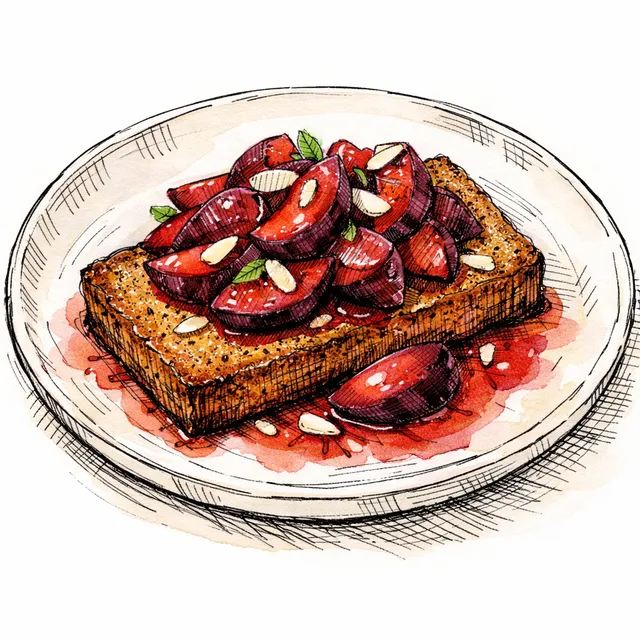
Brown Butter & Black Pepper Financier Slab with Macerated Red Plums
The inspiration for this came from my fine-dining days, where we overcomplicated everything. I wanted that same elegant payoff, minus the tweezers. I remember wiping down my home kitchen counter, labeling my prep bowls with painter's tape, and realizing a financier does not need fussy individual molds. Bake it as a slab. It keeps the edges chewy and the center tender. This recipe is special to me because it proves the two-texture rule: a warm, nutty cake meets cold, sharply acidic plums pooling in their own syrup. The black pepper acts as a bridge, pulling the deep toast of the browned butter into the bright, floral sweetness of raw red plums. Why this works: The black pepper is a one-contrast upgrade that wakes up the palate without crowding the plate. Fix it fast: If your plums lack acidity, add a micro-adjustment of lemon or yuzu juice to the syrup. Make it yours: Swap the plums for tart cherries, or introduce toasted black sesame into the batter. Just remember to weigh your ingredients in grams, trust your timer, and let the slab rest. Future you deserves clean slices. We are not adding steps, just improving decisions.
Featured Recipe
Brown Butter & Black Pepper Financier Slab with Macerated Red Plums
Warm, nutty, and baked in under 15 minutes. Cold, sharply acidic, and pooling with their own syrup. This is the two-texture rule at work. The black pepper acts as a bridge, pulling the deep toast of the browned butter into the bright, floral sweetness of the raw red plums. Precision is freedom: measure your egg whites, trust your timer, and let the contrasts do the heavy lifting.
Save a copy to your collection for editing
Timeline
Ingredients
- 300 g red plums(halved, pitted, and thinly sliced)
- 30 g granulated sugar(for maceration)
- 15 g lemon juice(freshly squeezed)
- 2 g freshly ground black pepper(divided between fruit and batter)
- 115 g unsalted butter(plus extra for greasing if not using parchment)
- 100 g almond flour(fine ground)
- 120 g powdered sugar(sifted if clumpy)
- 40 g all-purpose flour
- 120 g egg whites(about 4 large eggs, room temperature)
- 3 g kosher salt(Diamond Crystal)
- 1 pinch flaky sea salt(to finish)
Instructions
- 1
Set up your station and macerate the fruit. In a medium bowl, combine 300g red plums, 30g granulated sugar, 15g lemon juice, and 1g freshly ground black pepper. Toss gently until the sugar dissolves into a light syrup. Set aside. Let time and osmotic pressure do the work while you bake.
3 min
Tip: Slice the plums thinly to expose maximum surface area. More surface area means faster juice extraction.
- 2
Brown the butter. Place 115g unsalted butter in a small saucepan over medium heat. Swirl the pan occasionally as it melts, foams, and eventually clears. The moment it smells intensely like toasted hazelnuts and the milk solids turn deep brown, pour it into a heatproof bowl to cool slightly.
5 min
Tip: Use a light-colored pan so you can actually see the milk solids browning. Keep a close eye—it goes from perfect to burnt in seconds.
- 3
Whisk the dry ingredients. In a large mixing bowl (labeled with painter's tape if you're working ahead), combine 100g almond flour, 120g powdered sugar, 40g all-purpose flour, 3g kosher salt, and the remaining 1g freshly ground black pepper. Add 120g egg whites and whisk vigorously until a thick, smooth paste forms.
3 min
Tip: Don't overthink the whisking here; you are just hydrating the dry ingredients and breaking up lumps, not whipping air into the whites.
- 4
Emulsify the batter. Slowly pour the warm browned butter (including all the toasted brown specks from the bottom of the bowl) into the almond paste, whisking continuously. The batter should look glossy and homogenous. We're not adding steps—just improving decisions by building a stable emulsion.
2 min
Tip: If the butter is too hot, it will cook the egg whites. It should be warm to the touch but not scalding.
- 5
Quick-bake the slab. Pour the batter into a parchment-lined quarter sheet pan, using an offset spatula to spread it evenly into the corners. Bake at 400°F (200°C) for 12 to 14 minutes. You are looking for deeply golden, crispy edges and a center that springs back slightly when pressed.
14 min
Tip: Wipe down the counter and wash your bowls while the slab bakes. A clean workspace is a clear mind.
- 6
Let it cool. Future you deserves clean slices. Pull the pan from the oven and let it rest on a wire rack for at least 5 minutes. The crumb needs time to set. Lift the slab out by the parchment paper and use a sharp knife to cut it into neat rectangles.
5 min
Tip: Wiping your knife between cuts gives you those perfect, bakery-style edges.
- 7
Plate and contrast. Place a warm slice of financier on a plate. Top generously with the cold macerated plums, making sure to spoon the accumulated pepper-lemon syrup over the cake so it soaks into the crumb. Finish with a pinch of flaky sea salt. Contrast is the secret ingredient.
2 min
Tip: Serve immediately. The clash between the warm, rich cake and the cold, sharp fruit is best experienced in the first five minutes.
Chef's Notes
Why this works: A financier batter is a workhorse—high in fat, low in moisture, incredibly quick to bake. By spreading it thin in a quarter sheet pan, we maximize the surface area, yielding more of those crispy, caramelized edges. Fix it fast: If your brown butter gets too dark, immediately pour it into a cool bowl to stop the cooking process. Black specks are flavor; burnt ash is not. One-contrast upgrades: Black pepper in the batter is subtle and warming; black pepper on the raw plums is sharp and assertive. We're layering the same ingredient in two different thermal states to build complexity without crowding the plate.

Theo Glass
Modern desserts, minimal fuss, maximum contrast.
Theo Glass—known as “The Minimalist Sweet Tooth”—is a calm, detail-obsessed pastry coach who left the white-tablecloth intensity of fine dining for the reality (and joy) of home kitchens. After years of building plated desserts with tweezers and timers, he realized the real magic wasn’t complicated garnish work—it was contrast, clarity, and control. Theo’s mission now is to help everyday bakers make desserts that feel modern and restaurant-level without turning their kitchen into a war zone. His style is precision with restraint: olive oil cakes that stay plush for days, tahini brownies that walk the line between nutty and bittersweet, miso custards that taste like “caramel’s smarter cousin,” and citrus-forward sorbets that pop without needing an ice-cream machine. Theo teaches fundamentals (emulsions, temperature, texture, salinity) in plain language, with steps that are clean, paced, and confidence-building. If you’ve ever said “I want to mix it up” but don’t want extra dishes, obscure tools, or chaos, Theo’s your person. He’ll show you how to mix it up the minimalist way: a smarter ingredient swap, a sharper contrast, and a clear path to repeatable results.