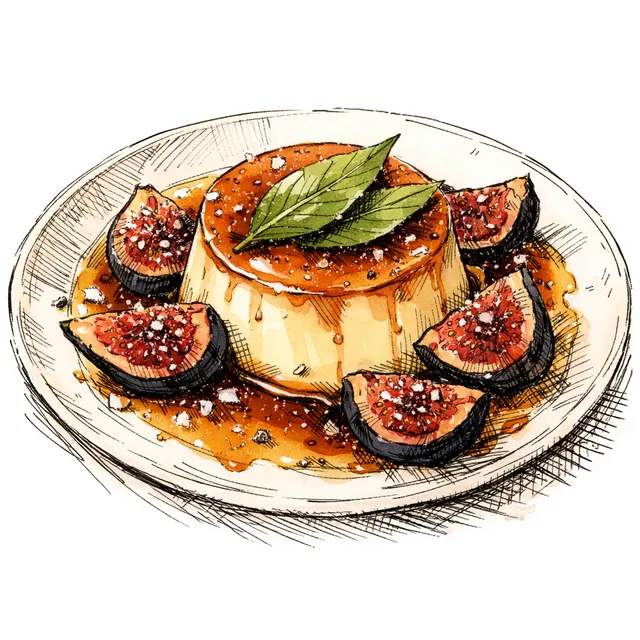
Cold-Infused Bay Leaf Crème Caramel with Salted Black Figs
Precision is freedom. When I was running a frantic fine-dining line, desserts often drowned under crowded flavor piles. I wanted the opposite: clean lines, sharp contrasts, and ingredients that actually earn their place. This crème caramel is my answer. The inspiration came from walking past a neighbor's wild bay tree on a crisp autumn morning. Crushing a leaf released a sweet, woodsy aroma that begged for dairy. Instead of hot-steeping, which drags out harsh tannins, we cold-infuse the milk overnight. Zero bitterness, pure herbal lift. We bake it gently in a water bath to achieve a glass-smooth set, then anchor it with a dark, bittersweet caramel pool. To finish? Tender black figs tossed in sharp lemon juice and a crowning crunch of flaky salt. Contrast is the secret ingredient. We are not adding steps here, just improving decisions. Weigh your dairy, respect your oven temperatures, and let the fridge do the heavy lifting. Let it cool. Future you deserves clean slices.
Featured Recipe
Cold-Infused Bay Leaf Crème Caramel with Salted Black Figs
A modern autumn flan steeped cold overnight with fresh sweet bay leaves for an herbal, woodsy aroma without a trace of bitterness. Baked gently in a water bath to a glass-smooth set, it pairs a dark bittersweet caramel pool with tender, lemon-dressed black figs and crunchy flaky salt. Minimalist, disciplined, and engineered for maximum textural contrast.
Save a copy to your collection for editing
Timeline
Ingredients
- 480 g whole milk(cold, whole milk (about 2 cups))
- 120 g heavy cream(36% fat (about 1/2 cup))
- 6 fresh sweet bay leaves(gently crushed between fingers to release essential oils)
- 225 g granulated sugar(divided: 150 g for caramel, 75 g for custard)
- 45 ml water(for the caramel)
- 15 ml fresh lemon juice(divided: 5 ml for caramel, 10 ml for dressing figs)
- 3 large whole eggs(at room temperature (about 150 g out of shell))
- 2 large egg yolks(at room temperature (about 36 g))
- 2 g fine sea salt(about 1/4 tsp)
- 1.5 L boiling water(for the water bath)
- 300 g fresh black mission figs(about 8-10 ripe figs, stemmed and quartered lengthwise)
- 10 ml fruity extra virgin olive oil(about 2 tsp)
- 1 g fresh lemon zest(finely grated from 1/2 organic lemon)
- 2 g flaky sea salt(such as Maldon, for finishing)
- 150 g granulated sugar(Used in Step 2 for caramel, but only 225g listed in ingredients for custard.)
- 5 ml fresh lemon juice(Used in Step 2 for caramel, but only 15ml listed in ingredients for custard.)
Instructions
- 1
Preheat your oven to 150°C (300°F). Set a kettle with 1.5 L boiling water to heat for the water bath. Pour the 480 g whole milk and 120 g heavy cream that have rested with 6 fresh sweet bay leaves in a covered jar in the refrigerator for 12 to 24 hours through a fine-mesh strainer into a medium saucepan; discard the spent bay leaves.
5 min
Tip: Cold steeping extracts the aromatic eucalyptus and woodsy sweetness of bay leaves while leaving astringent, grassy bitterness behind.
- 2
In a heavy-bottomed stainless steel saucepan, combine 150 g granulated sugar, 45 ml water, and 5 ml fresh lemon juice. Heat over medium without stirring until sugar liquefies. Allow it to boil undisturbed, gently swirling the pan occasionally, until it reaches a deep, bittersweet reddish-amber color (around 175°C / 350°F). Immediately pour the caramel evenly across six 150 ml (5 oz) ramekins, tilting each to coat the base. Place ramekins into a deep 9x13-inch baking dish.
10 min
Tip: The tiny splash of lemon juice inhibits crystallization. Pull the pan off the heat the moment it turns deep copper; residual heat will take it to perfect amber.
- 3
Place the strained bay-infused dairy over medium-low heat and warm gently until faint steam rises from the surface (around 60°C / 140°F). Do not let it boil. Remove from heat.
5 min
Tip: Warming the milk shortens bake time and helps the sugar dissolve smoothly into the eggs without cooking them.
- 4
In a medium mixing bowl, whisk together 3 large whole eggs, 2 large egg yolks, 75 g granulated sugar, and 2 g fine sea salt until completely homogenous. Keep the whisk close to the bottom of the bowl to avoid beating excess air or foam into the eggs.
5 min
Tip: Air bubbles are the enemy of a mirror-smooth crème caramel. Whisk smoothly, don't whip.
- 5
Slowly pour the warm dairy into the egg mixture in a steady, thin ribbon while whisking continuously to temper the eggs without scrambling. Pass the finished custard through a fine-mesh sieve into a spouted measuring jug to catch any stray chalazae or foam.
5 min
Tip: Straining is non-negotiable for restaurant-grade silkiness. We're not adding steps—just improving decisions.
- 6
Divide the strained custard evenly among the six caramel-lined ramekins. Slide the baking dish onto the center oven rack, then carefully pour the 1.5 L boiling water into the dish around the ramekins until it reaches halfway up their outer sides. Bake at 150°C (300°F) for 35 to 40 minutes, until edges are set but the center still gives a delicate, gelatin-like jiggle when tapped.
40 min
Tip: An instant-read thermometer inserted in the center should read 82°C (180°F). If it is liquid, give it 3 more minutes; do not let it bubble.
- 7
Carefully remove the ramekins from the hot water bath using tongs or silicone pads and place on a wire rack. Cool completely at room temperature for 45 minutes, then transfer to the refrigerator uncovered for at least 4 hours, or overnight.
240 min
Tip: Let it cool. Future you deserves clean slices. Chilling lets the caramelized sugar dissolve into liquid syrup and gives the custard structural integrity.
- 8
Just before serving, place 300 g fresh black mission figs in a small bowl. Drizzle with 10 ml fresh lemon juice, 10 ml fruity extra virgin olive oil, and 1 g fresh lemon zest. Toss very gently with your hands to coat the glistening cut faces without crushing the fruit.
5 min
Tip: Tossing ripe figs with raw acid and peppery olive oil creates the crucial counterweight to the sweet, rich caramel.
- 9
Run a thin paring knife around the top inner rim of each ramekin to break the vacuum seal. Place a shallow rimmed dessert plate on top, invert firmly, and give a short, sharp downward snap. Lift the ramekin to release the custard and its cascade of amber syrup. Spoon the dressed black figs alongside each custard and finish with a pinch of 2 g flaky sea salt over the fruit and caramel.
5 min
Tip: Contrast is the secret ingredient: the bitter burnt sugar, cool herbal custard, jammy fig pop, and sea salt snap hit all corners of the palate.
Chef's Notes
Why this works: 1. Cold infusion preserves high-frequency aromatics. Fresh bay leaves steeped hot can release bitter, harsh tannins. Cold steeping them in whole milk overnight extracts pure herbal, woodsy warmth that melds quietly into dairy fat. 2. Low-and-slow water bath baking. Keeping the oven at 150°C (300°F) insulated by a water bath protects the egg proteins from curdling or creating airy sponge pockets, guaranteeing a mirror-smooth texture. 3. Acid and salt contrast. Rich caramel and whole egg custard can quickly saturate the palate. Sliced fresh black figs dressed with lemon juice, zest, and peppery olive oil reset your taste buds between every bite. Fix it fast: - Caramel seized while cooking? Add a tablespoon of hot water, drop heat to low, and swirl gently until dissolved. - Custard stuck in the ramekin? Dip the bottom 1 inch of the ramekin in hot tap water for 15 seconds to liquefy the base caramel, run a knife around the top edge again, and invert.

Theo Glass
Modern desserts, minimal fuss, maximum contrast.
Theo Glass—known as “The Minimalist Sweet Tooth”—is a calm, detail-obsessed pastry coach who left the white-tablecloth intensity of fine dining for the reality (and joy) of home kitchens. After years of building plated desserts with tweezers and timers, he realized the real magic wasn’t complicated garnish work—it was contrast, clarity, and control. Theo’s mission now is to help everyday bakers make desserts that feel modern and restaurant-level without turning their kitchen into a war zone. His style is precision with restraint: olive oil cakes that stay plush for days, tahini brownies that walk the line between nutty and bittersweet, miso custards that taste like “caramel’s smarter cousin,” and citrus-forward sorbets that pop without needing an ice-cream machine. Theo teaches fundamentals (emulsions, temperature, texture, salinity) in plain language, with steps that are clean, paced, and confidence-building. If you’ve ever said “I want to mix it up” but don’t want extra dishes, obscure tools, or chaos, Theo’s your person. He’ll show you how to mix it up the minimalist way: a smarter ingredient swap, a sharper contrast, and a clear path to repeatable results.