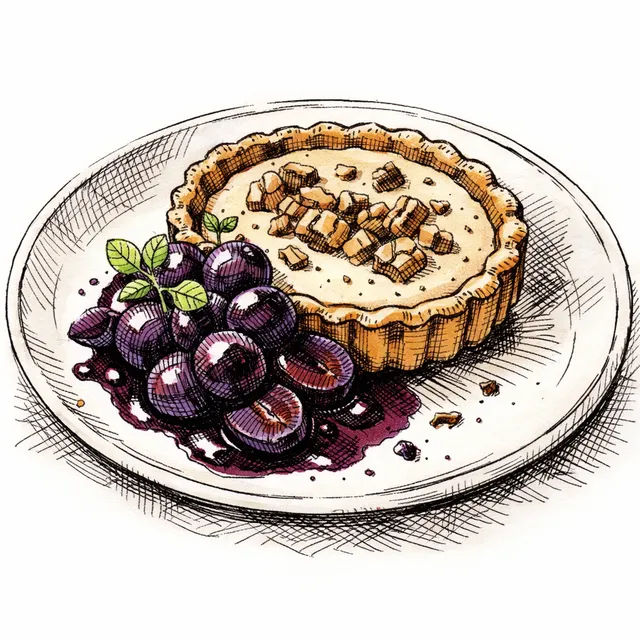
Cold-Infused Black Walnut Custard Tart with Tart Concord Grape
Precision is freedom. When I was running line pastry, we spent hours overbuilding plates. Now, I want clean flavors and sharp contrasts. This tart was born from a rainy autumn afternoon testing cold infusions. Hot roasting brings out muddy bitterness in black walnuts; cold-steeping them in cream preserves their rich, earthy woodsy notes without the harshness. Pair that silkiness with an electric Concord grape reduction, and every bite wakes up.
Why this works
The browned-butter sablé provides structural snap, while the tart grape cuts right through the rich, nutty custard. Contrast is the secret ingredient.
Fix it fast
Weigh your ingredients in grams. Let it cool completely before slicing. Future you deserves clean, sharp edges from the knife. Make it your own by swapping the walnuts for pecans if needed, but respect the chill times. We are not adding steps here—just improving decisions.
Featured Recipe
Cold-Infused Black Walnut Custard Tart with Tart Concord Grape
A crisp browned-butter sablé crust filled with a silky custard cold-infused with toasted black walnuts, finished with an electric Concord grape reduction and flaky salt. Minimal fuss, laser-sharp contrast, and clean bakery-case slices.
Save a copy to your collection for editing
Timeline
Ingredients
- 120 g shelled black walnuts(about 1 cup; roughly chopped)
- 360 g heavy cream(35% milkfat, cold)
- 120 g whole milk(cold)
- 160 g all-purpose flour(about 1 1/4 cups)
- 45 g powdered sugar(sifted)
- 3 g fine sea salt(divided (1/2 tsp total))
- 85 g unsalted butter(6 tbsp, browned and thoroughly chilled until firm)
- 3 large egg yolk(divided (1 for crust, 2 for custard))
- 15 g ice water(1 tbsp)
- 75 g granulated sugar(divided (50g for custard, 25g for glaze))
- 20 g cornstarch(about 2 tbsp)
- 2 g sheet gelatin(1 bronze sheet, bloomed in ice water (or 1/2 tsp powdered gelatin))
- 5 g pure vanilla extract(1 tsp)
- 240 g Concord grape juice(100% unsweetened juice, about 1 cup)
- 10 g fresh lemon juice(2 tsp)
- 1 g flaky sea salt(for finishing)
- 2 large egg yolk(mentioned in step 6 but only 3 listed in ingredients)
- 50 g granulated sugar(mentioned in step 6 but only 75g listed in ingredients)
- splash fresh cream(mentioned in step 2 as a topping off option)
Instructions
- 1
Toast 120 g shelled black walnuts on a sheet pan at 165°C (325°F) for 10 minutes until deeply fragrant. Let cool completely, then crush lightly with a rolling pin. In a sealable container, combine the crushed nuts with 360 g heavy cream and 120 g whole milk. Cover and refrigerate for 12 to 16 hours.
15 min
Tip: Why this works: Black walnuts carry pungent, volatile aromatic oils that turn astringent and bitter if boiled. A gentle cold steep draws out their buttery, woodsy core without extracting harsh tannins.
- 2
Strain the cold dairy through a fine-mesh sieve into a clean bowl, pressing firmly on the nuts with a flexible spatula to extract every gram of fat and aromatics. You need 420g of strained liquid; if short, top off with a splash of fresh cream.
5 min
Tip: Wipe the counter clean before proceeding. Label the bowl with painter's tape so you do not mix it up with straight cream.
- 3
Make the sablé crust: In a bowl, whisk 160 g all-purpose flour, 45 g powdered sugar, and 1.5 g fine sea salt. Cut in 85 g unsalted butter (browned and chilled) with your fingertips until the mixture resembles coarse sand. Add 1 large egg yolk and 15 g ice water, pressing gently just until a cohesive dough forms. Wrap into a flat disc and chill for 45 minutes.
15 min
Tip: Brown butter solids add a toasted hazel note that ties the nutty profile together. Do not knead—minimal gluten formation ensures clean, snap-crisp cuts.
- 4
Preheat your oven to 175°C (350°F). Roll the chilled dough between two sheets of parchment paper to 3mm thickness. Fit into a 23cm (9-inch) fluted tart pan with a removable base, trimming the top flush with the edge. Dock the bottom with a fork, line with parchment paper, fill with pie weights, and bake for 18 minutes. Remove weights and bake 7 minutes more until deep golden brown and dry. Cool completely on a wire rack.
30 min
Tip: Docking prevents steam bubbles. Let it cool. Future you deserves clean slices that don't crumble.
- 5
While the shell cools, reduce 240 g Concord grape juice, 25 g granulated sugar, and 10 g fresh lemon juice in a small saucepan over medium heat for 12 minutes until reduced to a glossy syrup of about 75g. Remove from heat and allow to cool to room temperature.
15 min
Tip: The high acid and deep purple hue provide the critical one-contrast upgrade against the rich black walnut custard.
- 6
Whisk 2 large egg yolk, 50 g granulated sugar, 20 g cornstarch, and remaining 1.5 g fine sea salt in a medium bowl until pale and smooth. In a saucepan, heat the strained black walnut cream infusion until just steaming (not boiling). Slowly temper half the warm cream into the egg mixture while whisking, then pour everything back into the saucepan.
8 min
Tip: Tempering the eggs gradually prevents scrambling. Keep a silicone spatula handy to scrape corners of the pot.
- 7
Cook the custard over medium-low heat, whisking constantly and scraping the bottom, until it thickens and bubbles burst for 1 full minute. Pull from the heat, whisk in bloomed 2 g sheet gelatin and 5 g pure vanilla extract until fully melted and integrated.
5 min
Tip: Boiling for 60 seconds is mandatory to deactivate the amylase enzymes in egg yolks, ensuring your custard stays stable and sliceable.
- 8
Immediately pour the hot custard into the baked tart shell, smoothing the surface with a small offset spatula. Let it sit at room temperature for 20 minutes, then transfer to the refrigerator for at least 2 hours until fully set.
25 min
Tip: Why this works: Pouring hot allows the custard to level effortlessly without tearing the delicate blind-baked crust.
- 9
Spoon the cooled Concord grape reduction over the set custard, gently swirling it toward the edges with the back of a spoon. Finish with a sparse pinch of 1 g flaky sea salt. Slice with a hot, dry chef's knife, wiping the blade between each cut.
5 min
Tip: Two-texture rule at work: crisp pastry snap against velvet custard, cut through by fruit acid and salt.
Chef's Notes
Why this works: Black walnuts are notorious for unruly tannins when exposed to direct heat in dairy. A cold overnight infusion extracts only their earthy, winey, high-toned wood notes. Pairing that deep profile with the sharp acidity of Concord grape and flaky sea salt provides the necessary counterweights. Fix it fast: If your custard shows any tiny lumps before pouring, pass it through a fine-mesh sieve immediately; precision is freedom. Store uncovered in the fridge for up to 2 days for the crispest crust.

Theo Glass
Modern desserts, minimal fuss, maximum contrast.
Theo Glass—known as “The Minimalist Sweet Tooth”—is a calm, detail-obsessed pastry coach who left the white-tablecloth intensity of fine dining for the reality (and joy) of home kitchens. After years of building plated desserts with tweezers and timers, he realized the real magic wasn’t complicated garnish work—it was contrast, clarity, and control. Theo’s mission now is to help everyday bakers make desserts that feel modern and restaurant-level without turning their kitchen into a war zone. His style is precision with restraint: olive oil cakes that stay plush for days, tahini brownies that walk the line between nutty and bittersweet, miso custards that taste like “caramel’s smarter cousin,” and citrus-forward sorbets that pop without needing an ice-cream machine. Theo teaches fundamentals (emulsions, temperature, texture, salinity) in plain language, with steps that are clean, paced, and confidence-building. If you’ve ever said “I want to mix it up” but don’t want extra dishes, obscure tools, or chaos, Theo’s your person. He’ll show you how to mix it up the minimalist way: a smarter ingredient swap, a sharper contrast, and a clear path to repeatable results.