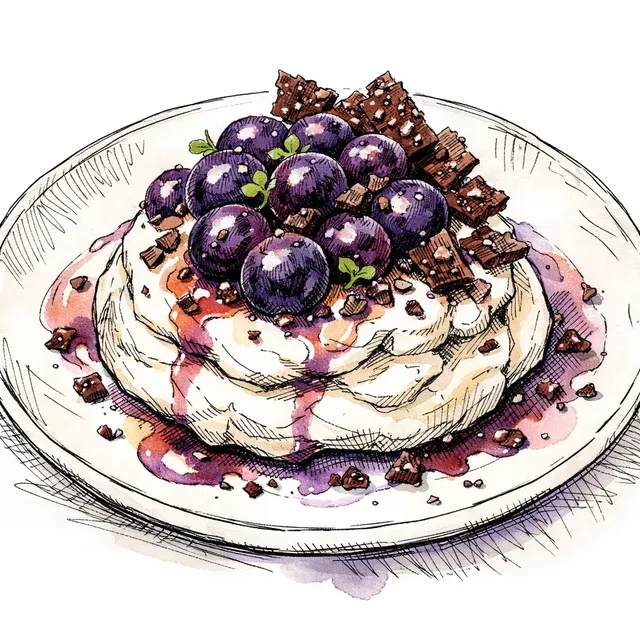
Cold-Infused Concord Grape Pavlova with Salted Labneh & Cocoa Nib Crackle
Concord grapes have a loud, unapologetic perfume that reminds me of autumn kitchens in upstate New York. For years, I watched pastry chefs boil that electric fruit into submission, losing its raw soul to heat. I wanted something cleaner. By cold-macerating the grapes, we capture that bright floral punch without the jammy dullness. Precision is freedom, and letting the refrigerator do the heavy lifting changes everything. Paired with a brown sugar pavlova—shatteringly crisp outside, marshmallow-soft within—and anchored by salted labneh, this dessert is a masterclass in contrast. The labneh brings necessary tang, while roasted cocoa nibs and flaky salt deliver the bitter snap and crunch it all demands. We are not adding steps here; we are simply making better decisions. Let your meringue cool completely. Future you deserves clean slices, and your guests deserve a dessert that tastes like modern minimalism done right. Make it your own by swapping the labneh for thick Greek yogurt if you need to, but keep the salt and the crunch. Contrast is the secret ingredient.
Featured Recipe
Cold-Infused Concord Grape Pavlova with Salted Labneh & Cocoa Nib Crackle
A shatteringly crisp brown sugar pavlova with a marshmallow core, crowned with cold-infused Concord grapes and tangy salted labneh. Cold maceration extracts the grape's raw, electric floral perfume without the dullness of prolonged boiling. Finished with roasted cocoa nibs and flaky salt for unapologetic contrast.
Save a copy to your collection for editing
Timeline
Ingredients
- 500 g Concord grapes(stemmed, rinsed, and gently patted dry)
- 65 g granulated sugar(for macerating the grapes)
- 15 g verjus(or unseasoned rice vinegar)
- 2 fresh bay leaves(bruised slightly to release essential oils)
- 120 g egg whites(from about 4 large eggs, strictly room temperature)
- 2 g fine sea salt(divided: 1g for meringue, 1g for labneh)
- 1 g cream of tartar(for meringue structure)
- 150 g superfine sugar(caster sugar; dissolves smoothly)
- 50 g light brown sugar(adds subtle caramel depth and chew)
- 8 g cornstarch(ensures a tender, marshmallow interior)
- 200 g labneh(chilled; whole-milk Greek yogurt works if well-drained)
- 100 g heavy cream(cold, minimum 36% milk fat)
- 20 g roasted cocoa nibs(for crucial bitter, crunchy contrast)
- 2 g flaky sea salt(such as Maldon, for finishing)
Instructions
- 1
Set a clean glass bowl on your digital scale. Add 500g Concord grapes and gently press about half of them between your fingers to pop the skins. Pour in 65g granulated sugar, 15g verjus, and drop in 2 fresh bay leaves. Toss gently to coat, cover tightly with plastic wrap, label with painter's tape, and place in the refrigerator to cold-infuse for at least 2 hours (or overnight).
15 min
Tip: Do not puree or mash aggressively; you only want to burst the skins so osmotic pressure pulls out the vivid purple nectar cold.
- 2
Preheat your oven to 225°F (107°C) with a rack set in the center. Wipe your stand mixer bowl and whisk attachment with a paper towel dampened with lemon juice to remove stray fats. Add 120g egg whites, 1g fine sea salt, and 1g cream of tartar. Whip on medium-low speed until foamy, then increase to medium. Gradually rain in 150g superfine sugar and 50g light brown sugar one tablespoon at a time over 6 minutes. Once stiff, glossy peaks form, sift 8g cornstarch over the meringue and fold gently with a flexible spatula until homogenous.
15 min
Tip: Slow addition of sugar is non-negotiable. Rushing creates syrupy weeping in the oven. Precision is freedom.
- 3
Line a heavy half-sheet pan with parchment paper. Use a cake pan to trace an 8-inch (20 cm) circle on the underside of the paper. Dab a dot of meringue under each corner of the parchment to anchor it. Spoon the meringue into the center of the ring. Using an offset spatula, shape it into a neat disk with straight sides, forming a gentle crater in the center to hold the cream later. Transfer immediately to the oven and bake at 225°F (107°C) for 75 minutes without opening the door.
75 min
Tip: Resist opening the oven door during baking. The low, dry heat needs uninterrupted consistency to dehydrate the shell while preserving the soft core.
- 4
When the 75-minute timer sounds, turn the oven completely off. Prop the oven door open slightly with the handle of a wooden spoon. Let the pavlova cool undisturbed inside the cooling oven for 60 minutes.
60 min
Tip: Thermal shock causes meringue collapses. Let it cool slowly—future you deserves clean slices.
- 5
While the pavlova cools, set a fine-mesh strainer over a bowl. Pour the cold-infused grapes into the strainer, collecting the electric purple cold juice below. Transfer the drained grape solids to a small saucepan. Simmer over medium-low heat for 6 minutes, stirring gently until the skins soften and release natural pectin. Remove from heat, pluck out and discard the 2 fresh bay leaves, and let the cooked grapes cool for 10 minutes. Stir the warm jammy fruit back into the raw, cold-infused juice to unite deep jam and bright raw acidity.
15 min
Tip: Keeping half the juice raw preserves the volatile floral compounds that boiling normally obliterates.
- 6
In a chilled mixing bowl, combine 200g labneh, 100g heavy cream, and the remaining 1g fine sea salt. Whisk steadily by hand until soft, billowy peaks form that hold their shape on a spoon without separating.
10 min
Tip: Stop whisking the moment you hit soft peaks; the acidity in labneh can cause over-whipped cream to turn grainy quickly.
- 7
Carefully slide the fully cooled pavlova onto a flat serving board or cake plate. Spoon the whipped salted labneh into the center crater, smoothing it toward the edges. Ladle the cold-infused Concord grape compote and its glossy syrup directly over the labneh. Scatter 20g roasted cocoa nibs and 2g flaky sea salt evenly across the top, and serve immediately.
10 min
Tip: Assemble just before serving. A pavlova holds its crispness for about 45 minutes once crowned with cream.
Chef's Notes
Why this works: Concord grapes are famous for two things: an intoxicating, wild floral perfume and an aggressively high sugar content. Standard cooking boils away those volatile top notes, reducing Concords to one-note grape jelly. Cold-infusing the skins with a hint of verjus and bay leaves draws out the raw ruby pigments and fragrant acidity without heat damage. Simmering just the solids blooms the pectin, and reuniting them delivers maximum fruit expression. Pair that with cold salted labneh instead of sweetened whipped cream, and suddenly you have genuine tension against the brown sugar meringue. Contrast is the secret ingredient. Fix it fast: If your pavlova develops a hairline crack while cooling, don't panic. The center is meant to sink slightly to form a nest for the labneh. If your labneh mixture feels a little stiff before plating, whisk in one additional tablespoon of cold heavy cream to loosen it to silk.

Theo Glass
Modern desserts, minimal fuss, maximum contrast.
Theo Glass—known as “The Minimalist Sweet Tooth”—is a calm, detail-obsessed pastry coach who left the white-tablecloth intensity of fine dining for the reality (and joy) of home kitchens. After years of building plated desserts with tweezers and timers, he realized the real magic wasn’t complicated garnish work—it was contrast, clarity, and control. Theo’s mission now is to help everyday bakers make desserts that feel modern and restaurant-level without turning their kitchen into a war zone. His style is precision with restraint: olive oil cakes that stay plush for days, tahini brownies that walk the line between nutty and bittersweet, miso custards that taste like “caramel’s smarter cousin,” and citrus-forward sorbets that pop without needing an ice-cream machine. Theo teaches fundamentals (emulsions, temperature, texture, salinity) in plain language, with steps that are clean, paced, and confidence-building. If you’ve ever said “I want to mix it up” but don’t want extra dishes, obscure tools, or chaos, Theo’s your person. He’ll show you how to mix it up the minimalist way: a smarter ingredient swap, a sharper contrast, and a clear path to repeatable results.