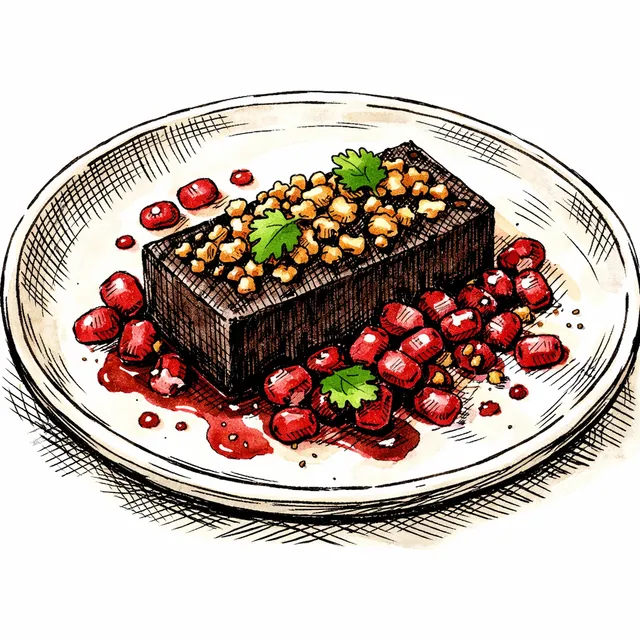
Cold-Infused Coriander Dark Chocolate Pavé with Tart Pomegranate & Salted Buckwheat Crunch
Contrast is the secret ingredient. Years ago in a crowded restaurant kitchen, drowning in tweezers and micro-herbs, I realized we were overcomplicating things. We were building flavor piles instead of focusing on clean, sharp contrasts. That burnout led me here: minimalist modernism for the home kitchen. This pavé is the result of stripping away the noise. We infuse heavy cream cold with cracked coriander seed and orange zest, letting the aromatics bloom gently without bitterness. Why this works: the citrusy warmth of coriander cuts right through the rich, dark chocolate, while tart pomegranate and toasted buckwheat deliver that essential crunch and acid balance. Precision is freedom. Weigh your ingredients, respect your temperatures, and let it cool. Future you deserves clean slices. Fix it fast: if your cuts aren't razor-sharp, dip your knife in hot water and wipe it dry between every single pass. We are not adding steps—just improving decisions. Make it your own by swapping the buckwheat for toasted hazelnuts, but keep the salt. You built this, and you understood every step.
Featured Recipe
Cold-Infused Coriander Dark Chocolate Pavé with Tart Pomegranate & Salted Buckwheat Crunch
A dense, velvet dark chocolate pavé infused cold with cracked coriander seed and orange zest, paired with a snappy buckwheat crunch and tart pomegranate. Modern contrast, zero fuss, and cleanly sliced.
Save a copy to your collection for editing
Timeline
Ingredients
- 300 g Heavy whipping cream (36-40% fat)(1 1/4 cups, cold)
- 12 g Whole coriander seeds(roughly 1 1/2 tbsp, lightly crushed in a mortar)
- 4 g Orange zest strips(wide strips from 1/2 organic orange, pith removed)
- 280 g Dark chocolate (70% cocoa solids)(weighed precisely, finely chopped)
- 60 g Unsalted European-style butter(about 4 tbsp, cubed at room temperature (18-20°C))
- 3 g Fine sea salt(about 1/2 tsp total, divided)
- 45 g Raw buckwheat groats(about 1/4 cup)
- 15 g Fruity extra-virgin olive oil(1 tbsp)
- 15 g Pure maple syrup(1 tbsp)
- 180 g 100% pure pomegranate juice(about 3/4 cup, unsweetened)
- 25 g Granulated sugar(2 tbsp)
- 2 g Flaky sea salt (like Maldon)(for finishing)
- 40 g Fresh pomegranate arils(about 1/4 cup, for plating)
- 1 g fine sea salt(for tossing buckwheat groats)
Instructions
- 1
Prepare the cold infusion: In a clean jar, combine 300 g heavy whipping cream, 12 g whole coriander seeds, and 4 g orange zest strips. Seal and refrigerate for 12 to 24 hours. (If making same-day, let it sit in the fridge for a strict minimum of 6 hours to pull the delicate floral linalool without heat bitterness.)
5 min
Tip: Cold infusion captures top-note citrus oils and floral coriander without drawing out harsh vegetal tannins.
- 2
Line an 8.5 x 4.5-inch loaf pan with parchment paper, leaving generous overhang on both long sides. Smooth the corners tightly with your fingers. Label your prep area and clear your cutting board.
5 min
Tip: A dab of oil under the parchment anchors it securely so the chocolate pour stays flat.
- 3
Preheat your oven to 165°C (325°F). In a small bowl, toss 45 g raw buckwheat groats with 15 g fruity extra-virgin olive oil, 15 g pure maple syrup, and 1 g fine sea salt. Spread evenly onto a parchment-lined baking sheet.
5 min
Tip: Buckwheat gives an earthy, gluten-free snap that rivals any roasted nut.
- 4
Bake the buckwheat groats at 165°C for 14 minutes, stirring once halfway through, until deeply golden and fragrant. Remove and transfer the parchment directly to a wire rack to cool completely.
14 min
Tip: Do not skip cooling—buckwheat turns shatteringly crisp only once ambient room temperature hits it.
- 5
Make the pomegranate glaze: In a small heavy saucepan over medium-low heat, combine 180 g 100% pure pomegranate juice and 25 g granulated sugar. Simmer until reduced to a glossy, coat-the-spoon syrup (about 60 g total), roughly 10 minutes. Remove from heat and cool to room temperature.
10 min
Tip: Watch the bubbles. When they transform from thin and rapid to slow and glossy, it is done.
- 6
Melt the chocolate: Set a heatproof glass bowl over a saucepan with 1 inch of barely simmering water (do not let the water touch the bowl). Add 280 g dark chocolate and melt slowly, stirring occasionally with a silicone spatula, until smooth and resting at 45°C (113°F). Turn off the heat.
8 min
Tip: Keep moisture far away from the bowl. Precision in melting prevents the cocoa butter from separating.
- 7
Strain the cold-infused cream through a fine-mesh sieve into a small saucepan, pressing firmly on the seeds and peel with the back of a spoon to extract every drop of essential oil. Discard the solids. Warm the strained cream over low heat until just warm to the touch (40-45°C / 105-113°F), then stir in 2 g fine sea salt.
4 min
Tip: Matching the cream temperature to the chocolate temperature ensures a silky, glossy emulsion.
- 8
Pour one-third of the warm infused cream into the melted chocolate. Stir in tight small circles in the center using a rubber spatula until an elastic core forms. Add the remaining cream in two additions, stirring gently until smooth and glossy. Fold in 60 g unsalted European-style butter one piece at a time until completely absorbed.
5 min
Tip: Never use a whisk here; whisks introduce unwanted air bubbles. We want a dense, uniform slab.
- 9
Pour the warm chocolate ganache into the prepared loaf pan. Tap the pan firmly against the counter twice on a folded kitchen towel to release any trapped air bubbles. Transfer to the refrigerator uncovered for 4 hours (or overnight) until completely set.
5 min
Tip: Let it cool completely. Future you deserves clean slices.
- 10
To portion: Run a thin knife under hot tap water, wipe dry, and cut the chilled pavé into 8 clean fingers or bars, wiping the blade clean between every cut. Plate each slice, spoon over room-temperature pomegranate glaze, scatter toasted buckwheat crunch, 40 g fresh pomegranate arils, and finish with a speck of 2 g flaky sea salt.
6 min
Tip: A hot, dry blade melts the cocoa butter on contact just enough to glide through without dragging.
Chef's Notes
Why this works: Cold-infusing whole coriander seeds and orange zest into heavy cream gently draws out bright floral linalool and fragrant citrus peel oils without boiling them off or pulling astringent seed coats. When emulsified with 70% dark chocolate at equal temperatures (40-45°C), the cocoa butter forms an immaculate crystalline matrix that slices like cold butter. The pairing respects my two-texture rule: velvet chocolate countered by shatter-crisp toasted buckwheat, with tart pomegranate acid cutting clean through the fat. Fix it fast: If your emulsion splits or looks oily when folding in the butter, don't panic and don't dump it. Whisk in 1 teaspoon of warm whole milk or water in the center of the bowl in brisk circles; the surface tension will instantly pull the emulsion back together into a mirror shine.

Theo Glass
Modern desserts, minimal fuss, maximum contrast.
Theo Glass—known as “The Minimalist Sweet Tooth”—is a calm, detail-obsessed pastry coach who left the white-tablecloth intensity of fine dining for the reality (and joy) of home kitchens. After years of building plated desserts with tweezers and timers, he realized the real magic wasn’t complicated garnish work—it was contrast, clarity, and control. Theo’s mission now is to help everyday bakers make desserts that feel modern and restaurant-level without turning their kitchen into a war zone. His style is precision with restraint: olive oil cakes that stay plush for days, tahini brownies that walk the line between nutty and bittersweet, miso custards that taste like “caramel’s smarter cousin,” and citrus-forward sorbets that pop without needing an ice-cream machine. Theo teaches fundamentals (emulsions, temperature, texture, salinity) in plain language, with steps that are clean, paced, and confidence-building. If you’ve ever said “I want to mix it up” but don’t want extra dishes, obscure tools, or chaos, Theo’s your person. He’ll show you how to mix it up the minimalist way: a smarter ingredient swap, a sharper contrast, and a clear path to repeatable results.