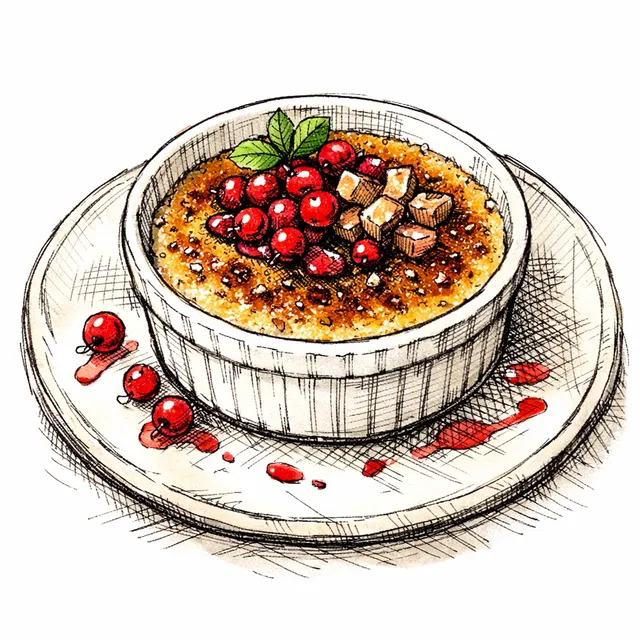
Cold-Infused Roasted Chestnut Crème Brûlée with Tart Lingonberry
When I left fine dining, I wanted desserts that felt luxurious without requiring a tiny tweezer to assemble. This chestnut crème brûlée was born in my home kitchen on a freezing November evening. Roasting chestnuts smells like old European street corners, but traditional chestnut desserts often turn heavy and pasty. By cold-infusing the cream with roasted chestnuts overnight, we capture that honeyed, toasted essence cleanly, leaving the starch behind. Precision is freedom here; weigh your ingredients and respect the oven temperature. We top it with a sharp, acid-driven lingonberry spoon-over because sugar needs friction to shine. Contrast is the secret ingredient. Make it your own by swapping the lingonberry for redcurrant or even a tart cherry reduction if that is what is in your pantry. Let it chill properly. Future you deserves clean slices and a dessert that tastes like you spent all day in a Michelin-starred kitchen, even if you were just wearing sweatpants.
Featured Recipe
Cold-Infused Roasted Chestnut Crème Brûlée with Tart Lingonberry
A velvety, restaurant-grade custard where slow cold-infusion draws out the toasted, honeyed essence of chestnuts without the heavy starch. Paired against a shattering caramelized sugar crust and a sharp, acid-driven lingonberry spoon-over, this dessert delivers maximum contrast with zero wasted effort.
Save a copy to your collection for editing
Timeline
Ingredients
- 200 g roasted chestnuts(peeled, vacuum-packed or freshly roasted, roughly crushed)
- 400 g heavy cream(36% milkfat)
- 150 g whole milk(cold)
- 90 g egg yolks(about 5 large yolks, room temperature)
- 65 g granulated sugar(for the custard base)
- 1.5 g fine sea salt(approx 1/4 tsp)
- 2 g vanilla bean paste(approx 1/2 tsp)
- 30 g granulated sugar(for torching the crust)
- 120 g lingonberries(fresh or frozen (can substitute unsweetened cranberries))
- 35 g granulated sugar(for the lingonberry compote)
- 30 g water(2 tbsp)
- 1 g orange zest(finely microplaned)
- 1 g flaky sea salt(Maldon, for finishing)
- 7.5 g granulated sugar(for torching)
Instructions
- 1
Roughly crush 200g roasted chestnuts into coarse, pebble-sized pieces. Place them into a clean container, pour in 400g heavy cream and 150g whole milk, press the chestnuts beneath the liquid surface, seal tightly, and chill in the refrigerator for 12 to 16 hours to cold-infuse.
10 min
Tip: Why this works: Hot steeping dissolves chestnut starches into the dairy, leaving the custard gluey and muddy. Cold infusion pulls out only the volatile roasted aromatics, nut oil, and delicate sugars, giving you a remarkably silky texture.
- 2
Set a fine-mesh sieve over a bowl and strain the mixture to remove the solids. Gently press the chestnuts with the back of a silicone spatula to extract the clinging cream, but do not force solids through. You should have 480g of infused liquid; top up with a splash of fresh cold milk if slightly short.
5 min
Tip: Do not squeeze too aggressively; we want the clean, fragrant fats, not a puree.
- 3
Preheat your oven to 150°C (300°F). In a medium bowl, gently whisk 90g egg yolks, 65g granulated sugar, 1.5g fine sea salt, and 2g vanilla bean paste until homogeneous and the sugar begins to dissolve—about 45 seconds without whipping air. Slowly pour in the strained chestnut dairy while whisking gently. Strain the custard through a fine sieve into a measuring pitcher to pop bubbles.
10 min
Tip: Whisk low and slow. Air bubbles create a spongy surface rather than a glassy, mirror-smooth bake.
- 4
Place four shallow 150ml (5 oz) ceramic ramekins into a high-sided roasting pan lined with a clean kitchen towel. Divide the custard evenly among the ramekins. Pour boiling water into the roasting pan until it reaches halfway up the ramekin sides. Bake at 150°C (300°F) for 35 to 40 minutes, until the edges are set and the center retains a gentle, uniform jiggle (internal temp should read 82°C / 180°F).
40 min
Tip: The kitchen towel insulates the bottoms of the ramekins from direct metal heat, preventing overcooking and rubbery rims.
- 5
While the custards bake, combine 120g lingonberries, 35g granulated sugar, 30g water, and 1g orange zest in a small saucepan over medium heat. Bring to a gentle simmer for 4 to 5 minutes until berries burst slightly and the syrup thickens into a glossy, loose spoonable glaze. Remove from heat and chill.
10 min
Tip: One-contrast upgrade: Chestnuts carry deep, sweet autumn earthiness. Lingonberry acidity pierces right through the dairy richness.
- 6
Carefully remove the ramekins from the water bath and set them on a wire rack to cool to room temperature (about 30 minutes). Once cooled, transfer them uncovered to the refrigerator to chill completely for at least 2 hours.
120 min
Tip: Let it cool. Future you deserves clean cuts. Torching a warm custard will melt the interior into soup.
- 7
Just before serving, blot any surface moisture with a paper towel. Sprinkle an even 7.5g granulated sugar (from the total 30g granulated sugar) over each custard. Torch with a kitchen blowtorch using circular motions until amber and bubbling. Let rest 2 minutes to crystallize, then top with a spoonful of cold lingonberry compote and a tiny pinch of 1g flaky sea salt.
10 min
Tip: Two thin layers of sugar torched sequentially will yield a cleaner, more delicate glass shatter than one thick heap.
Chef's Notes
Why this works: Chestnut custards are infamous for feeling starchy or heavy when cooked down in a saucepan. Cold infusion extracts pure roasted aroma and nut oils into the dairy fats without softening the cellular starch into paste. Fix it fast: If your custard bubbles or curdles at the edges, your oven runs hot; drop the temperature to 135°C (275°F) next time and rely on the internal thermometer reading of 82°C (180°F). Precision is freedom.

Theo Glass
Modern desserts, minimal fuss, maximum contrast.
Theo Glass—known as “The Minimalist Sweet Tooth”—is a calm, detail-obsessed pastry coach who left the white-tablecloth intensity of fine dining for the reality (and joy) of home kitchens. After years of building plated desserts with tweezers and timers, he realized the real magic wasn’t complicated garnish work—it was contrast, clarity, and control. Theo’s mission now is to help everyday bakers make desserts that feel modern and restaurant-level without turning their kitchen into a war zone. His style is precision with restraint: olive oil cakes that stay plush for days, tahini brownies that walk the line between nutty and bittersweet, miso custards that taste like “caramel’s smarter cousin,” and citrus-forward sorbets that pop without needing an ice-cream machine. Theo teaches fundamentals (emulsions, temperature, texture, salinity) in plain language, with steps that are clean, paced, and confidence-building. If you’ve ever said “I want to mix it up” but don’t want extra dishes, obscure tools, or chaos, Theo’s your person. He’ll show you how to mix it up the minimalist way: a smarter ingredient swap, a sharper contrast, and a clear path to repeatable results.