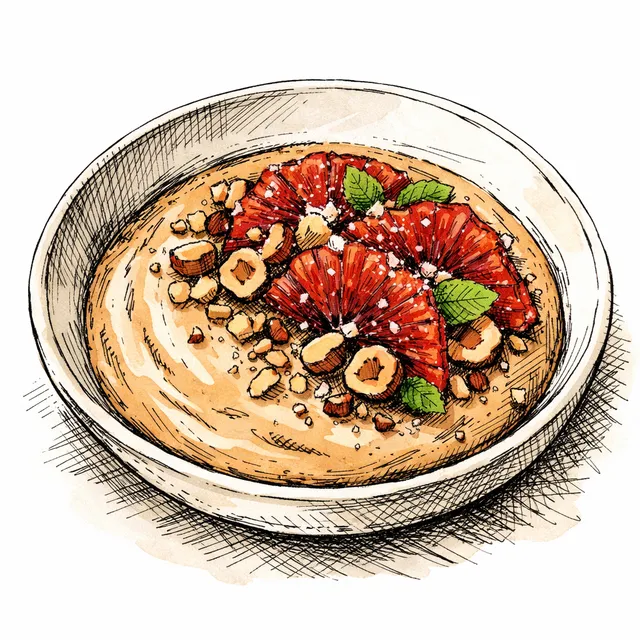
Cold-Infused Roasted Hazelnut Budino with Tart Blood Orange & Flaky Salt
Back in my fine-dining days, we used to overcomplicate every custard on the menu. It took burning out to realize that purity beats pretense every single time. This budino was born from a quiet afternoon in my home kitchen when I wanted that deep, round nuttiness of roasted hazelnuts without the harsh tannins that high heat brings. So, we steep them cold. Precision is freedom, and letting the dairy do the heavy lifting overnight changes everything. We cut the buttery richness with a sharp crown of fresh blood orange and crushed hazelnut crunch, hitting our two-texture rule with absolute precision. Contrast is the secret ingredient. Make it your own by swapping the blood orange for tart yuzu or Meyer lemon depending on what looks best at the market. Let it chill properly. Future you deserves clean slices and zero fuss.
Featured Recipe
Cold-Infused Roasted Hazelnut Budino with Tart Blood Orange & Flaky Salt
A velvety Italian pudding steeped cold with crushed roasted hazelnuts for pure, round nuttiness without the harsh tannins of high heat. We cut the buttery richness with a sharp crown of fresh blood orange and crushed hazelnut crunch, hitting the two-texture rule with absolute precision. Minimal active effort, restaurant-level finish, and zero fuss.
Save a copy to your collection for editing
Timeline
Ingredients
- 400 g Whole milk(approx. 1 2/3 cups)
- 200 g Heavy cream(36% fat; approx. 3/4 cup plus 1 tbsp)
- 150 g Roasted hazelnuts(unsalted; 120 g coarsely cracked for infusion, 30 g finely chopped for garnish)
- 100 g Dark brown sugar(approx. 1/2 cup packed)
- 32 g Cornstarch(approx. 1/4 cup)
- 2 g Fine sea salt(approx. 1/2 tsp)
- 4 large Egg yolks(approx. 72 g)
- 40 g Unsalted butter(cold and cubed into small pieces; approx. 3 tbsp)
- 5 g Pure vanilla extract(approx. 1 tsp)
- 2 medium Blood oranges(zested then segmented into clean supremes)
- 1 g Flaky sea salt(Maldon or similar, for finishing)
- 30 g roasted hazelnuts(finely chopped, for topping)
Instructions
- 1
Place 120 g roasted hazelnuts into a zip-top bag and crack them coarsely with a rolling pin. In a 1-quart glass container, combine 400 g whole milk and 200 g heavy cream. Add the cracked hazelnuts, stir once, seal tightly, and chill in the refrigerator for at least 12 hours (up to 24 hours).
5 min
Tip: Do not blitz the nuts to a powder—cracked pieces yield clean, aromatic dairy without turning the liquid muddy or cloudy.
- 2
Set a fine-mesh sieve over a bowl and strain the chilled hazelnut dairy, pressing lightly on the solids with a flexible spatula to release every drop of infused liquid. Discard the spent hazelnut solids.
3 min
Tip: Wipe your counter before starting the cook. Precision begins with an uncluttered station.
- 3
In a medium heavy-bottomed saucepan off the heat, whisk together 100 g dark brown sugar, 32 g cornstarch, and 2 g fine sea salt. Whisk in about 100 g of the strained hazelnut dairy until the starch is completely dissolved, whisk in the 4 large egg yolks, then pour in the remainder of the strained hazelnut dairy until smooth.
3 min
Tip: Dissolving starch in cool liquid first prevents stubborn clumps. We are not adding steps—just improving decisions.
- 4
Place the saucepan over medium heat. Whisk steadily across the bottom and corners of the pot. When the mixture begins to simmer and thicken, look for heavy volcanic bubbles breaching the surface, then set a timer and cook for exactly 60 seconds while whisking continuously before pulling off the heat.
6 min
Tip: Boiling for a full minute deactivates the amylase enzyme in the yolks, ensuring your budino will not thin out after chilling.
- 5
Immediately add 40 g unsalted butter and 5 g pure vanilla extract to the hot pan. Whisk gently until the butter melts and emulsifies completely into a glossy, satin-smooth custard.
2 min
Tip: Mounting cold butter off the flame provides the signature elastic sheen of a classic Italian budino.
- 6
Pour the warm custard into 4 low tumblers or coupe glasses (approx. 140 g per portion). Press a small piece of plastic wrap directly onto the surface of each budino to prevent a skin. Chill in the refrigerator for at least 3 hours until firmly set and thoroughly cold.
4 min
Tip: Let it cool. Future you deserves clean spoonfuls and a flawless temperature drop.
- 7
While the puddings chill, finely grate 1 tsp zest from the 2 blood oranges, then slice away the peel and white pith completely. Segment the oranges by cutting between the membranes, letting the clean segments drop into a small bowl along with their juice and the reserved zest.
5 min
Tip: Removing all white pith guarantees pure, vivid acidity that will cleanly puncture the rich hazelnut dairy.
- 8
Peel back the plastic wrap from each chilled budino. Crown each glass with blood orange segments and a spoonful of juice. Top with the reserved 30 g roasted hazelnuts (finely chopped) and finish with a pinch of 1 g flaky sea salt.
3 min
Tip: Serve immediately. The contrast between cold, silky pudding, crisp warm-roasted nuts, and bracing citrus is the whole point.
Chef's Notes
Why this works: Cold-infusing cracked roasted hazelnuts pulls out warm, volatile praline aromatics without extracting the harsh, dry tannins lingering in the skins. Mounting cold butter into the hot cornstarch pudding creates a velvety emulsion that sets with a soft spoon-coating texture. Fix it fast: If you detect even a single starch lump after cooking, pour the warm pudding through a fine-mesh sieve directly into your serving glasses before chilling. Precision is freedom, and contrast is the secret ingredient.

Theo Glass
Modern desserts, minimal fuss, maximum contrast.
Theo Glass—known as “The Minimalist Sweet Tooth”—is a calm, detail-obsessed pastry coach who left the white-tablecloth intensity of fine dining for the reality (and joy) of home kitchens. After years of building plated desserts with tweezers and timers, he realized the real magic wasn’t complicated garnish work—it was contrast, clarity, and control. Theo’s mission now is to help everyday bakers make desserts that feel modern and restaurant-level without turning their kitchen into a war zone. His style is precision with restraint: olive oil cakes that stay plush for days, tahini brownies that walk the line between nutty and bittersweet, miso custards that taste like “caramel’s smarter cousin,” and citrus-forward sorbets that pop without needing an ice-cream machine. Theo teaches fundamentals (emulsions, temperature, texture, salinity) in plain language, with steps that are clean, paced, and confidence-building. If you’ve ever said “I want to mix it up” but don’t want extra dishes, obscure tools, or chaos, Theo’s your person. He’ll show you how to mix it up the minimalist way: a smarter ingredient swap, a sharper contrast, and a clear path to repeatable results.