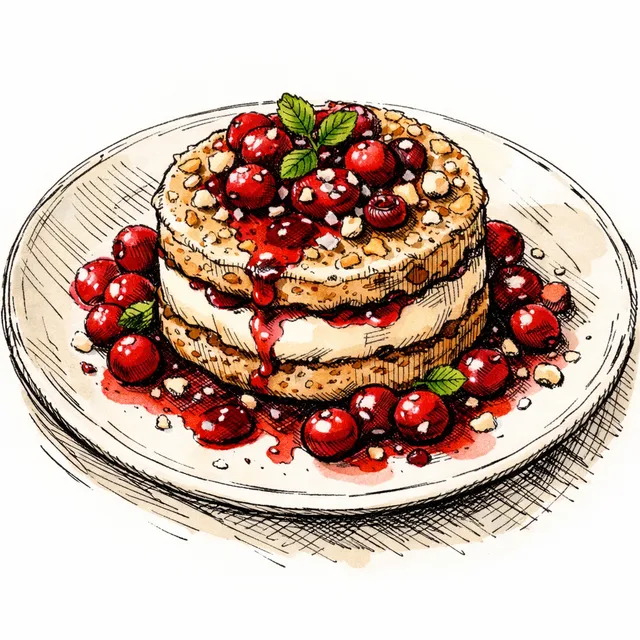
Cold-Infused Roasted Hazelnut Dacquoise with Tart Cranberry & Flaky Salt
When I left fine dining, I wanted to strip away the noise. No crowded plates, just sharp choices. This dacquoise is the result of a late-night craving in my home kitchen, staring at a bag of leftover hazelnuts and wondering why we usually steep warm cream instead of playing the long game. Cold-infusing milk with deeply roasted hazelnuts overnight changes everything—it pulls out a clean, toasted depth without any cooked-dairy heaviness. Stacking those crisp-chewy hazelnut meringues with a velvet mousseline felt right, but it needed a knife to cut through the richness. Enter a thin ribbon of tart autumn cranberry gel and a deliberate crackle of flaky sea salt. Contrast is the secret ingredient. Precision is freedom here—weigh your ingredients, respect your temperatures, and let it chill properly. Future you deserves clean slices. Want to make it your own? Swap the cranberry for sharp red currant or yuzu curd if you prefer citrus over autumn fruit. We are not adding steps—just improving decisions.
Featured Recipe
Cold-Infused Roasted Hazelnut Dacquoise with Tart Cranberry & Flaky Salt
Crisp-chewy hazelnut meringue stacked with a velvet mousseline made from milk cold-infused with deeply roasted hazelnuts. A thin ribbon of tart autumn cranberry gel and a crackle of flaky sea salt cut straight through the rich, buttery nuttiness.
Save a copy to your collection for editing
Timeline
Ingredients
- 270 g Roasted hazelnuts(Deeply roasted and skinned; split into 150g crushed for infusion, 90g finely ground for meringue, and 30g chopped for garnish)
- 400 g Whole milk(Cold; yields roughly 300g after straining nuts)
- 120 g Egg whites(From about 4 large eggs, at room temperature)
- 75 g Egg yolks(From about 4 large eggs)
- 200 g Granulated sugar(Split into 100g for meringue, 60g for pastry cream, 40g for cranberry gel)
- 30 g Powdered sugar(Sifted)
- 20 g All-purpose flour(Provides structural resilience to the meringue)
- 25 g Cornstarch(For thickening the pastry cream)
- 140 g Unsalted European butter(82% butterfat, tempered precisely to 19°C / 66°F)
- 150 g Fresh cranberries(Fresh or frozen)
- 1 tsp Orange zest(Finely grated on a microplane)
- 1 tsp Lemon juice(Freshly squeezed for crisp acidity)
- 45 g Water(About 3 tablespoons)
- 0.5 tsp Vanilla bean paste(Or pure vanilla extract)
- 0.5 tsp Fine sea salt(Split: 1/4 tsp for dacquoise, 1/4 tsp for pastry cream)
- 0.25 tsp Flaky sea salt(Maldon or similar, for finishing)
- 150 g roasted hazelnuts, crushed(Mentioned in Step 1 for infusing milk)
- 40 g granulated sugar(Mentioned in Step 2 for cranberry compote)
- 1/4 tsp fine sea salt(Mentioned in Step 3 for custard)
- 100 g granulated sugar(Mentioned in Step 4 for meringue)
- 90 g finely ground roasted hazelnuts(Mentioned in Step 4 for dacquoise)
- 1/4 tsp fine sea salt(Mentioned in Step 4 for dacquoise)
- 30 g roasted hazelnuts, chopped(Mentioned in Step 8 for topping)
Instructions
- 1
Pour 400g whole milk through a fine-mesh sieve set over a bowl to strain out 150g roasted hazelnuts, crushed that have cold-infused in the refrigerator for 16 to 24 hours. Press gently on the solids with a rubber spatula to yield exactly 300g cold-infused hazelnut milk. Discard the spent nut solids, wipe down your counter, and set the infused milk aside.
5 min
Tip: Do not aggressively crush the nuts during straining or you will introduce cloudy grit to the milk. Gentle gravity does the work.
- 2
In a small saucepan, combine 150g fresh cranberries, 40g granulated sugar, 45g water, 1 tsp orange zest, and 1 tsp lemon juice. Bring to a simmer over medium heat. Cook until the cranberries burst and collapse into a thick, glossy jam, about 6 minutes. Puree with an immersion blender until smooth, push through a fine sieve into a shallow container, and transfer to the freezer to chill rapidly down to room temperature.
10 min
Tip: Spreading the pureed gel across a wide, shallow container cuts cooling time in half.
- 3
In a medium heatproof bowl, whisk 75g egg yolks, 60g granulated sugar, 25g cornstarch, 1/4 tsp fine sea salt, and 1/2 tsp vanilla bean paste until pale and homogenous. In a saucepan, bring 300g cold-infused hazelnut milk to a bare simmer over medium-low heat. Slowly pour half of the hot milk into the yolk mixture while whisking constantly to temper. Return the entire mixture to the saucepan and cook, whisking vigorously, until the custard bubbles and thickens into a glossy, dense cream, about 2 minutes. Scrape into a clean bowl, press plastic wrap directly onto the surface, and let cool until it registers 20°C (68°F).
12 min
Tip: Temperature matching is non-negotiable here. If this custard is warmer than 22°C when beaten with butter later, the mousseline will break.
- 4
Preheat your oven to 165°C (325°F). Line a large half-sheet pan with parchment paper and draw two 18x18 cm (7x7 inch) squares on the reverse side. In a completely clean metal bowl, whip 120g egg whites on medium speed until foamy. Gradually stream in 100g granulated sugar in three additions, increasing to medium-high until you hit stiff, glossy peaks. Gently fold in 90g finely ground roasted hazelnuts, 30g powdered sugar, 20g all-purpose flour, and 1/4 tsp fine sea salt using a flexible spatula in broad, sweeping motions just until no dry pockets remain. Transfer to a piping bag fitted with a 12mm round tip and pipe concentric coils inside each marked square.
12 min
Tip: Treat the meringue with respect. Overfolding deflates the air pockets that give dacquoise its characteristic chewy interior.
- 5
Bake the piped dacquoise squares at 165°C (325°F) for 18 minutes until lightly browned and dry to the touch on the surface, but still yielding slightly when pressed in the center. Transfer the sheet pan to a wire rack and let the layers cool completely in their skins.
18 min
Tip: Do not attempt to peel dacquoise off parchment while warm. It releases effortlessly once chilled and set.
- 6
Place 140g unsalted European butter (at 19°C / 66°F) into the bowl of a stand mixer fitted with the paddle attachment. Beat on medium-high speed for 3 minutes until pale, creamy, and aerated. Switch to the whisk attachment. With the mixer running on medium speed, add the cooled hazelnut pastry cream (at 20°C) one tablespoon at a time, allowing each addition to fully incorporate before adding the next. Once fully combined, whip on high for 60 seconds until the mousseline is silky, pale, and holds firm structural peaks. Transfer to a piping bag fitted with a plain round tip.
10 min
Tip: If your butter and pastry cream are both within 1°C of 20°C, this emulsion happens instantly without curdling.
- 7
Carefully peel the cooled dacquoise squares from the parchment. Using a sharp serrated knife and a gentle sawing motion, trim the edges of each square so you have two clean 16x16 cm (6.5x6.5 inch) cake tiles. Wipe your blade between every cut.
8 min
Tip: Save the trimmed dacquoise shards for personal snacking. Cook's privilege.
- 8
Set the first dacquoise square onto a small serving board or plate. Pipe half of the hazelnut mousseline evenly across the surface in neat dots or strips. Smooth gently with a small offset spatula. Spread the chilled cranberry gel evenly over the mousseline, stopping 5mm shy of the edges. Gently place the second dacquoise square on top, pressing lightly to level. Pipe the remaining mousseline over the top layer in smooth, clean lines. Scatter 30g roasted hazelnuts, chopped across the top and finish with 0.25 tsp flaky sea salt. Transfer to the refrigerator to chill for at least 3 hours before slicing.
12 min
Tip: Chilling allows the moisture from the mousseline to migrate into the dacquoise, turning it from brittle meringue into a tender, sliceable cake texture.
Chef's Notes
Why this works: Hot steeping roasted nuts tends to draw out aggressive, bitter tannins and heavy oils from the skins. Cold infusion extracts only pure, clean hazelnut aromatics directly into the milk's fat globules over 16-24 hours. The result is a mousseline that tastes like roasted hazelnut essence without muddy bitterness. The Two-Texture Rule: A proper dacquoise delivers a crisp crust and a chewy, macaron-like center. Paired with the velvet mousseline, you get instant structural contrast. The cranberry gel is our high-voltage acid contrast—without it, hazelnut on butter on sugar quickly tires the palate. Fix it fast: If your mousseline looks curdled or greasy while whipping, your butter was too cold or the custard was too warm. Hit the outside of the mixing bowl with a hairdryer on low for 10 seconds while whipping; the friction will re-emulsify the fats into velvet. If it feels too runny, pop the bowl into the fridge for 8 minutes, then re-whip. Precision is freedom: Weigh your ingredients. Respect the 20°C temperature rule for the butter and custard. Let the finished cake rest in the fridge for a full 3 hours. Future you deserves clean slices.

Theo Glass
Modern desserts, minimal fuss, maximum contrast.
Theo Glass—known as “The Minimalist Sweet Tooth”—is a calm, detail-obsessed pastry coach who left the white-tablecloth intensity of fine dining for the reality (and joy) of home kitchens. After years of building plated desserts with tweezers and timers, he realized the real magic wasn’t complicated garnish work—it was contrast, clarity, and control. Theo’s mission now is to help everyday bakers make desserts that feel modern and restaurant-level without turning their kitchen into a war zone. His style is precision with restraint: olive oil cakes that stay plush for days, tahini brownies that walk the line between nutty and bittersweet, miso custards that taste like “caramel’s smarter cousin,” and citrus-forward sorbets that pop without needing an ice-cream machine. Theo teaches fundamentals (emulsions, temperature, texture, salinity) in plain language, with steps that are clean, paced, and confidence-building. If you’ve ever said “I want to mix it up” but don’t want extra dishes, obscure tools, or chaos, Theo’s your person. He’ll show you how to mix it up the minimalist way: a smarter ingredient swap, a sharper contrast, and a clear path to repeatable results.