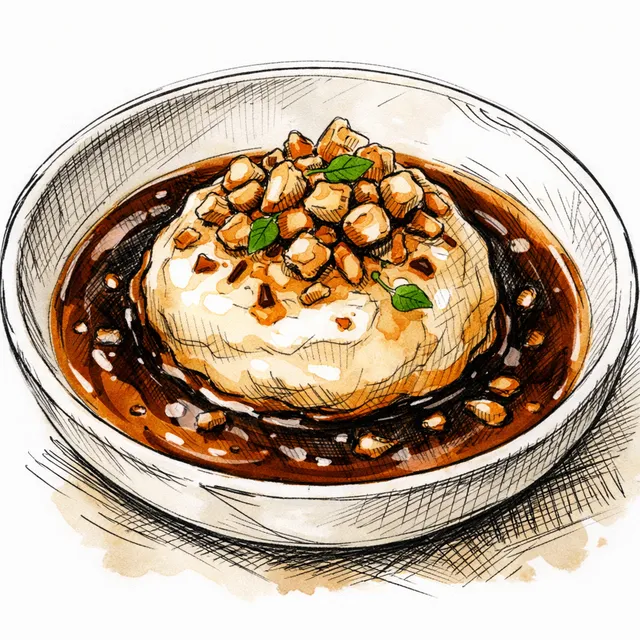
Cold-Infused Roasted Macadamia Île Flottante with Bittersweet Espresso Caramel
Precision is freedom. When I was running a frantic fine-dining pastry station, floating islands were often overbuilt with spun sugar and excessive garnish. I wanted to strip it back. This version comes from a quiet Sunday morning in my own kitchen, listening to rain tap the window, craving something impossibly light yet grounded in deep, autumnal warmth. We cold-steep the warm crème anglaise with deeply roasted macadamia nuts, letting the dairy absorb that buttery, toasted oil without muddying the texture. Why this works: the creamy, nutty custard meets feather-light baked meringue, anchored sharply by a bitter espresso caramel and a snap of flaky sea salt. Contrast is the secret ingredient. Fix it fast: if your caramel threatens to seize, drop the heat and whisk steadily. Weigh your ingredients. Respect the temperatures. Let it cool completely. Future you deserves clean slices and effortless elegance. We are not adding steps—just improving decisions. Make it your own by swapping the macadamias for toasted hazelnuts, but keep the espresso bite. You've got this.
Featured Recipe
Cold-Infused Roasted Macadamia Île Flottante with Bittersweet Espresso Caramel
Feather-light baked meringues float in a chilled crème anglaise cold-steeped with deeply roasted macadamia nuts. Finished with a bitter espresso caramel and flaky sea salt, it delivers clean late-fall warmth without heaviness.
Save a copy to your collection for editing
Timeline
Ingredients
- 200 g raw macadamia nuts(about 1 1/3 cups, whole or halves)
- 350 g whole milk(about 1 1/2 cups)
- 150 g heavy cream(about 2/3 cup, divided)
- 80 g egg yolks(from 4 large eggs)
- 160 g granulated sugar(about 3/4 cup plus 1 tbsp, divided)
- 120 g egg whites(from 4 large eggs, room temperature)
- 1/4 tsp cream of tartar(or 1/2 tsp fresh lemon juice)
- 45 g freshly brewed espresso(about 3 tbsp, warm)
- 1/2 tsp fine sea salt(divided)
- 1/4 tsp flaky sea salt(Maldon or similar, for finishing)
- 50 g heavy cream(Used in Step 7 for espresso caramel, but only 150g is listed.)
- 50 g granulated sugar(Used in Step 7 for espresso caramel, but only 160g is listed and subsequent steps use up the remaining amount.)
- 1/4 tsp fine sea salt(Used in Step 7 for espresso caramel, but only 1/2 tsp is listed and 1/4 tsp is used in Step 3.)
- 2 tablespoons water(Used in Step 7 for caramel.)
Instructions
- 1
Heat oven to 165°C (325°F). Spread 200 g raw macadamia nuts in an even layer on a rimmed baking sheet. Roast for 12 to 14 minutes, shaking the pan halfway through, until deep golden amber and fragrant. Transfer immediately to a cold plate to halt cooking. Reserve 40 grams of the roasted nuts for garnish; coarsely crush the remaining 160 grams.
15 min
Tip: Macadamias carry exceptionally high oil content. They turn from toasted to scorched in under two minutes, so rely on your timer and your nose.
- 2
In a clean glass container, combine the crushed 160 g roasted macadamias, 350 g whole milk, and 100 g heavy cream. Seal tightly with a lid, label with tape, and refrigerate for at least 8 hours (or up to 16 hours). Once steeped, pour the mixture through a fine-mesh sieve into a measuring bowl, pressing firmly on the nut solids to extract every gram of infused fat and flavor. Discard solids.
10 min
Tip: Cold-infusion pulls the buttery, roasted volatile aromatics without cooking the delicate milk sugars, eliminating any curdled or boiled-dairy profile.
- 3
Set a medium bowl over a damp towel. Whisk 80 g egg yolks, 50 g granulated sugar, and 1/4 tsp fine sea salt together until pale and slightly ribbony, about 90 seconds. Pour the strained macadamia dairy into a medium saucepan and warm over medium-low heat until steam rises and bubbles ring the perimeter (75°C / 167°F).
5 min
Tip: Tempering is non-negotiable. Cold eggs hit by hot dairy turn into scrambled egg soup; slow incorporation guarantees silk.
- 4
Slowly pour one-third of the hot dairy into the yolk mixture while whisking constantly. Pour the tempered mixture back into the saucepan. Cook over medium-low heat, stirring constantly in figure-eight motions with a heatproof spatula, until the custard reaches exactly 82°C (180°F) and coats the back of a spoon cleanly. Immediately strain into a clean bowl set over an ice bath, stirring until cool. Cover surface directly with plastic wrap and chill.
10 min
Tip: Keep your digital thermometer in the pan. At 82°C the custard thickens perfectly without curdling. Let it cool. Future you deserves clean, glossy spoons.
- 5
Adjust oven to 120°C (250°F). Lightly butter four 6-ounce ramekins and coat the interiors with a thin layer of sugar, knocking out excess. In a clean stand mixer bowl, whip 120 g egg whites with 1/4 tsp cream of tartar on medium speed until frothy. With the mixer running, add 60 g granulated sugar in a slow, steady stream over 1 minute. Increase to medium-high and whip until firm, glossy peaks form with soft curl tips.
8 min
Tip: Wipe your mixing bowl with a paper towel and a drop of lemon juice before starting to eliminate lingering grease that stalls volume.
- 6
Divide the meringue evenly among the four prepared ramekins, smoothing the tops with an offset spatula. Place ramekins in a deep roasting pan and pour boiling water into the pan until it reaches halfway up the ramekin sides. Bake at 120°C (250°F) for 20 minutes until puffed, dry to the touch, and softly set. Remove from water bath immediately and let cool to room temperature (about 15 minutes). Run a thin paring knife around edges to release.
35 min
Tip: Baking meringues in a low water bath creates an impossibly velvety, cloud-like texture without the rubberiness of boiling or microwaving.
- 7
While meringues cool, combine 50 g granulated sugar and 2 tablespoons of water in a small stainless steel saucepan. Cook over medium heat without stirring until the sugar dissolves and turns into a deep amber caramel (about 5-6 minutes). Remove from heat and slowly whisk in 45 g freshly brewed espresso, the remaining 50 g heavy cream, and 1/4 tsp fine sea salt. Swirl over low heat until smooth. Let cool to room temperature to thicken slightly.
10 min
Tip: Espresso cuts straight through the richness of dairy and toasted nut oil. Add the warm espresso carefully; caramel splatters vigorously on contact.
- 8
Roughly chop the reserved 40 g roasted macadamias. To assemble, ladle cold macadamia crème anglaise into the bottom of four wide, shallow bowls. Unmold a meringue gently into the center of each pool. Spoon the bittersweet espresso caramel over the summit, and finish with the chopped macadamias and a pinch of 1/4 tsp flaky sea salt.
5 min
Tip: Contrast is the secret ingredient. Serve immediately while the custard is ice-cold, the meringue is tender, and the nuts provide sharp crunch.
Chef's Notes
Why this works: Macadamia nuts are dense with natural fats that traditional hot steeping can dull or scorch. A 12-hour cold-infusion in whole dairy coaxingly draws out their buttery, sweet notes while preserving a light, pristine profile. Pairing that velvety richness with the bitter snap of espresso caramel and mineral sea salt enforces our two-texture rule without crowding the plate. Fix it fast: - Crème anglaise overheated slightly? If it looks textured rather than glassy, don't panic. Blitz it in an upright blender with 1 tablespoon of cold cream for 20 seconds, then strain through a fine-mesh sieve. It resets the emulsion cleanly. - Meringue sticking to the ramekin? Dip the base of each ramekin in hot tap water for 10 seconds before running a thin offset spatula around the perimeter.

Theo Glass
Modern desserts, minimal fuss, maximum contrast.
Theo Glass—known as “The Minimalist Sweet Tooth”—is a calm, detail-obsessed pastry coach who left the white-tablecloth intensity of fine dining for the reality (and joy) of home kitchens. After years of building plated desserts with tweezers and timers, he realized the real magic wasn’t complicated garnish work—it was contrast, clarity, and control. Theo’s mission now is to help everyday bakers make desserts that feel modern and restaurant-level without turning their kitchen into a war zone. His style is precision with restraint: olive oil cakes that stay plush for days, tahini brownies that walk the line between nutty and bittersweet, miso custards that taste like “caramel’s smarter cousin,” and citrus-forward sorbets that pop without needing an ice-cream machine. Theo teaches fundamentals (emulsions, temperature, texture, salinity) in plain language, with steps that are clean, paced, and confidence-building. If you’ve ever said “I want to mix it up” but don’t want extra dishes, obscure tools, or chaos, Theo’s your person. He’ll show you how to mix it up the minimalist way: a smarter ingredient swap, a sharper contrast, and a clear path to repeatable results.