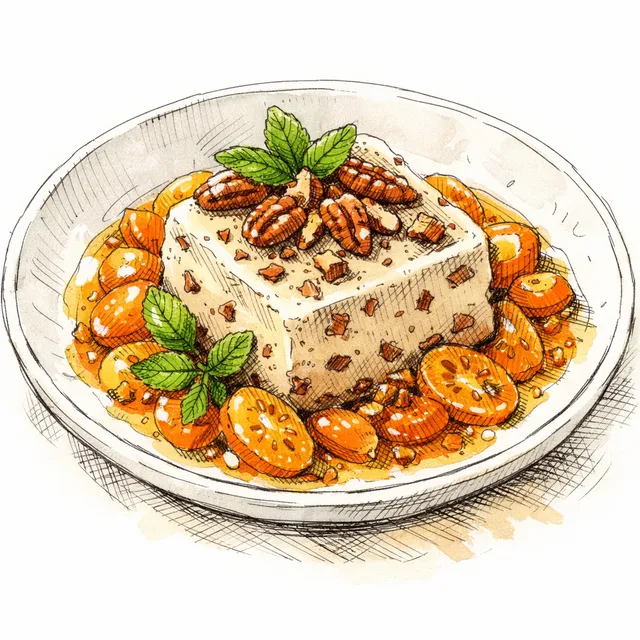
Cold-Infused Roasted Pecan Parfait Glacé with Tart Kumquat Compote
When I left the fine-dining world, I carried a grudge against overbuilt desserts. I wanted simplicity that still felt dangerous. This parfait is my answer. The inspiration came from a late-night kitchen experiment where I steeped roasted pecans directly into cold dairy, extracting pure, toasted warmth without a single drop of greasy nut oil. Precision is freedom, and freezing this mixture into a razor-sharp slice changes everything. I remember serving an early version to a skeptical line cook who took one bite and went dead silent—the ultimate compliment. What makes this special is the contrast. You get the velvet weight of the pecan base cut straight through by a sharp, aggressive kumquat compote. It is minimalist modernism for your home kitchen. Why this works: cold-steeping locks in the clean roast. Fix it fast: slice it cold and finish with flaky salt. Contrast is the secret ingredient. Let it cool. Future you deserves clean slices.
Featured Recipe
Cold-Infused Roasted Pecan Parfait Glacé with Tart Kumquat Compote
A velvety frozen slice that eats like silk rather than ice, pairing the deep, buttery warmth of cold-steeped roasted pecans with an assertive, sour-bright kumquat compote. Modern pastry at home is about disciplined contrast: zero greasy nut oils, razor-sharp clean edges, and flaky salt to cut through the richness.
Save a copy to your collection for editing
Timeline
Ingredients
- 200 g raw pecan halves(divided; 150g for cold infusion, 50g reserved for crunchy topping)
- 360 g heavy whipping cream(cold, minimum 36% fat content)
- 4 large egg yolks(about 75g, at room temperature)
- 110 g granulated sugar(divided; 70g for parfait base, 40g for kumquat compote)
- 30 g water(for boiling sugar syrup)
- 5 g pure vanilla extract(about 1 teaspoon)
- 2 g fine sea salt(divided; 1.5g in parfait base, 0.5g in compote)
- 180 g fresh kumquats(washed, sliced thin into rounds, seeds removed)
- 20 g fresh lemon juice(about 1.5 tablespoons to sharpen acidity)
- 1 g smoked flaky sea salt(Maldon or smoked sea salt for finishing each slice)
- 40 g granulated sugar(mentioned in step 3 for kumquat compote)
- 0.5 g fine sea salt(mentioned in step 3 for kumquat compote)
- 70 g granulated sugar(mentioned in step 6 for syrup)
- 1.5 g fine sea salt(mentioned in step 7 for pâte à bombe)
Instructions
- 1
Preheat your oven to 165°C (325°F). Spread 200 g raw pecan halves across a rimmed baking sheet. Toast until deeply fragrant and the centers turn amber-brown, exactly 12 minutes. Transfer 150 g raw pecan halves to a bowl to cool completely; keep the remaining 50 g raw pecan halves aside on the board for the crisp garnish.
15 min
Tip: Why this works: pecans carry dense oils that turn bitter if burnt. Roasting low and slow at 165°C caramelizes the nut sugars without scorch.
- 2
Once cool to the touch, crush the 150 g raw pecan halves coarsely with the back of a measuring cup or rolling pin. Tip them into a clean container, pour in 360 g heavy whipping cream, cover tightly, and place in the refrigerator for 240 minutes to cold-infuse.
240 min
Tip: Why this works: hot infusion leaches astringent tannins and clouding fats from nut skins. A slow, cold steep extracts only the sweet, roasted, volatile aroma compounds.
- 3
While the cream steeps, slice the remaining 50 g raw pecan halves finely into neat matchsticks and set aside. Combine 180 g fresh kumquats, 40 g granulated sugar, 20 g fresh lemon juice, and 0.5 g fine sea salt in a small saucepan over medium-low heat. Simmer gently for 8 minutes until the kumquat skins soften and the juices turn syrupy. Chill thoroughly.
15 min
Tip: Fix it fast: keep the heat low so the kumquat rounds stay intact rather than melting into jam. You want distinct translucent citrus discs for visual bite.
- 4
Line a standard 21x11 cm (8.5x4.5 inch) loaf pan with plastic wrap, leaving generous overhang on all four sides so you can lift the frozen block effortlessly later. Set the lined pan in the freezer to chill.
5 min
Tip: A lightly dampened paper towel under the plastic wrap helps it cling smoothly to the metal corners without wrinkles.
- 5
Strain the cold pecan cream through a fine-mesh sieve into a chilled bowl, pressing lightly on the solids with a silicone spatula to harvest every drop of pecan milk. Discard the spent crushed nuts. Whip the cold pecan-infused cream to medium-soft peaks and tuck it back in the fridge.
10 min
Tip: Do not whip to stiff peaks; over-whipped cream makes a dense, greasy frozen parfait. Medium-soft peaks give that restaurant-grade melt.
- 6
Place 4 large egg yolks in the bowl of a stand mixer fitted with the whisk attachment. In a small pot, bring 70 g granulated sugar and 30 g water to a boil over medium heat until it registers 118°C (244°F) on a digital probe thermometer, about 5 minutes.
5 min
Tip: Precision is freedom: 118°C cooks the yolks safely, denatures the proteins for maximum loft, and prevents icy crystals from forming.
- 7
Set the mixer to medium-low and pour the 118°C syrup down the inside wall of the bowl in a steady, thin stream. Increase speed to high and whip the pâte à bombe for 6 minutes until pale, quadrupled in volume, and cooled to room temperature. Add 5 g pure vanilla extract and 1.5 g fine sea salt during the final 30 seconds.
6 min
Tip: Do not rush: pouring directly onto spinning beaters will flick hot sugar against the bowl sides. Aim for the gap between the whisk and the bowl wall.
- 8
Gently fold one-third of the chilled whipped pecan cream into the room-temperature egg yolk base using a silicone spatula to lighten it. Add the remaining whipped cream in two additions, cutting down the center and sweeping up the sides with broad, deliberate strokes until completely uniform.
4 min
Tip: We're not adding steps—just improving decisions. Two gentle folding motions protect the trapped air bubbles that keep this dessert soft straight from the freezer.
- 9
Pour the mousse-like parfait base into the chilled loaf pan, smoothing the surface with a small offset spatula. Fold the plastic wrap overhang over the top to seal. Transfer to the coldest shelf of your freezer for at least 360 minutes (or overnight) until rock-solid.
360 min
Tip: Let it freeze completely. Future you deserves clean slices. Cutting an under-frozen parfait results in a slumping wedge instead of an architectural prism.
- 10
To serve, unmold the frozen parfait onto a chilled cutting board and peel away the plastic wrap. Dip a sharp chef's knife in boiling water and wipe it completely dry before each cut. Slice into 2 cm (0.8 inch) thick slabs. Plate immediately, spooning a generous glossy puddle of chilled tart kumquat compote alongside, and finishing with 50 g raw pecan halves (toasted matchsticks) and a light pinch of 1 g smoked flaky sea salt.
10 min
Tip: Contrast is the secret ingredient. The clean hot knife slice gives razor-sharp edges; the bitter-tart kumquat cuts the rich frozen butterfat instantly.
Chef's Notes
Why this works: Most pecan desserts coat the palate in cloying brown sugar or heavy corn syrup. Cold-steeping dark-roasted pecans into dairy bypasses the greasy nut fats and isolates the pure, fragrant pyrazines—the toasted, biscuit-like aromatics. Paired with a pâte à bombe base, it sets with the density of frozen custard without requiring an ice cream maker. The high acid and edible rind bitterness of the simmered kumquats provide the single contrasting counterweight that lifts the whole plate.

Theo Glass
Modern desserts, minimal fuss, maximum contrast.
Theo Glass—known as “The Minimalist Sweet Tooth”—is a calm, detail-obsessed pastry coach who left the white-tablecloth intensity of fine dining for the reality (and joy) of home kitchens. After years of building plated desserts with tweezers and timers, he realized the real magic wasn’t complicated garnish work—it was contrast, clarity, and control. Theo’s mission now is to help everyday bakers make desserts that feel modern and restaurant-level without turning their kitchen into a war zone. His style is precision with restraint: olive oil cakes that stay plush for days, tahini brownies that walk the line between nutty and bittersweet, miso custards that taste like “caramel’s smarter cousin,” and citrus-forward sorbets that pop without needing an ice-cream machine. Theo teaches fundamentals (emulsions, temperature, texture, salinity) in plain language, with steps that are clean, paced, and confidence-building. If you’ve ever said “I want to mix it up” but don’t want extra dishes, obscure tools, or chaos, Theo’s your person. He’ll show you how to mix it up the minimalist way: a smarter ingredient swap, a sharper contrast, and a clear path to repeatable results.