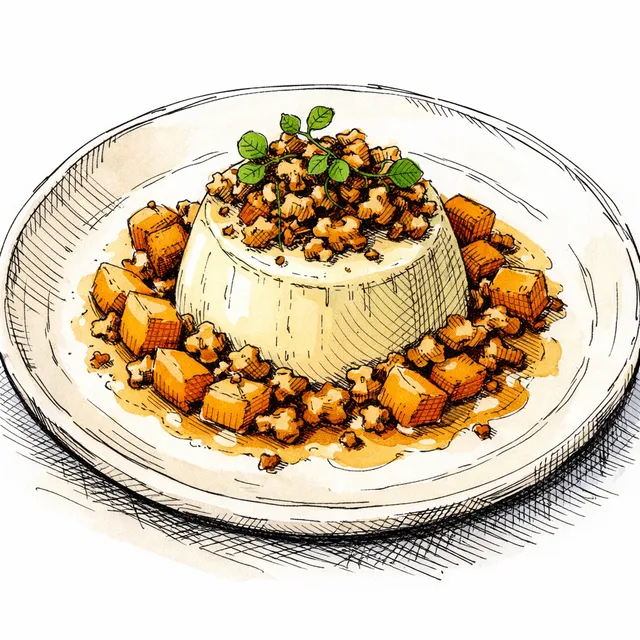
Cold-Infused Roasted Walnut Panna Cotta with Tart Quince & Brown Butter Crunch
Contrast is the secret ingredient. Years ago in a frantic restaurant kitchen, I watched too many desserts collapse under their own weight—plates crowded with pointless garnishes. I wanted the opposite. This panna cotta was born from a desire to strip away the noise. We cold-infuse roasted walnuts to dodge astringent tannins, yielding a dairy base that tastes intensely of toasted nuts without a hint of bitterness. Precision is freedom here; weigh your ingredients and respect the chill. Pair that fragile, silky wobble with sharp, poached quince and a salty brown butter crunch, and you get a lesson in modern minimalism. We are not adding steps—just improving decisions. Let it cool. Future you deserves clean slices.
Featured Recipe
Cold-Infused Roasted Walnut Panna Cotta with Tart Quince & Brown Butter Crunch
An exercise in restraint and high-contrast autumn pastry. Silky roasted walnut cream is extracted cold to dodge astringent tannins, set to a fragile wobble, and cut by sharp poached quince and a salted brown butter crunch.
Save a copy to your collection for editing
Timeline
Ingredients
- 200 g raw English walnut halves(split: 140g for the cold infusion dairy, 60g finely chopped for the crunch)
- 320 g heavy cream (36% fat)(cold)
- 220 g whole milk(cold)
- 3.5 g sheet gelatin (silver grade, 160 bloom)(about 1.75 sheets; bloom in ice water)
- 95 g granulated sugar(split: 45g for panna cotta, 35g for quince, 15g for crunch)
- 3 g flaky sea salt (Maldon)(split: 1g into panna cotta base, 2g for the crunch and finishing)
- 1 ripe quince(about 250g, peeled, cored, and cut into 1/4-inch dice)
- 30 g fresh lemon juice(about 2 tbsp)
- 150 g water(for simmering the quince)
- 30 g unsalted butter(browned until nutty and amber)
- 35 g all-purpose flour
Instructions
- 1
Roast all 200g raw English walnut halves on a parchment-lined sheet pan at 165°C (325°F) for 12 minutes until deeply fragrant and warm mahogany in color. Let cool completely. Roughly crush 140g roasted walnuts into a glass jar, pour in 320g heavy cream (36% fat) and 220g whole milk, seal, and chill in the refrigerator for 12 hours. Set aside the remaining 60g roasted walnuts for the crumble.
15 min
Tip: Why this works: Boiling walnuts extracts the harsh, bitter tannins from their skins. A 12-hour cold steep pulls only clean, buttery walnut oils and sweet aromatics into the dairy.
- 2
Strain the cold-infused dairy through a fine-mesh sieve into a clean bowl, pressing firmly with a ladle to extract the oils; you should yield about 450g of fragrant walnut liquid. Submerge 3.5g sheet gelatin in a bowl of ice water for 5 minutes until completely supple.
5 min
Tip: Label your bowl with painter's tape and weigh the yield. Precision is freedom. If you fall short of 450g, top up with a splash of whole milk.
- 3
Pour 150g of the strained walnut dairy into a small saucepan with 45g granulated sugar and 1g flaky sea salt. Warm over medium-low heat just until steam rises and sugar dissolves (around 60°C / 140°F)—do not boil. Squeeze excess water from 3.5g sheet gelatin, whisk it into the warm cream until dissolved, then stir in the remaining cold strained walnut cream to drop the temperature rapidly.
6 min
Tip: Warming only one-third of the base protects the cold-extracted aromatics and saves chilling time later. We are not adding steps—just improving decisions.
- 4
Pour the panna cotta mixture equally among 4 low-profile serving glasses or shallow ceramic bowls (approx. 110g per portion). Transfer to the refrigerator uncovered for 15 minutes, then cover loosely and chill for at least 3 hours until set with a fragile, glistening wobble.
5 min
Tip: A shallow dish ensures rapid, uniform setting and keeps the gelatin ratio minimal so the cream melts on your tongue instead of rubberizing.
- 5
Combine 1 ripe quince dice, 150g water, 35g granulated sugar, and 30g fresh lemon juice in a small heavy-bottomed saucepan. Bring to a gentle simmer over medium-low heat, cover, and cook for 20 minutes until the quince is tender and blush pink. Uncover and simmer 4 minutes more until the liquid reduces to a glossy, tart syrup. Remove from heat and chill thoroughly.
25 min
Tip: Quince needs acidity to balance its floral density. The lemon juice keeps the syrup sharp and cuts right through the fatty panna cotta base.
- 6
Preheat oven to 175°C (350°F). In a small pan, melt 30g unsalted butter over medium heat until foaming subsides and milk solids turn deep amber brown. In a bowl, toss 35g all-purpose flour, 15g granulated sugar, the reserved finely chopped 60g roasted walnuts, and 1g flaky sea salt. Drizzle the hot browned butter over the dry mix, pinch into shaggy pea-sized crumbs, spread onto a baking sheet, and bake for 10 minutes until golden. Cool completely.
15 min
Tip: Browned butter echoes the Maillard notes of roasted walnut. Let it cool before touching—future you deserves clean crunch.
- 7
Retrieve the set panna cottas from the refrigerator. Spoon 2 tablespoons of chilled tart quince and its syrup over half of each cream's surface. Spoon a neat cluster of brown butter walnut crunch opposite the quince. Garnish the surface with a tiny pinch from the remaining 1g flaky sea salt and serve immediately.
5 min
Tip: Respect the two-texture rule: keep the crunch piled on one side so it doesn't sog out in the syrup before the spoon hits the table.
Chef's Notes
Why this works: Roasted walnuts are loaded with delicate volatile oils, but standard hot extractions pull the astringent skin tannins along with them, leaving your cream tasting like wood polish. Cold-steeping the crushed roasted nuts in cold milk and cream for 12 hours bypasses those bitter tannins entirely, giving you pure roasted nuttiness with pristine, round dairy notes. The quince provides high-voltage malic acidity, while the browned butter walnut crumble guarantees the snap that a delicate panna cotta demands. If you cannot find quince, firm Granny Smith apples tossed with lemon juice make a fast, razor-sharp stand-in.

Theo Glass
Modern desserts, minimal fuss, maximum contrast.
Theo Glass—known as “The Minimalist Sweet Tooth”—is a calm, detail-obsessed pastry coach who left the white-tablecloth intensity of fine dining for the reality (and joy) of home kitchens. After years of building plated desserts with tweezers and timers, he realized the real magic wasn’t complicated garnish work—it was contrast, clarity, and control. Theo’s mission now is to help everyday bakers make desserts that feel modern and restaurant-level without turning their kitchen into a war zone. His style is precision with restraint: olive oil cakes that stay plush for days, tahini brownies that walk the line between nutty and bittersweet, miso custards that taste like “caramel’s smarter cousin,” and citrus-forward sorbets that pop without needing an ice-cream machine. Theo teaches fundamentals (emulsions, temperature, texture, salinity) in plain language, with steps that are clean, paced, and confidence-building. If you’ve ever said “I want to mix it up” but don’t want extra dishes, obscure tools, or chaos, Theo’s your person. He’ll show you how to mix it up the minimalist way: a smarter ingredient swap, a sharper contrast, and a clear path to repeatable results.