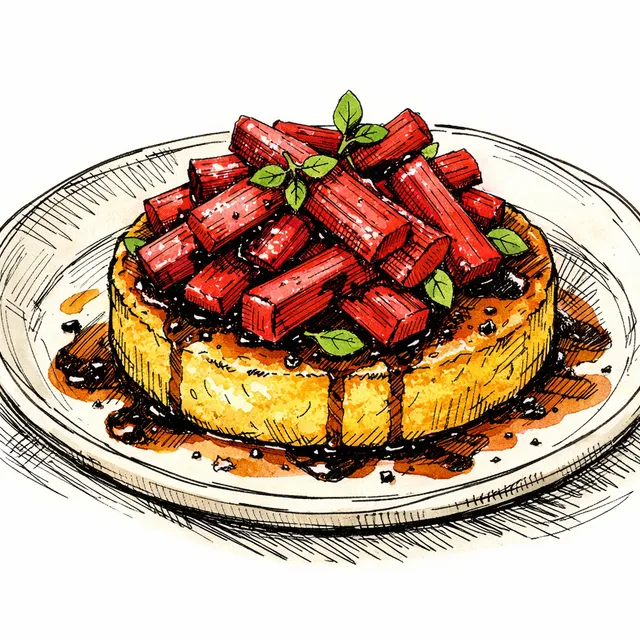
Cold Rhubarb, Warm Polenta: A Study in Contrast
Let's talk about rhubarb. My fine-dining days were filled with overbuilt, mushy rhubarb compotes. I burned out on them. Then, one spring afternoon, I shaved raw rhubarb paper-thin, tossed it with white balsamic and sugar (measured in grams, always), and put it in the fridge while I wiped down the counter. An hour later, it had relaxed into something bright, crunchy, and entirely new. I served it over a steaming, edge-crisped olive-oil polenta cake. It was a tiny win that changed how I approach fruit. What makes this recipe special to me is the pure math of it. Cold against warm. Sharp against rich. The snap of macerated rhubarb against the sandy crumb of polenta. We follow the two-texture rule here. Contrast is the secret ingredient. Why this works: The white balsamic draws out the rhubarb's moisture, softening the fibers while retaining its bite. The olive oil in the cake provides a fruity, robust fat to carry that acid. Make it yours: Swap the white balsamic for a splash of yuzu, or fold toasted black sesame into the batter. Just remember to set your timer and respect the temperatures. We are not adding steps—just improving decisions.
Featured Recipe
Cold Balsamic-Macerated Rhubarb over Warm Olive-Oil Polenta Cake
Raw rhubarb is a revelation when you treat it right. We shave it thin, macerate it in white balsamic and sugar until it relaxes, and chill it down hard. Dropped over a steaming, edge-crisped olive-oil polenta cake, the temperature and texture contrast does all the heavy lifting. We're not adding steps—just improving decisions.
Save a copy to your collection for editing
Timeline
Ingredients
- 200 g Rhubarb stalks(Trimmed and shaved paper-thin on a bias)
- 50 g Caster sugar(For the maceration)
- 15 g White balsamic vinegar(About 1 tablespoon)
- 1 Lemon(Zest only)
- 100 g Fruity extra-virgin olive oil(Plus a little extra for greasing the skillet)
- 60 g Fine polenta or cornmeal(For texture)
- 80 g All-purpose flour
- 4 g Baking powder(About 1 teaspoon)
- 3 g Flaky sea salt(Divided (1g for rhubarb, 2g for cake))
- 100 g Large eggs(About 2 large eggs, room temperature)
- 90 g Granulated sugar(For the cake batter)
- 50 g Plain whole-milk yogurt(Room temperature)
Instructions
- 1
Wipe the counter. Using a mandoline or a very sharp knife, shave the 200 g Rhubarb stalks on a sharp bias into paper-thin ribbons. Toss in a mixing bowl with the 50 g Caster sugar, 15 g White balsamic vinegar, 1 Lemon zest, and 1 g Flaky sea salt. Massage gently with your hands for 15 seconds until the sugar begins to dissolve. Slap a piece of painter's tape on the bowl, label it, and put it in the fridge.
10 min
Tip: The cold and the acid will do the work. Over 45 minutes, the rhubarb will release its juices, creating a bright pink syrup while retaining a crisp snap.
- 2
Preheat your oven to 175°C (350°F). Brush an 8-inch cast-iron skillet with a little 100 g Fruity extra-virgin olive oil and line the bottom with a circle of parchment paper.
5 min
Tip: A cast-iron skillet gives us crispy, caramelized edges that contrast beautifully with the soft center. If using a regular cake pan, watch the edges—they won't brown as aggressively.
- 3
In a medium bowl, whisk the 60 g Fine polenta or cornmeal, 80 g All-purpose flour, 4 g Baking powder, and remaining 2 g Flaky sea salt. In a separate large bowl, whisk the 100 g Large eggs and 90 g Granulated sugar vigorously until pale. Stream in the 100 g Fruity extra-virgin olive oil while whisking, then fold in the 50 g Plain whole-milk yogurt. Add the dry ingredients and fold just until no dry spots remain.
10 min
Tip: Don't overmix once the flour hits the wet ingredients. Precision is freedom, but overworking gluten is a trap.
- 4
Pour the batter into your prepared skillet and tap it once on the counter to settle. Bake until the edges are deeply golden and the center springs back when gently pressed.
25 min
Tip: Set a timer for 22 minutes to check it. Every oven lies; trust your eyes and fingertips.
- 5
Pull the skillet from the oven and let it sit at room temperature for exactly 10 minutes. We want it warm, not molten.
10 min
Tip: Let it cool slightly. Future you deserves clean slices, and resting sets the crumb so it won't collapse when you cut it.
- 6
Cut the warm cake into wedges. Pull the 200 g Rhubarb stalks from the fridge—it should be vibrant and sitting in a pool of cold, sharp syrup. Spoon the cold rhubarb ribbons and a heavy drizzle of that syrup directly over the warm cake slices.
5 min
Tip: Contrast is the secret ingredient. Serve immediately while the cake is steaming and the rhubarb is fridge-cold.
Chef's Notes
Raw rhubarb can be aggressively tart, but a 45-minute cold maceration breaks down the cell walls just enough to tame it. It keeps its snap but loses its bite. The white balsamic bridges the gap between the tart fruit and the rich, grassy olive oil in the warm cake. Use the best olive oil you have for the batter—it's front and center here.

Theo Glass
Modern desserts, minimal fuss, maximum contrast.
Theo Glass—known as “The Minimalist Sweet Tooth”—is a calm, detail-obsessed pastry coach who left the white-tablecloth intensity of fine dining for the reality (and joy) of home kitchens. After years of building plated desserts with tweezers and timers, he realized the real magic wasn’t complicated garnish work—it was contrast, clarity, and control. Theo’s mission now is to help everyday bakers make desserts that feel modern and restaurant-level without turning their kitchen into a war zone. His style is precision with restraint: olive oil cakes that stay plush for days, tahini brownies that walk the line between nutty and bittersweet, miso custards that taste like “caramel’s smarter cousin,” and citrus-forward sorbets that pop without needing an ice-cream machine. Theo teaches fundamentals (emulsions, temperature, texture, salinity) in plain language, with steps that are clean, paced, and confidence-building. If you’ve ever said “I want to mix it up” but don’t want extra dishes, obscure tools, or chaos, Theo’s your person. He’ll show you how to mix it up the minimalist way: a smarter ingredient swap, a sharper contrast, and a clear path to repeatable results.