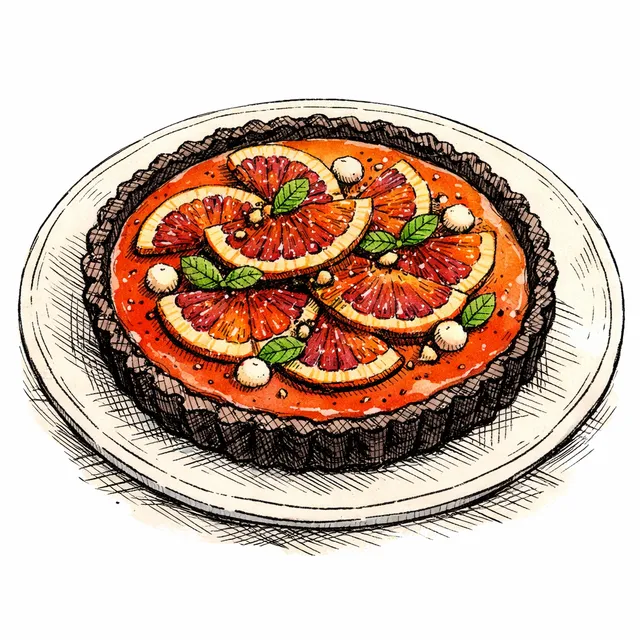
Contrast is the Secret Ingredient: Cold-Set Blood Orange Tart
Baking citrus dulls its edge. That was the hard lesson I learned years ago in a windowless fine-dining prep kitchen, staring at a tray of muted, over-baked orange tarts. I realized then: we’re not adding steps—just improving decisions. That memory inspired this Cold-Set Blood Orange & Olive Oil Tart with Dark Cocoa Crust. By relying on a precise measure of gelatin rather than heavy heat, we preserve the sharp, floral brightness of the fruit.What makes this special to me is the engineering. It follows my two-texture rule perfectly. We pair that slick, vibrant curd with a bitter, crumbly cocoa-brown butter crust. A finishing slick of grassy, fruity olive oil and a pinch of flaky salt creates maximum contrast with zero stress. Precision is freedom here. Weigh your gelatin in grams. Label your bowls with a strip of painter's tape.### Why this worksHeat destroys the delicate top notes of citrus. A cold-set method locks them in.### Make it yoursSwap the blood orange for yuzu or Meyer lemon, but keep the dark cocoa crust—that bitterness is a non-negotiable guardrail for balance. Above all: let it cool. Future you deserves clean slices.
Featured Recipe
Cold-Set Blood Orange & Olive Oil Tart with Dark Cocoa Crust
Baking citrus dulls its edge. By relying on a precise measure of gelatin rather than heavy heat, we preserve the sharp, floral brightness of spring blood oranges while guaranteeing perfectly clean slices. Paired with a bitter cocoa-brown butter crust and a slick of grassy olive oil, it’s maximum contrast with zero stress.
Save a copy to your collection for editing
Timeline
Ingredients
- 113 g unsalted butter(melted and browned)
- 120 g all-purpose flour(weighed, not scooped)
- 30 g Dutch-process cocoa powder(for deep, dark bitterness)
- 50 g powdered sugar
- 1/2 tsp kosher salt(divided)
- 7 g unflavored powdered gelatin(about 1 packet)
- 30 g cold water(for blooming gelatin)
- 200 g freshly squeezed blood orange juice(about 3-4 oranges, strained)
- 10 g blood orange zest
- 100 g granulated sugar
- 3 whole large eggs(straight from the fridge is fine)
- 50 g fruity extra-virgin olive oil(plus extra for serving)
- to taste flaky sea salt(for finishing)
- 1/4 tsp kosher salt(A second quantity of kosher salt is mentioned in step 4)
Instructions
- 1
Preheat your oven to 350°F (175°C). In a small saucepan, melt 113g unsalted butter over medium heat. Swirl the pan occasionally. Let it pop and foam until the milk solids drop to the bottom and turn a deep, toasted hazelnut color, about 5-7 minutes. Pour into a bowl to stop the cooking and let it cool slightly. This deep, nutty backdrop is your first layer of contrast.
10 min
Tip: Listen to the butter; when the crackling stops, the water is gone and browning happens fast. Don't walk away.
- 2
In a medium mixing bowl, whisk together 120g all-purpose flour, 30g Dutch-process cocoa powder, 50g powdered sugar, and 1/4 tsp kosher salt. Pour in the slightly cooled brown butter and stir with a spatula until the mixture resembles damp, dark sand. Press it firmly and evenly into the bottom and up the sides of a 9-inch removable-bottom tart pan.
5 min
Tip: Use the flat bottom of a measuring cup to press the crust evenly. We’re not adding steps—just improving decisions.
- 3
Bake the crust for 15 minutes. It will look dry and smell intensely of toasted cocoa. Set the pan on a wire rack to cool completely. A cold crust means a crisp foundation for our set curd.
15 min
Tip: Because the crust is dark, you can't rely on visual browning. Trust your timer.
- 4
While the crust bakes, let's prep the filling. In a small bowl, evenly sprinkle 7g unflavored powdered gelatin over 30g cold water. Set aside to bloom. In a medium heatproof bowl, combine 200g freshly squeezed blood orange juice, 10g blood orange zest, 100g granulated sugar, 3 large eggs, and the remaining 1/4 tsp kosher salt.
5 min
Tip: Wipe your counter now. Keeping your workspace clean lowers your heart rate.
- 5
Set the bowl of the orange mixture over a saucepan of barely simmering water to create a double boiler. Whisk constantly. We are gently structuring the eggs. Cook until the mixture hits exactly 165°F (74°C) on an instant-read thermometer and lightly coats the back of a spoon. Do not let it boil, or you will ruin the fresh citrus notes.
8 min
Tip: Precision is freedom. Use a thermometer. Guessing leads to scrambled eggs or a runny tart.
- 6
Immediately remove the bowl from the heat. Whisk in the bloomed gelatin mass until it is completely and seamlessly dissolved. Pour the mixture through a fine-mesh sieve into a clean, painter's tape-labeled bowl. This removes the spent zest and any tiny egg bits, guaranteeing silk.
2 min
Tip: Do not skip straining. Texture engineering is about removing distractions.
- 7
Let the strained curd cool at room temperature until it reaches roughly 110°F (43°C)—warm to the touch, but not hot. Slowly stream in 50g fruity extra-virgin olive oil while whisking vigorously to emulsify. Pour this glossy, cohesive filling directly into your cooled cocoa crust.
10 min
Tip: If the curd is too hot, the oil will separate and pool. Temperature management is everything.
- 8
Carefully transfer the tart to the refrigerator. Let it chill completely undisturbed for at least 3 hours, or until fully set. When ready to serve, slice the tart cold. Let it cool—future you deserves clean slices. Finish each slice with a drizzle of extra olive oil and a pinch of to taste flaky sea salt.
180 min
Tip: Run a thin, sharp knife under hot water and wipe it dry before slicing for absolute perfection.
Chef's Notes
Why this works: Baking citrus curds dulls their flavor. By warming the blood orange base just enough to structure the eggs, then letting gelatin do the actual setting, we preserve the bright, raw, floral edge of the fruit. Paired with a deeply bitter cocoa crust and grassy olive oil, you have a one-contrast upgrade that tastes straight out of a restaurant kitchen.

Theo Glass
Modern desserts, minimal fuss, maximum contrast.
Theo Glass—known as “The Minimalist Sweet Tooth”—is a calm, detail-obsessed pastry coach who left the white-tablecloth intensity of fine dining for the reality (and joy) of home kitchens. After years of building plated desserts with tweezers and timers, he realized the real magic wasn’t complicated garnish work—it was contrast, clarity, and control. Theo’s mission now is to help everyday bakers make desserts that feel modern and restaurant-level without turning their kitchen into a war zone. His style is precision with restraint: olive oil cakes that stay plush for days, tahini brownies that walk the line between nutty and bittersweet, miso custards that taste like “caramel’s smarter cousin,” and citrus-forward sorbets that pop without needing an ice-cream machine. Theo teaches fundamentals (emulsions, temperature, texture, salinity) in plain language, with steps that are clean, paced, and confidence-building. If you’ve ever said “I want to mix it up” but don’t want extra dishes, obscure tools, or chaos, Theo’s your person. He’ll show you how to mix it up the minimalist way: a smarter ingredient swap, a sharper contrast, and a clear path to repeatable results.