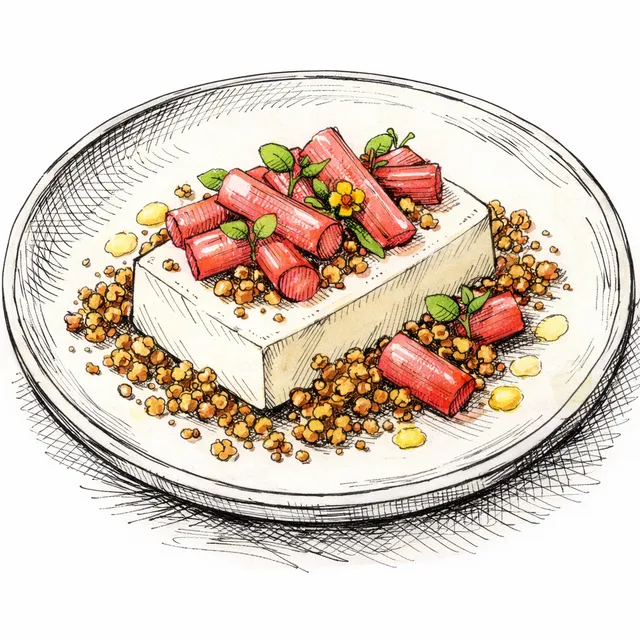
Cold-Set Buttermilk Terrine: Precision Meets Spring
I stepped away from fine-dining pastry because I got tired of building desserts that took three days and required tweezers. I wanted food that felt fancy but respected my time. That is the origin of this Cold-Set Buttermilk Terrine. Years ago, during a brutal spring dinner service, our ovens went down and we had to pivot. I learned right then that gelatin, buttermilk, and a cold walk-in are your best friends. This recipe is lactic, structurally sound, and takes just ten minutes of active work. We are leaning entirely into springtime acidity. The sharpness of the cultured buttermilk directly echoes a neon-pink, yuzu-macerated rhubarb syrup. No custard, no oven. Just a digital scale, measured temperatures, and deliberate resting. Why this works: Gelatin gives us that perfect wobble, but chilling it completely ensures those razor-sharp slices. Let it cool. Future you deserves clean slices. The toasted quinoa satisfies our two-texture rule, adding an earthy snap against the rich dairy. Fix it fast: If you cannot find yuzu, do not panic. Swap in fresh grapefruit juice and a microplane of lemon zest. Contrast is the secret ingredient. Weigh your gelatin, respect the resting time, and enjoy the payoff.
Featured Recipe
Cold-Set Buttermilk Terrine with Yuzu-Macerated Rhubarb & Quinoa Crunch
A lactic, structurally sound dessert that takes ten minutes of active work and rewards you with razor-sharp slices. We are leaning entirely into springtime acidity: the sharpness of the buttermilk echoes a neon-pink, yuzu-macerated rhubarb syrup. No custard, no oven, just measured temperatures and deliberate resting.
Save a copy to your collection for editing
Timeline
Ingredients
- 7 g powdered gelatin(About 1 packet, but weigh it for structural precision)
- 30 g cold water(For blooming the gelatin)
- 150 g heavy cream(Minimum 36% fat)
- 120 g granulated sugar(Divided: 70g for the terrine, 50g for maceration)
- 1 vanilla bean(Split and seeds scraped)
- 400 g whole-milk buttermilk(Must be whole milk for proper texture; low-fat will weep)
- 50 g extra-virgin olive oil(Choose something fruity and grassy)
- 250 g fresh rhubarb(Washed, trimmed, and sliced into 2mm half-moons)
- 15 g yuzu juice(Can substitute fresh lemon juice if yuzu is unavailable)
- 3 sprigs fresh tarragon(Bruised slightly to release essential oils)
- 40 g dry white quinoa(Rinsed and thoroughly dried)
- 20 g cocoa nibs(For bitter contrast)
- 20 g maple syrup(Dark amber preferred)
- 2 g flaky sea salt(Such as Maldon)
- 70 g granulated sugar(mentioned in step 2 but not listed)
Instructions
- 1
In a small bowl, sprinkle 7g powdered gelatin evenly over 30g cold water. Do not stir. Let it sit to bloom and hydrate completely. Line an 8x4-inch loaf pan with a smooth sheet of parchment paper, leaving an overhang on the long sides for easy lifting.
5 min
Tip: Why this works: Blooming gelatin in cold liquid ensures it dissolves smoothly later without clumping. Precision here prevents a rubbery set.
- 2
In a small saucepan over medium heat, combine 150g heavy cream, 70g granulated sugar, and the scraped seeds and pod of 1 vanilla bean. Heat gently just until the sugar dissolves and the liquid begins to steam. Do not let it boil.
5 min
Tip: Heat management is crucial. Boiling the cream will alter its flavor and could degrade the gelatin when added.
- 3
Remove the cream from the heat. Discard the vanilla pod. Whisk in the bloomed gelatin until completely dissolved and seamless. Transfer to a large bowl and let cool for 2 minutes, then gently whisk in 400g whole-milk buttermilk and 50g extra-virgin olive oil until the mixture is homogeneous.
5 min
Tip: Adding cold buttermilk to hot cream can shock the gelatin. Let the cream cool slightly, and whisk constantly to build a stable emulsion with the olive oil.
- 4
Pour the buttermilk mixture into your prepared pan. Tap the pan once on the counter to release any trapped air bubbles. Transfer to the refrigerator and chill uncovered until completely firm.
240 min
Tip: Let it cool. Future you deserves clean slices. Do not rush the chill time.
- 5
While the terrine sets, prepare the acidic contrast. In a medium bowl, combine the thinly sliced 250g fresh rhubarb, 50g granulated sugar, 15g yuzu juice, and 3 sprigs fresh tarragon. Toss well, cover with plastic wrap, and let macerate at room temperature. Stir once an hour.
10 min
Tip: The two-texture rule applies here: the sugar and acid will break down the rhubarb slightly, yielding a bright pink syrup while leaving a crisp bite.
- 6
In a dry skillet over medium heat, toast 40g dry white quinoa and 20g cocoa nibs, shaking the pan frequently until the quinoa smells nutty and pops slightly. Remove from heat immediately, stir in 20g maple syrup and 2g flaky sea salt. Spread flat onto a piece of parchment paper to cool and harden.
8 min
Tip: Cocoa nibs can burn in a flash. Rely on your nose. The maple syrup will bubble rapidly and then crystalize as it cools, creating our shatter.
- 7
To serve, use the parchment overhang to lift the terrine from the pan. Dip a sharp chef's knife in hot water, wipe it completely dry, and cut thick, clean slices. Discard the tarragon from the rhubarb. Top each slice with a generous spoonful of the macerated rhubarb, its vibrant syrup, and a scattering of the broken quinoa crunch.
5 min
Tip: Wipe your knife between every single cut. We are not adding steps—just improving decisions.
Chef's Notes
Contrast is the secret ingredient. Here, the lactic tang of the buttermilk mirrors the sharpness of the yuzu, while the olive oil provides a grounding, grassy undertone. By letting the rhubarb macerate rather than cooking it into a compote, we preserve its structural integrity and raw, vibrant bite. The quinoa-cocoa crunch is our necessary micro-adjustment for texture.

Theo Glass
Modern desserts, minimal fuss, maximum contrast.
Theo Glass—known as “The Minimalist Sweet Tooth”—is a calm, detail-obsessed pastry coach who left the white-tablecloth intensity of fine dining for the reality (and joy) of home kitchens. After years of building plated desserts with tweezers and timers, he realized the real magic wasn’t complicated garnish work—it was contrast, clarity, and control. Theo’s mission now is to help everyday bakers make desserts that feel modern and restaurant-level without turning their kitchen into a war zone. His style is precision with restraint: olive oil cakes that stay plush for days, tahini brownies that walk the line between nutty and bittersweet, miso custards that taste like “caramel’s smarter cousin,” and citrus-forward sorbets that pop without needing an ice-cream machine. Theo teaches fundamentals (emulsions, temperature, texture, salinity) in plain language, with steps that are clean, paced, and confidence-building. If you’ve ever said “I want to mix it up” but don’t want extra dishes, obscure tools, or chaos, Theo’s your person. He’ll show you how to mix it up the minimalist way: a smarter ingredient swap, a sharper contrast, and a clear path to repeatable results.