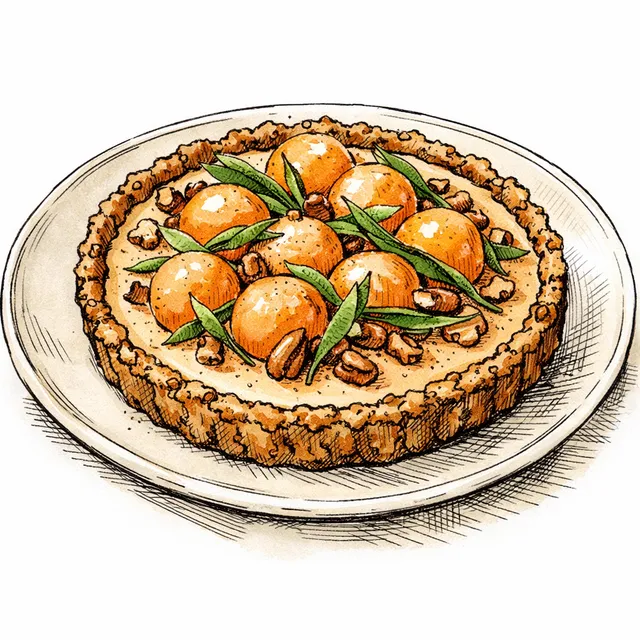
Cold-Set Cantaloupe & Tarragon Tart
I spent years in fine dining watching cantaloupe get pushed around sad fruit plates. The flavor is brilliant, but the texture lacks edge. This tart fixes that. We’re not adding steps—just improving decisions. By pureeing and cold-setting the melon, we force it into a vivid, clean-cutting gelee.
The inspiration came from a late-summer kitchen shift. I was exhausted, eating leftover prep: a slice of melon, a pinch of flaky salt, and a stray tarragon leaf. The contrast was electric. Sweet, herbal, savory. I knew it needed a crust, so I built one with toasted pecans and fruity olive oil (120g nuts, 45g oil). This recipe is special to me because it rescues an underdog ingredient through sheer technique.
Why this works The two-texture rule is in full effect. The crisp snap of the salted pecan crust anchors the yielding, cool melon. A splash of white balsamic brings the necessary acid.
Fix it fast Let it cool. Future you deserves clean slices. Chill it for at least four hours before even thinking about a knife.
Make it yours Swap tarragon for Thai basil if you prefer. Just weigh your gelatin. Precision is freedom.
Featured Recipe
Cold-Set Cantaloupe & Tarragon Tart with Salted Pecan Crust
Cantaloupe is too often relegated to sad fruit salads. Here, we transform it into a vivid, clean-cutting gelee infused with fresh tarragon and white balsamic. Anchored by a toasted pecan and olive oil crust, it is a masterclass in summer contrast—bright, herbal, and unapologetically crisp. Precision is freedom.
Save a copy to your collection for editing
Timeline
Ingredients
- 150 g raw pecans(roughly 1.5 cups)
- 50 g rolled oats(provides structure to the crust)
- 45 g light brown sugar(packed)
- 3 g kosher salt(about 1/2 tsp)
- 60 g extra virgin olive oil(fruity profile preferred)
- 600 g ripe cantaloupe flesh(about 1 medium melon, roughly chopped)
- 50 g granulated sugar(adjust based on melon sweetness)
- 15 g white balsamic vinegar(about 1 tbsp)
- 10 g fresh tarragon sprigs(about 4 sprigs)
- 10 g powdered gelatin(about 1 packet plus 1/2 tsp)
- 45 g cold water(for blooming gelatin)
- 1 pinch flaky sea salt(for finishing)
Instructions
- 1
In a small bowl, sprinkle 10g powdered gelatin evenly over 45g cold water. Let sit to bloom. We want an even hydration so we get a flawless, clean-cutting set later.
2 min
Tip: Never dump gelatin in a pile; sprinkle it like fresh snow to avoid dry clumps.
- 2
In a food processor, pulse 150g raw pecans, 50g rolled oats, 45g light brown sugar, and 3g kosher salt until it resembles coarse sand. The oats provide structure; the pecans bring fat and a deep, toasted baseline.
3 min
Tip: Don't over-process into a paste. We are strictly enforcing the two-texture rule: we need that crunch.
- 3
Drizzle 60g extra virgin olive oil into the processor, pulsing twice just to hydrate the sand. Press the mixture firmly into a 9-inch tart pan with a removable bottom. Bake at 350°F (175°C) for 12 to 14 minutes until toasted. Set a timer. When it's out, let it cool completely.
15 min
Tip: Use the flat bottom of a measuring cup to pack the crust tightly into the edges.
- 4
While the crust bakes, wipe down your counter. Then, blend 600g ripe cantaloupe flesh until completely smooth. Pass the puree through a fine-mesh sieve into a medium saucepan. Discard the pulp. A smooth puree ensures our final texture is glass-like.
5 min
Tip: Pushing it through a sieve takes an extra minute, but we are not adding steps—just improving decisions.
- 5
Add 50g granulated sugar, 15g white balsamic vinegar, and 10g fresh tarragon sprigs to the saucepan. Heat gently over medium-low for 10 minutes until steaming, but do not boil. The heat gently pulls the anise notes from the tarragon and marries them with the white balsamic's floral acidity.
10 min
Tip: Boiling will muddy the fresh melon flavor and destroy the delicate tarragon notes. Watch the temperature.
- 6
Remove the saucepan from the heat. Pluck out and discard the tarragon sprigs. Whisk in the bloomed gelatin until completely dissolved. Let the mixture cool at room temperature for 15 minutes. Temperature management is key here; pouring hot liquid into a nut crust causes leaks.
15 min
Tip: I like to mark the resting bowl with a piece of painter's tape so no one disturbs it while it drops in temperature.
- 7
Place the cooled tart crust on a flat baking sheet—this is your transport safety net. Carefully pour the cooled cantaloupe mixture into the crust. Transfer to the fridge and chill for at least 4 hours, until firmly set.
240 min
Tip: Carrying a liquid tart to the fridge without a baking sheet under it is a gamble you will eventually lose.
- 8
Remove from the fridge. Sprinkle with 1 pinch flaky sea salt and slice with a sharp, warm knife. Future you deserves clean slices. The contrast between the crisp, savory crust and the cold, herbaceous melon is exactly why we bake.
2 min
Tip: Dip your knife in hot water and wipe it dry between every single cut. No shaming, just geometry.
Chef's Notes
If your cantaloupe is exceptionally ripe and sweet, you can pull the sugar back to 35g. The white balsamic vinegar acts as our one-contrast upgrade, elevating the fruit from flatly sweet to complex and bright. Do not skip it.

Theo Glass
Modern desserts, minimal fuss, maximum contrast.
Theo Glass—known as “The Minimalist Sweet Tooth”—is a calm, detail-obsessed pastry coach who left the white-tablecloth intensity of fine dining for the reality (and joy) of home kitchens. After years of building plated desserts with tweezers and timers, he realized the real magic wasn’t complicated garnish work—it was contrast, clarity, and control. Theo’s mission now is to help everyday bakers make desserts that feel modern and restaurant-level without turning their kitchen into a war zone. His style is precision with restraint: olive oil cakes that stay plush for days, tahini brownies that walk the line between nutty and bittersweet, miso custards that taste like “caramel’s smarter cousin,” and citrus-forward sorbets that pop without needing an ice-cream machine. Theo teaches fundamentals (emulsions, temperature, texture, salinity) in plain language, with steps that are clean, paced, and confidence-building. If you’ve ever said “I want to mix it up” but don’t want extra dishes, obscure tools, or chaos, Theo’s your person. He’ll show you how to mix it up the minimalist way: a smarter ingredient swap, a sharper contrast, and a clear path to repeatable results.