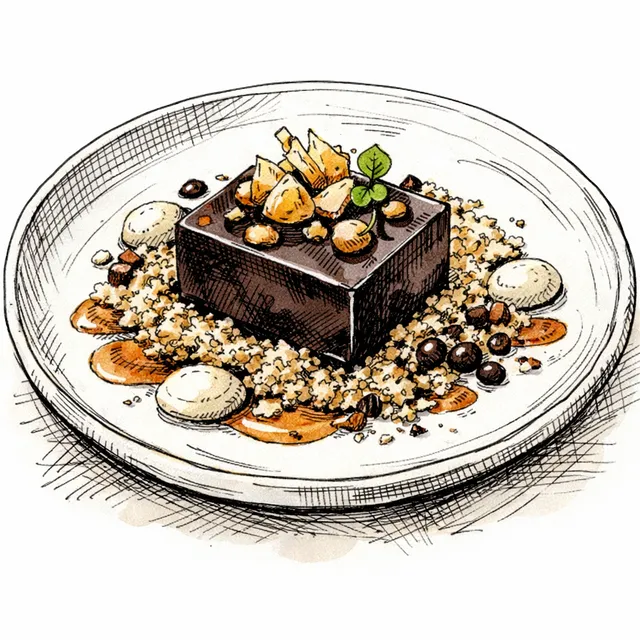
Cold-Set Dark Chocolate & Miso Pavé with Buckwheat Sand
Summer desserts don’t need to be fruit salads. This is an exercise in pure texture and temperature management. I originally drafted this Cold-Set Dark Chocolate & Miso Pavé during a sweltering July in a cramped restaurant kitchen. I was burnt out on overbuilt, melting plates. I wanted a dessert that did the work in the fridge, not the oven. Precision is freedom. By relying on a tight emulsion of 70% dark chocolate and perfectly temped cream (weigh your grams, please), we bypass the bake entirely. White miso provides a savory baseline that pulls the heavy chocolate out of the mud. To obey our two-texture rule, we add a raw buckwheat sand. It brings an earthy, shattering crunch against the dense, cold silk of the pavé.\n\n### Why this works\nThe salt in the miso amplifies the cocoa notes without adding heaviness, while the chilled, firm ganache eats like a truffle.\n\n### Fix it fast\nIf your ganache breaks, your cream was too cold. A splash of warm milk and brisk whisking brings it back.\n\n### Make it yours\nSwap the buckwheat for toasted cocoa nibs or black sesame. Whatever you do, let it cool and set completely overnight. Future you deserves clean slices. Contrast is the secret ingredient.
Featured Recipe
Cold-Set Dark Chocolate & Miso Pavé with Buckwheat Sand
Summer desserts don’t need to be fruit salads. This is an exercise in pure texture and temperature management—a cold-set ganache pavé that relies on a perfect emulsion rather than the oven. White miso brings a savory baseline that pulls the dark chocolate out of the mud, while a raw buckwheat sand obeys our two-texture rule.
Save a copy to your collection for editing
Timeline
Ingredients
- 300 g 70% dark chocolate(Chopped or high-quality fèves. Do not use grocery store chocolate chips; they contain stabilizers that ruin the emulsion.)
- 250 g heavy cream(Minimum 36% fat.)
- 50 g whole milk(Brings the fat ratio down just enough to prevent the ganache from splitting.)
- 20 g light honey(Acts as an invert sugar to keep the set texture smooth and sliceable.)
- 15 g white miso paste(Our one-contrast upgrade. Salty, earthy, and perfectly aligns with roasted cocoa notes.)
- 40 g unsalted butter(Room temperature, cut into small cubes.)
- 40 g toasted buckwheat groats(Also sold as kasha. Provides a profound, nutty crunch without adding sweetness.)
- 15 g cocoa nibs(Raw bitterness to cut the richness.)
- 3 g flaky sea salt(Maldon or similar.)
Instructions
- 1
Wipe down your counter. Line an 8x4-inch loaf pan with parchment paper, leaving an overhang on the long sides. Smooth out any wrinkles—the ganache will copy whatever texture it sits on.
3 min
Tip: Painter's tape is your friend here. Use a tiny piece on the outside of the pan to hold the parchment tight.
- 2
In a dry skillet over medium heat, toast 40 g toasted buckwheat groats and 15 g cocoa nibs for 4 minutes, shaking constantly, until deeply fragrant. Off heat, toss in 3 g flaky sea salt and transfer to a small bowl to cool completely.
5 min
Tip: Why this works: Toasting awakens the oils in the nibs and amplifies the earthiness of the buckwheat. Do not skip cooling; hot sand will melt the surface of the finished pavé.
- 3
Place 300 g 70% dark chocolate in a medium heatproof bowl. Set over a saucepan of barely simmering water (a bain-marie), ensuring the water doesn't touch the bowl. Stir gently until 80% melted, then remove from heat. The residual heat will melt the rest.
6 min
Tip: Temperature management starts here. Never boil the water beneath your chocolate—gentle heat protects the cocoa butter crystals.
- 4
While the chocolate melts, combine 250 g heavy cream, 50 g whole milk, 20 g light honey, and 15 g white miso paste in a small saucepan. Whisk vigorously to dissolve the miso. Heat over medium until just steaming (around 85°C/185°F). Do not let it boil.
6 min
Tip: Fix it fast: If the miso looks clumpy, grab an immersion blender for 10 seconds before heating.
- 5
Pour one-third of the hot dairy mixture over the melted chocolate. Using a silicone spatula, stir in tight, rapid circles in the dead center of the bowl. It will look split and greasy at first—keep stirring. As friction builds, an elastic, glossy core will form. Repeat with the remaining dairy in two more additions.
4 min
Tip: This is the crucial moment. We are forcing fat and water to hold hands. Keep your circles small and fast. Precision is freedom.
- 6
When the ganache is smooth and registers around 35°C/95°F, drop in 40 g unsalted butter. Stir gently until the butter completely disappears into the emulsion, leaving a mirror-like finish.
2 min
Tip: If the butter is too cold, it will drop the temperature too fast and leave lumps. Room temperature is non-negotiable.
- 7
Pour the ganache into the prepared pan. Tap the pan firmly against the counter three times to force trapped air bubbles to the surface. Transfer uncovered to the refrigerator to cold-set for at least 3 hours.
180 min
Tip: Let it cool. Future you deserves clean slices. Leaving it uncovered prevents condensation from raining down onto the surface.
- 8
To serve, use the parchment overhang to lift the pavé onto a cutting board. Run a sharp chef's knife under hot tap water, wipe it completely dry, and trim the edges. Cut into 1-inch thick slices, wiping and heating the knife between every single cut. Plate cold and top aggressively with the buckwheat sand.
5 min
Tip: No shaming, but if you don't heat and wipe your knife, you will butcher the texture. Contrast is the secret ingredient—the cold silk against the hard crunch.
Chef's Notes
We are not adding steps—just improving decisions. The temperature of the dairy and the speed of your spatula during the emulsion phase dictate the final mouthfeel of this dish. Grams are used because volume measurements for chopped chocolate vary wildly. Trust the scale, respect the emulsion, and you will produce a restaurant-level dessert without turning on your oven.

Theo Glass
Modern desserts, minimal fuss, maximum contrast.
Theo Glass—known as “The Minimalist Sweet Tooth”—is a calm, detail-obsessed pastry coach who left the white-tablecloth intensity of fine dining for the reality (and joy) of home kitchens. After years of building plated desserts with tweezers and timers, he realized the real magic wasn’t complicated garnish work—it was contrast, clarity, and control. Theo’s mission now is to help everyday bakers make desserts that feel modern and restaurant-level without turning their kitchen into a war zone. His style is precision with restraint: olive oil cakes that stay plush for days, tahini brownies that walk the line between nutty and bittersweet, miso custards that taste like “caramel’s smarter cousin,” and citrus-forward sorbets that pop without needing an ice-cream machine. Theo teaches fundamentals (emulsions, temperature, texture, salinity) in plain language, with steps that are clean, paced, and confidence-building. If you’ve ever said “I want to mix it up” but don’t want extra dishes, obscure tools, or chaos, Theo’s your person. He’ll show you how to mix it up the minimalist way: a smarter ingredient swap, a sharper contrast, and a clear path to repeatable results.