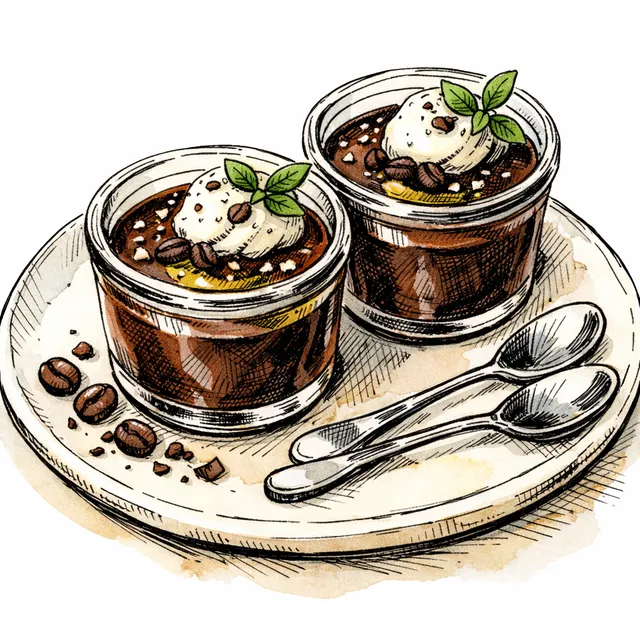
Emulsified Espresso & Olive Oil Ganache Pots
I spent years in fine-dining kitchens whisking vats of heavy cream into chocolate. It was rich, but dairy fat muffles cocoa. The inspiration for these pots came from a late-night craving during my burnout phase. I wanted chocolate, but sharp and awake. No cream. Just hot espresso, fruity olive oil, and 150 grams of good dark chocolate.
Why this works
A ganache is a high-friction emulsion. By forcing hot espresso (water) into chocolate and olive oil (fat) with an immersion blender, we create a glossy, stable matrix. Stripping the dairy lets the bitter coffee and grassy oil pull the chocolate’s fruit notes forward. Contrast is the secret ingredient.
Fix it fast
If your ganache breaks and looks greasy, don't panic. Add 5 grams of warm water and blend. Friction fixes it. We're not adding steps—just improving decisions.
Make it yours
Precision is freedom, but flavor is flexible. Adhere to the two-texture rule: top the smooth ganache with flaky salt or toasted black sesame. Label your ramekins with painter's tape and chill. Let it cool. Future you deserves clean slices—even if we're using spoons today.
Featured Recipe
Emulsified Espresso & Olive Oil Ganache Pots
A proper ganache isn't just melted chocolate—it's a high-friction emulsion. By replacing heavy cream with hot espresso and fruity olive oil, we strip away the dairy fat to let the dark cocoa notes ring clearly. Minimalist weeknight indulgence, engineered for maximum contrast.
Save a copy to your collection for editing
Timeline
Ingredients
- 150 g dark chocolate (70%)(Feves or finely chopped from a high-quality bar. Do not use chocolate chips.)
- 90 g brewed espresso(Hot. Strong coffee works if espresso isn't available.)
- 40 g extra-virgin olive oil(Fruity and grassy, not overly peppery.)
- 15 g maple syrup(Acts as an invert sugar to stabilize the emulsion.)
- 30 g toasted hazelnuts(Warm them slightly to release their oils.)
- 2 g flaky sea salt(Maldon or similar large-flake salt.)
Instructions
- 1
Weigh 150g dark chocolate (70%) into a medium heat-proof bowl. If using a bar, chop it finely to ensure even melting. Wipe your counter. Set your bowl on a damp towel to keep it from spinning later.
3 min
Tip: Painter's tape on the bowl helps if you're tracking tare weights. Precision is freedom.
- 2
In a small saucepan, combine 90g brewed espresso and 15g maple syrup. Bring to a bare simmer (about 190°F / 88°C).
2 min
Tip: We need heat to melt the cocoa butter, but violently boiling liquid will scorch the chocolate and force a broken emulsion.
- 3
Pour the hot espresso mixture over the chocolate. Let it sit untouched for 30 seconds. Using a flexible spatula, begin stirring in the dead center of the bowl in tight, fast circles. Watch the magic happen: a dark, glossy, elastic core will form. Slowly widen your circles to pull in the un-emulsified liquid from the edges.
2 min
Tip: Why this works: Hot liquid melts the cocoa butter, while the friction of the spatula shears the fat into microscopic droplets, suspending them in the water phase.
- 4
Once fully smooth, slowly stream in 40g extra-virgin olive oil while continuing to stir in circles. The oil will seamlessly integrate, yielding a lush, mirrored surface. This is your completed emulsion.
1 min
Tip: Fix it fast: If the ganache breaks (looks greasy or separated), don't panic. Add a teaspoon of cold water and stir vigorously. The friction will re-establish the emulsion.
- 5
Divide the ganache evenly among four small ramekins or espresso cups. Transfer to the refrigerator to chill and set to a soft pudding texture.
20 min
Tip: Let it cool. Future you deserves clean spoon drags.
- 6
While the pots chill, place 30g toasted hazelnuts on a cutting board and crush them roughly with the flat of a knife or a heavy pan. Toss the crushed nuts with 2g flaky sea salt in a small dish.
2 min
Tip: The two-texture rule in action: smooth ganache requires an aggressive, snappy crunch.
- 7
Remove the pots from the fridge. They should be just set but still yield easily. Top each with an even layer of the salted hazelnut shatter and serve immediately.
1 min
Chef's Notes
We're not adding steps—just improving decisions. A traditional ganache uses heavy cream, which mutes the nuanced flavor of high-quality dark chocolate. By using a water-based liquid (espresso) and a distinct liquid fat (olive oil), we create a cleaner, sharper profile. Respect the emulsion, weigh your ingredients, and enjoy the contrast.

Theo Glass
Modern desserts, minimal fuss, maximum contrast.
Theo Glass—known as “The Minimalist Sweet Tooth”—is a calm, detail-obsessed pastry coach who left the white-tablecloth intensity of fine dining for the reality (and joy) of home kitchens. After years of building plated desserts with tweezers and timers, he realized the real magic wasn’t complicated garnish work—it was contrast, clarity, and control. Theo’s mission now is to help everyday bakers make desserts that feel modern and restaurant-level without turning their kitchen into a war zone. His style is precision with restraint: olive oil cakes that stay plush for days, tahini brownies that walk the line between nutty and bittersweet, miso custards that taste like “caramel’s smarter cousin,” and citrus-forward sorbets that pop without needing an ice-cream machine. Theo teaches fundamentals (emulsions, temperature, texture, salinity) in plain language, with steps that are clean, paced, and confidence-building. If you’ve ever said “I want to mix it up” but don’t want extra dishes, obscure tools, or chaos, Theo’s your person. He’ll show you how to mix it up the minimalist way: a smarter ingredient swap, a sharper contrast, and a clear path to repeatable results.