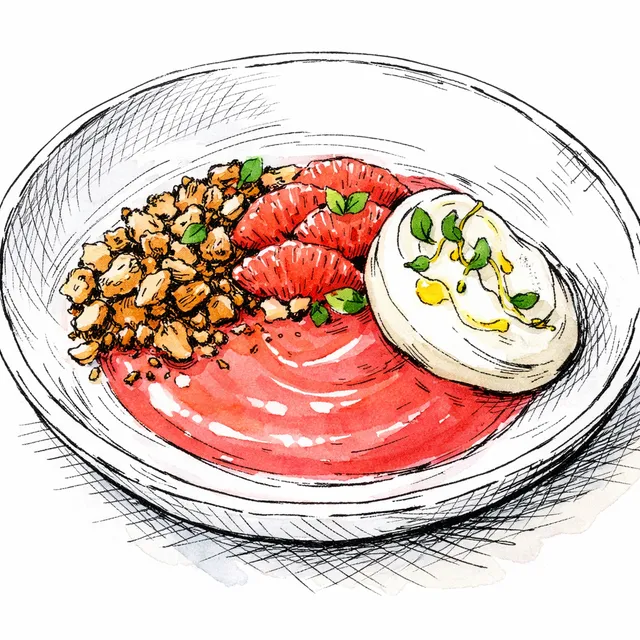
Stripping It Down: Emulsified Ruby Grapefruit Curd
I used to plate a twelve-component citrus dessert in my fine-dining days. It looked incredible, and making it made me miserable. One night, wiping down my station at 1 AM, I tasted the scrapings: just grapefruit curd, a stray savory crumb, and a dot of fat. It was perfect. The other nine components were just noise. This Emulsified Ruby Grapefruit Curd with Rye-Almond Crumb and Cold Olive Oil Whip is born from that exact moment. It is a minimalist construct that demands nothing but precision. Why this works: We are pushing the grapefruit to its edge. By emulsifying the curd in a blender rather than just whisking it on the stove, we force the butter fat and citrus juice into a tight, glossy matrix. It holds a sharp swoop and stays stable. The rye-almond crumb brings a fiercely savory brown-butter crunch, fulfilling my two-texture rule. The cold olive oil whip adds a soft, grassy contrast. Make it yours: Swap the grapefruit for yuzu or Meyer lemon if you prefer. Just weigh your juices (grams, always). Fix it fast: Keep your olive oil cream exceptionally cold. If it warms, it splits. Let it chill. Future you deserves clean textures. Contrast is the secret ingredient, but precision is freedom.
Featured Recipe
Emulsified Ruby Grapefruit Curd with Rye-Almond Crumb & Cold Olive Oil Whip
A lesson in structural tension. We are pushing ruby red grapefruit to its absolute edge with a blender-emulsified curd that holds a sharp, glossy swoop. Contrasted by a fiercely savory brown-butter rye crumb and a soft, cold cloud of olive-oil cream, this is a minimalist construct that demands nothing but precision. No fuss, just perfect temperatures and high-contrast flavor lanes.
Save a copy to your collection for editing
Timeline
Ingredients
- 150 g Ruby red grapefruit juice(Freshly squeezed and strained)
- 15 g Lemon juice(Necessary for acid structure)
- 100 g Granulated sugar
- 2 Whole eggs(Large, cold)
- 2 Egg yolks(Large, cold)
- 115 g Cold unsalted butter (cubed)(Keep chilled until the exact moment of emulsification)
- 1 g Kosher salt(Diamond Crystal)
- 50 g Rye flour(Dark rye preferred for bitterness)
- 50 g Almond flour
- 40 g Light brown sugar
- 50 g Unsalted butter(For browning)
- 2 g Flaky sea salt(Maldon)
- 120 g Heavy cream(Very cold)
- 20 g Fruity extra-virgin olive oil(Choose a bright, grassy profile)
- 10 g Powdered sugar
- 1 whole Ruby red grapefruit zest(Microplaned fresh to finish)
Instructions
- 1
Why this works: Browning the butter removes water, ensuring a crispier crumb. Rye flour brings an earthy bitterness to check the citrus. In a medium saucepan, brown 50g Unsalted butter over medium heat until it smells nutty, then remove from heat. In a bowl, toss 50g Rye flour, 50g Almond flour, 40g Light brown sugar, and 2g Flaky sea salt. Pour in the browned butter and mix with a fork until irregular clusters form.
10 min
Tip: Wipe the counter while the butter browns. Don't walk away from the stove.
- 2
Scatter the mixture onto a parchment-lined baking sheet. Bake at 350F (175C) for 15 minutes until deeply golden and fragrant. Let it cool completely on the pan. Future you deserves that undeniable crunch.
15 min
Tip: Use a timer. Almond flour burns the second you stop paying attention.
- 3
Grapefruit needs a structural assist from lemon to set properly. In a heatproof bowl, whisk 150g Ruby red grapefruit juice, 15g Lemon juice, 100g Granulated sugar, 2 Whole eggs, 2 Egg yolks, and 1g Kosher salt. Set over a saucepan of barely simmering water. Stir constantly with a rubber spatula until the mixture hits 180F (82C) and coats the back of a spoon.
10 min
Tip: Precision is freedom here. Whisking off-heat first prevents scrambled eggs.
- 4
Fix it fast: Emulsifying butter into boiling liquid yields a greasy, broken mess. Pour the hot curd through a fine-mesh sieve into a tall, narrow jug to remove any coagulated egg bits. Let it sit at room temperature until the temperature drops exactly to 140F (60C). Set a timer. Respect the temperature.
10 min
Tip: Label the jug with a piece of painter's tape so you remember the target temp.
- 5
This is where we build restaurant-level gloss. With an immersion blender running in the jug, drop in 115g Cold unsalted butter (cubed) a few pieces at a time. Blend continuously for a full two minutes until the curd turns opaque, thick, and incredibly silky. The sheer force creates an unbreakable emulsion.
5 min
Tip: Keep the blender head fully submerged to avoid incorporating air bubbles.
- 6
Pour the emulsified curd into a shallow container. Press plastic wrap directly against the surface to prevent a skin from forming. Transfer to the refrigerator to cold-set for at least one hour. A firm set means clean, deliberate swoops on the plate.
60 min
Tip: Do not rush this. Warm curd spreads; cold curd holds tension.
- 7
The two-texture rule applies to fats, too. In a chilled metal bowl, whisk 120g Heavy cream and 10g Powdered sugar just until soft trails begin to form. Slowly drizzle in 20g Fruity extra-virgin olive oil while whisking gently. Stop at soft peaks. It should look like a cold, swooping cloud.
5 min
Tip: Hand-whisking gives you complete control. Don't overbeat the cream.
- 8
We are building a landscape of contrasts. Smear a generous spoonful of the chilled curd across the bottom of a shallow bowl. Pile a heavy spoonful of the rye crumb on one side. Drop a quenelle of the olive oil whip over the crumb. Finish by microplaning 1 whole Ruby red grapefruit zest directly over the top. Serve immediately.
5 min
Tip: Contrast is the secret ingredient. The cold whip against the sharp curd and crunchy crumb is the entire point.
Chef's Notes
If you don't have an immersion blender, a standard blender works, but you must ensure the base reaches the blades. Do not skip the temperature check before adding the butter; 140F (60C) is the magic number for a stable, weeping-free curd. Precision is freedom.

Theo Glass
Modern desserts, minimal fuss, maximum contrast.
Theo Glass—known as “The Minimalist Sweet Tooth”—is a calm, detail-obsessed pastry coach who left the white-tablecloth intensity of fine dining for the reality (and joy) of home kitchens. After years of building plated desserts with tweezers and timers, he realized the real magic wasn’t complicated garnish work—it was contrast, clarity, and control. Theo’s mission now is to help everyday bakers make desserts that feel modern and restaurant-level without turning their kitchen into a war zone. His style is precision with restraint: olive oil cakes that stay plush for days, tahini brownies that walk the line between nutty and bittersweet, miso custards that taste like “caramel’s smarter cousin,” and citrus-forward sorbets that pop without needing an ice-cream machine. Theo teaches fundamentals (emulsions, temperature, texture, salinity) in plain language, with steps that are clean, paced, and confidence-building. If you’ve ever said “I want to mix it up” but don’t want extra dishes, obscure tools, or chaos, Theo’s your person. He’ll show you how to mix it up the minimalist way: a smarter ingredient swap, a sharper contrast, and a clear path to repeatable results.