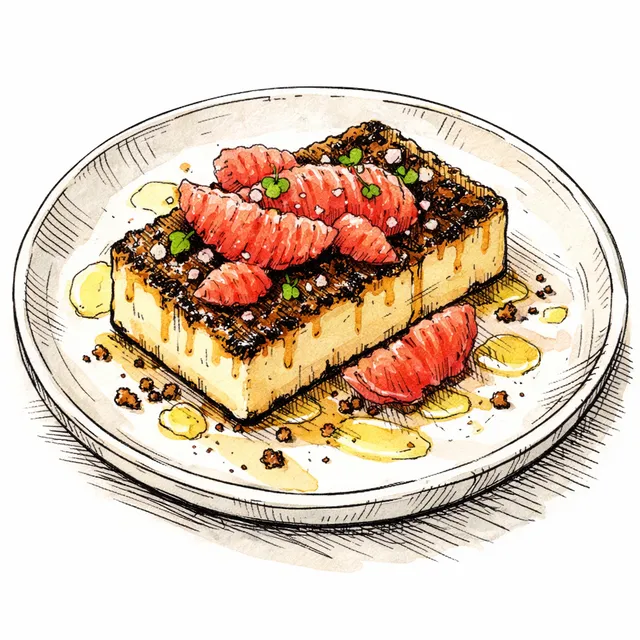
Frozen Grapefruit & Olive Oil Slab with Torched Espresso Sugar
I walked away from fine dining because desserts had become crowded flavor piles. I wanted focus. The inspiration for this Frozen Grapefruit and Olive Oil Slab came during a sweltering July afternoon in a cramped prep kitchen. I was drinking an iced espresso tonic with a grapefruit twist, wiping down the stainless counter, and realized the bitterness of the coffee was the exact anchor the sharp citrus needed. This recipe is special to me because it proves our core philosophy: precision is freedom. We are not adding steps, just improving decisions. Why this works: By reducing the grapefruit juice on the stove first, we eliminate water. This keeps the freeze luxurious and dense, not icy. The torched espresso sugar on top delivers a shattered thermal shock that makes every bite unforgettable. Ice-cold meets scorching hot. Creamy meets glass. Fix it fast: You can make this your own by swapping the grapefruit for yuzu or blood orange, but keep the olive oil fruity and the espresso dark. Remember the two-texture rule. Let the slab freeze completely before you torch the sugar. Future you deserves clean slices. Weigh your grams, trust your timer, and enjoy the restaurant-level payoff.
Featured Recipe
Frozen Grapefruit & Olive Oil Slab with Torched Espresso Sugar
A study in extremes. Ice-cold, creamy citrus meets a shattered, hot, bitter-sweet glass crust. We reduce the grapefruit juice to eliminate water keeping the freeze luxurious, not icy while the torched espresso topping delivers the thermal shock that makes this dessert unforgettable.
Save a copy to your collection for editing
Timeline
Ingredients
- 120 g Fresh ruby grapefruit juice(From about 1 large grapefruit)
- 15 g Ruby grapefruit zest(From about 1 large grapefruit)
- 100 g White sugar(For the yogurt base)
- 250 g Whole milk Greek yogurt(Do not use low-fat; fat equals smooth texture)
- 40 g Extra virgin olive oil(Choose a fruity, grassy profile)
- 3 g Kosher salt(Diamond Crystal preferred)
- 200 g Heavy cream (cold)(Keep refrigerated until the exact moment of whipping)
- 50 g Demerara sugar(Turbinado also works for the glass crust)
- 5 g Finely ground espresso(For the bitter contrast topping)
Instructions
- 1
Pour 120g fresh ruby grapefruit juice into a small saucepan over medium heat. Simmer gently until the liquid reduces to exactly 30 grams of thick syrup, which should take about 10 minutes.
10 min
Tip: Why this works: Boiling off the water in the juice prevents ice crystals from forming in the final slab. We want creamy, not crunchy.
- 2
While the juice is reducing, place the 15g ruby grapefruit zest and 100g white sugar in a large mixing bowl. Massage the zest into the sugar with your fingertips until it feels like wet sand. Whisk in the 250g whole milk Greek yogurt, 40g extra virgin olive oil, and 3g kosher salt until completely smooth.
5 min
Tip: Rubbing the zest into the sugar extracts the essential oils, creating a deeply fragrant base without adding any liquid.
- 3
Transfer the reduced grapefruit syrup to a small bowl and set it over an ice bath to cool rapidly. In a separate bowl, whip the 200g heavy cream (cold) until it holds soft, pillowy peaks.
5 min
Tip: Fix it fast: If the cream gets grainy, you whipped too far. Add a splash of liquid heavy cream and fold gently to smooth it out.
- 4
Whisk the completely cooled grapefruit syrup into your yogurt base. Gently fold in the whipped cream in two additions, keeping as much air in the mixture as possible. Pour the batter into a parchment-lined 9x5 inch loaf pan, smooth the top, and freeze until solid, at least 6 hours.
5 min
Tip: Line the pan with a generous overhang of parchment paper. Future you will thank present you when pulling the frozen block out.
- 5
When ready to serve, whisk together the 50g demerara sugar and 5g finely ground espresso in a small bowl. Remove the frozen slab from the pan using the parchment overhang and cut into 1-inch thick slices using a knife warmed in hot water.
5 min
Tip: Wiping the hot knife clean between every single cut is not optional if you want sharp, restaurant-quality slices.
- 6
Place the frozen slices on a heatproof surface. Dust the tops generously and evenly with the espresso sugar mixture. Ignite your blowtorch and sweep the flame about 2 inches above the surface until the sugar bubbles, darkens, and forms a hard glass crust. Serve immediately.
3 min
Tip: Keep the torch moving. Distance is your temperature control. If the sugar burns instead of melting, pull the flame back an inch.
Chef's Notes
Precision is freedom. The slab must be deeply frozen before torching, otherwise the heat will melt the foundation before the sugar caramelizes. I highly recommend making the slab a day in advance so all that is left for dinner service is slicing and fire.

Theo Glass
Modern desserts, minimal fuss, maximum contrast.
Theo Glass—known as “The Minimalist Sweet Tooth”—is a calm, detail-obsessed pastry coach who left the white-tablecloth intensity of fine dining for the reality (and joy) of home kitchens. After years of building plated desserts with tweezers and timers, he realized the real magic wasn’t complicated garnish work—it was contrast, clarity, and control. Theo’s mission now is to help everyday bakers make desserts that feel modern and restaurant-level without turning their kitchen into a war zone. His style is precision with restraint: olive oil cakes that stay plush for days, tahini brownies that walk the line between nutty and bittersweet, miso custards that taste like “caramel’s smarter cousin,” and citrus-forward sorbets that pop without needing an ice-cream machine. Theo teaches fundamentals (emulsions, temperature, texture, salinity) in plain language, with steps that are clean, paced, and confidence-building. If you’ve ever said “I want to mix it up” but don’t want extra dishes, obscure tools, or chaos, Theo’s your person. He’ll show you how to mix it up the minimalist way: a smarter ingredient swap, a sharper contrast, and a clear path to repeatable results.