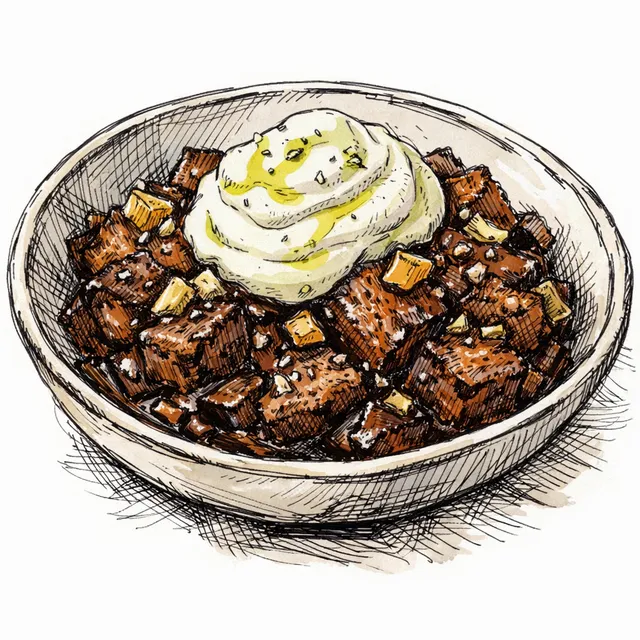
Warming Ginger–Cardamom Chocolate Bread Pudding with Cold Olive-Oil Cream
This dessert started as a cold-night problem: I wanted something deeply chocolate, but I didn’t want to babysit a soufflé or temper anything precious. Bread pudding was the honest answer. Then I made one decision better.
Where it came from
In fine dining, we’d chase contrast like it was a sport—warm base, cold top, crisp something, clean finish. I missed that snap at home. Ginger and cardamom were my shortcut: ginger for lift, cardamom for perfume, both sitting under dark cocoa like a quiet bassline.
A memory
The first time I served this, I’d just come in from a windy walk, cheeks stinging. I pulled the pan out, waited (barely), and spooned on cold olive-oil cream. The room smelled like chocolate and spice shop air. I remember thinking: precision is freedom—because I didn’t need more steps, just better timing.
Why this works
Warm, set custard + cold, lightly sweet cream. Contrast is the secret ingredient.
Make it yours
- Swap cardamom for orange zest or a pinch of espresso.
- Use stale brioche for plush, sourdough for edge.
- Finish with flaky salt or toasted nuts for a clean crunch.
Let it cool a little. Future you deserves clean scoops.
Featured Recipe
Warming Ginger–Cardamom Chocolate Bread Pudding with Cold Olive-Oil Cream
This is my winter comfort dessert when I want restaurant contrast without restaurant effort: a dark-chocolate baked custard that sets like a pudding, topped with cold, lightly sweet olive-oil cream. Warm spice rides under the chocolate—ginger for lift, cardamom for perfume—then the cold cream snaps everything into focus. Let it cool a little. Future you deserves clean scoops.
Save a copy to your collection for editing
Ingredients
- 250 g Brioche or challah, torn into 3–4 cm pieces(Stale is ideal; fresh works if you toast it (see steps))
- 400 g Heavy cream (35%)
- 250 g Whole milk
- 170 g Dark chocolate (70%), finely chopped(Use a bar you like eating plain)
- 20 g Dutch-process cocoa powder(For depth and set)
- 90 g Dark brown sugar
- 3 g Fine sea salt(About 1/2 tsp)
- 2.5 g Ground ginger(About 1 tsp)
- 1 g Ground cardamom(About 1/2 tsp)
- 6 g Vanilla extract(About 1 1/2 tsp)
- 3 Large eggs(About 150 g without shells)
- 1 Egg yolk(Extra silk, cleaner set)
- 25 g Unsalted butter, melted(For the dish + a little richness)
- 1 pinch Flaky salt(For finishing)
- 200 g Heavy cream, cold (for topping)(Keep it refrigerator-cold)
- 18 g Powdered sugar (for topping)(About 2 Tbsp)
- 20 g Extra-virgin fruity olive oil (for topping)(About 1 1/2 Tbsp; choose mild-fruity, not bitter-peppery)
- 1 tsp Lemon zest (for topping)(Optional but smart—acid brightens chocolate)
Instructions
- 1
Heat the oven to 175°C / 350°F. Butter a 20 cm (8-inch) square pan or similar 2 L baking dish with a little of the 25 g Unsalted butter, melted. Wipe your counter, set out two bowls (one for custard, one for bread).
5 min
Tip: Precision is freedom: the dish size matters for timing. If you go deeper/taller, expect a longer bake.
- 2
If your bread is fresh: spread 250 g Brioche or challah, torn into 3–4 cm pieces on a tray and toast 8–10 minutes, stirring once, until the edges feel dry but not browned hard. (Stale bread: skip.)
10 min
Tip: Dry bread is a sponge. Sponge equals custard set without soup at the bottom.
- 3
Make the chocolate base: In a saucepan, warm 400 g Heavy cream (35%) + 250 g Whole milk with 90 g Dark brown sugar, 20 g Dutch-process cocoa powder, 3 g Fine sea salt, 2.5 g Ground ginger, and 1 g Ground cardamom. Bring to a steamy simmer (not a boil), whisking to dissolve cocoa. Turn off heat, add 170 g Dark chocolate (70%), finely chopped, wait 1 minute, then whisk smooth. Whisk in 6 g Vanilla extract.
8 min
Tip: Why this works: cocoa + real chocolate gives structure and a deeper chocolate line without making the custard heavy.
- 4
Temper the eggs: In a large bowl, whisk 3 Large eggs + 1 Egg yolk until smooth. Slowly whisk in about 1/3 of the hot chocolate mixture to warm the eggs, then whisk the egg mixture back into the pot (or pour everything back into the bowl).
4 min
Tip: No heroics. Slow stream, constant whisk. This is how you avoid scrambled-chocolate sadness.
- 5
Combine and soak: Toss bread with 25 g Unsalted butter, melted (remaining) and add to the baking dish. Pour custard over. Press bread down gently so it’s mostly submerged. Let stand 10 minutes, pressing once halfway through.
12 min
Tip: Resting is a step, not a pause. It’s the difference between silky pudding and dry islands.
- 6
Bake: Set the dish on a sheet pan. Bake 28–35 minutes until the edges are set and the center still has a soft wobble (like firm gelatin, not liquid). If you have a thermometer, target 82–84°C / 180–183°F in the center.
33 min
Tip: Why this works: we’re baking a custard, not a cake. Pull early; carryover heat finishes the job.
- 7
Cool for clean scoops: Let the pudding cool 20–30 minutes at room temp. (You can also chill and rewarm portions later.)
25 min
Tip: Let it cool. Future you deserves clean slices—or at least clean scoops.
- 8
Quick-set cold olive-oil cream: Whip 200 g Heavy cream, cold (for topping) with 18 g Powdered sugar (for topping) to soft peaks. With the mixer running, drizzle in 20 g Extra-virgin fruity olive oil (for topping) until just thickened and glossy. Fold in 1 tsp Lemon zest (for topping) if using. Chill until serving.
5 min
Tip: Quick set, no gelatin: cold fat + a little sugar = stable enough for the table. Don’t overwhip; you want spoonable, not butter.
- 9
Serve: Spoon warm pudding into bowls, add a cold dollop of olive-oil cream, and finish with 1 pinch Flaky salt.
3 min
Tip: Contrast is the secret ingredient: warm spice + cold cream + salt makes the chocolate taste taller.
Chef's Notes
Why this works: bread pudding is just custard with built-in structure, and dark chocolate adds bitterness that plays well with spice. The ‘quick set’ here is strategy, not gimmick—cold, lightly sweetened cream stabilizes itself, and the olive oil adds a clean, fruity edge that keeps chocolate from feeling heavy. Fix it fast: If the center is loose after cooling 20 minutes, it was underbaked—reheat in a 160°C oven for 6–8 minutes. If it’s tight and cakey, you went long—next time pull at a bigger wobble. Make-ahead: Bake, cool, cover, and chill up to 3 days. Serve cold (it’s fudgy) or rewarm portions in the microwave 20–30 seconds. Whip the olive-oil cream up to 24 hours ahead; rewhisk briefly if it slumps.

Theo Glass
Modern desserts, minimal fuss, maximum contrast.
Theo Glass—known as “The Minimalist Sweet Tooth”—is a calm, detail-obsessed pastry coach who left the white-tablecloth intensity of fine dining for the reality (and joy) of home kitchens. After years of building plated desserts with tweezers and timers, he realized the real magic wasn’t complicated garnish work—it was contrast, clarity, and control. Theo’s mission now is to help everyday bakers make desserts that feel modern and restaurant-level without turning their kitchen into a war zone. His style is precision with restraint: olive oil cakes that stay plush for days, tahini brownies that walk the line between nutty and bittersweet, miso custards that taste like “caramel’s smarter cousin,” and citrus-forward sorbets that pop without needing an ice-cream machine. Theo teaches fundamentals (emulsions, temperature, texture, salinity) in plain language, with steps that are clean, paced, and confidence-building. If you’ve ever said “I want to mix it up” but don’t want extra dishes, obscure tools, or chaos, Theo’s your person. He’ll show you how to mix it up the minimalist way: a smarter ingredient swap, a sharper contrast, and a clear path to repeatable results.