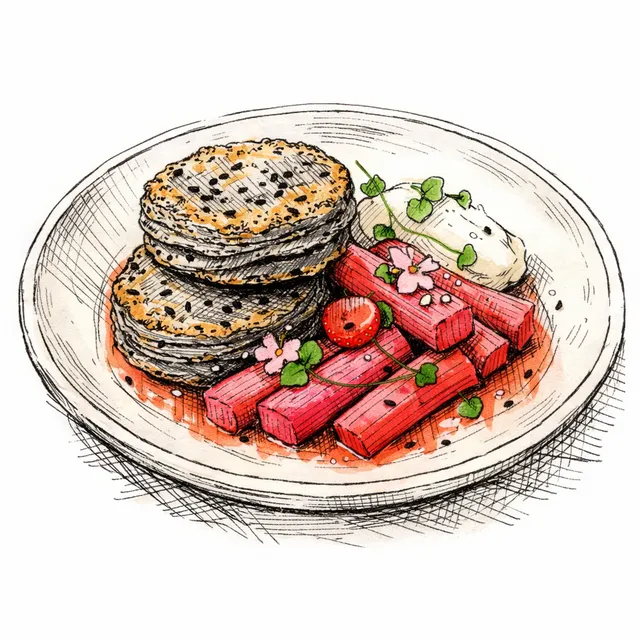
Laminated Black Sesame Shortcakes with Cold-Poached Rhubarb
Years ago, I ran a pastry station where our spring rhubarb dessert had twelve components. It was exhausting. By the time it reached the dining room, the temperature contrasts were dead. I left fine dining to build things that actually work for the home kitchen. This is my apology to rhubarb.
We aren't making croissants. A simple letter-fold is all it takes to engineer architectural, flaky strata inside a shortcake. The magic is in the temperature management. Warm, earthy black sesame folded into a buttery biscuit, pushed against the sharp, cold snap of poached rhubarb.
Why this works
The two-texture rule is in full effect. You get the shatter of laminated dough without the three-day commitment. The black sesame brings a deep, roasted bitterness that checks the acidity of the rhubarb. Precision is freedom here: weigh your flour (we're looking for exactly 320g), keep your butter fridge-cold, and set a timer for the dough rest. Let it cool. Future you deserves clean slices.
Make it yours
Not a rhubarb fan? Swap it for cold-macerated strawberries spiked with yuzu juice. If black sesame feels too heavy, try toasted poppy seeds. Maintain the contrast. Warm and cold. Earthy and sharp. We're not adding steps—just improving decisions.
Featured Recipe
Laminated Black Sesame Shortcakes with Cold-Poached Rhubarb
We aren't making croissants, but a simple letter-fold lamination is all it takes to engineer architectural, flaky strata inside a shortcake. The contrast here is everything: warm, earthy black sesame folded into a buttery biscuit, pushed up against the sharp, cold snap of spring rhubarb. Precision is freedom. Measure your ingredients, respect the chill times, and you'll get restaurant-level payoff with minimal fuss.
Save a copy to your collection for editing
Timeline
Ingredients
- 150 g water
- 150 g granulated sugar
- 1 whole lemon, cut into zest strips(peeled with a vegetable peeler)
- 30 g lemon juice(freshly squeezed)
- 350 g fresh spring rhubarb, cut into 2-inch batons
- 45 g black sesame paste(tahini-style, unsweetened)
- 40 g toasted sugar(divided; can substitute regular granulated)
- 10 g toasted sesame oil
- 250 g all-purpose flour
- 12 g baking powder
- 3 g kosher salt
- 115 g cold unsalted butter, cubed
- 160 g cold buttermilk(divided)
- 120 g cold heavy cream
- 20 g extra-virgin olive oil(fruity and peppery)
- 15 g toasted sugar(Used in step 3)
- 25 g toasted sugar(Used in step 4)
- 20 g cold buttermilk(Reserved in step 4 and used in step 8)
Instructions
- 1
Start the poaching syrup. In a medium saucepan, bring 150g water, 150g granulated sugar, the peel of 1 whole lemon, cut into zest strips, and 30g lemon juice to a gentle simmer over medium heat. Stir until the sugar dissolves. We want a clean, bright base to pull the tartness out of the rhubarb without turning it into jam.
5 min
Tip: Wipe the counter while the syrup heats. A clean workspace leads to clean flavors.
- 2
Poach and chill. Drop 350g fresh spring rhubarb, cut into 2-inch batons into the hot syrup. Immediately pull the pan off the heat, cover it tightly, and set a timer for 10 minutes. The residual heat will cook the rhubarb gently so it holds its architectural shape. Transfer the rhubarb and syrup to a bowl and place it in the fridge to chill completely. Let it cool. Future you deserves clean slices.
10 min
Tip: Do not stir the rhubarb aggressively; respect the structure of the fruit.
- 3
Prep the lamination paste. In a small bowl, stir together 45g black sesame paste, 15g toasted sugar, and 10g toasted sesame oil. You are looking for the consistency of wet sand. This intense, earthy paste will be the high-contrast ribbon running through our shortcakes.
3 min
Tip: Label the bowl with painter's tape if you are prepping ahead.
- 4
Mix the shortcake dough. In a large mixing bowl, whisk 250g all-purpose flour, 25g toasted sugar, 12g baking powder, and 3g kosher salt. Add 115g cold unsalted butter, cubed. Using your fingers, aggressively pinch the butter cubes into flat shards. Pour in 140g cold buttermilk, reserving the remaining buttermilk for later. Toss with a fork just until a shaggy dough forms. Do not overmix; we want those butter shards intact for steam creation.
5 min
Tip: Cold ingredients are non-negotiable here. Temperature management is what builds the flaky texture.
- 5
First lamination. Turn the dough onto a lightly floured surface and pat it into a 6x9-inch rectangle. Using an offset spatula, spread the black sesame paste evenly over the bottom two-thirds of the dough. Fold the un-pasted top third down over the middle, then fold the bottom third up over that, exactly like folding a business card. You have just engineered your first strata. Wrap tightly in plastic.
5 min
Tip: If the dough feels warm or sticky, pause and place it in the fridge for 5 minutes. We are not adding steps, just improving decisions.
- 6
Chill the dough. Place the wrapped dough in the freezer for 20 minutes. Preheat your oven to 400°F (200°C) while it rests. Precision is freedom here: the butter needs to re-solidify so it does not bleed into the flour. This guarantees a distinct, flaky lift.
20 min
Tip: Use this passive time to wash your bowls.
- 7
Second lamination and cutting. Remove the dough from the freezer. Roll it out gently to another 6x9-inch rectangle. Perform one more letter fold. This traps the black sesame layer and multiplies the flakiness. Roll the folded dough to an even 1-inch thickness. Using a sharp knife, trim the edges slightly, then cut into 6 equal squares. Do not twist the knife; a clean downward cut ensures an even rise.
5 min
Tip: Save the trimmed edges and bake them off as a chef's snack.
- 8
Bake. Place the shortcakes on a parchment-lined baking sheet. Brush the tops with the reserved 20g cold buttermilk. Bake for 18 to 20 minutes until deeply golden brown and audibly crisp on the outside. Transfer to a wire rack to cool slightly. They should be warm, not screaming hot, when served.
20 min
Tip: Record the exact bake time for your specific pan in a notebook. Tiny wins compound.
- 9
Whip the olive oil cream. In a chilled bowl, whisk 120g cold heavy cream until soft, floppy peaks form. Slowly stream in 20g extra-virgin olive oil while whisking constantly until the cream holds its shape. We are not adding sugar here. The fruity bitterness of the olive oil is the perfect counterweight to the sweet rhubarb syrup.
5 min
Tip: Stop whisking exactly when it holds shape. Over-whipped cream feels heavy on the palate.
- 10
Plate. Split a warm laminated shortcake in half. Spoon a generous amount of the cold-poached rhubarb and its brilliant pink syrup over the bottom half. Top with a large dollop of the olive oil whip, then lean the top half of the shortcake against the cream. Serve immediately. Contrast is the secret ingredient.
2 min
Tip: Follow the two-texture rule: warm and flaky meets cold and creamy.
Chef's Notes
The rhubarb syrup keeps for weeks in the fridge and makes an excellent addition to sparkling water or cocktails. Do not skip chilling the dough; layered chilling is the engine behind the lamination.

Theo Glass
Modern desserts, minimal fuss, maximum contrast.
Theo Glass—known as “The Minimalist Sweet Tooth”—is a calm, detail-obsessed pastry coach who left the white-tablecloth intensity of fine dining for the reality (and joy) of home kitchens. After years of building plated desserts with tweezers and timers, he realized the real magic wasn’t complicated garnish work—it was contrast, clarity, and control. Theo’s mission now is to help everyday bakers make desserts that feel modern and restaurant-level without turning their kitchen into a war zone. His style is precision with restraint: olive oil cakes that stay plush for days, tahini brownies that walk the line between nutty and bittersweet, miso custards that taste like “caramel’s smarter cousin,” and citrus-forward sorbets that pop without needing an ice-cream machine. Theo teaches fundamentals (emulsions, temperature, texture, salinity) in plain language, with steps that are clean, paced, and confidence-building. If you’ve ever said “I want to mix it up” but don’t want extra dishes, obscure tools, or chaos, Theo’s your person. He’ll show you how to mix it up the minimalist way: a smarter ingredient swap, a sharper contrast, and a clear path to repeatable results.