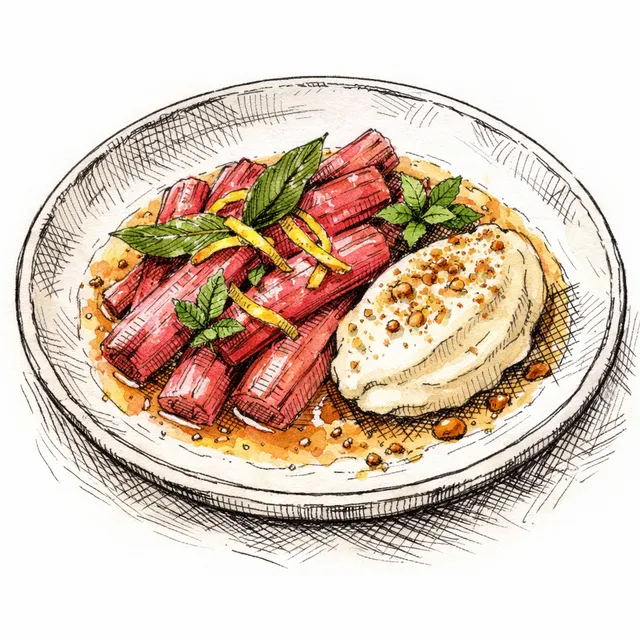
Lemon-Bay Poached Rhubarb with Cold Brown Butter Mascarpone
I spent years in fine dining watching cooks boil rhubarb into stringy mush. It tasted fine, but the texture was a surrender. The inspiration for this Lemon-Bay Poached Rhubarb came from a notebook entry I wrote after a particularly brutal dinner service: "Stop fighting the fruit." The Turning Point Here is the memory: I was plating fifty covers, frantic, dropping hot compote over rapidly melting ice cream. Everything bled together. I realized right there that contrast is the secret ingredient. Warm needs cold. Yielding needs snap. Why This Recipe Matters This dish is special to me because it proves that precision is freedom. By utilizing a residual-heat poach—dropping the rhubarb batons into a hot lemon-bay syrup and immediately pulling the pot off the heat—we engineer perfectly tender, structurally sound fruit. We pair that warm baton against an ice-cold brown butter mascarpone. A toasted coriander and almond crunch adds the necessary architectural snap. It satisfies my strict two-texture rule without overcrowding the plate. Make It Yours Try swapping the almond for toasted black sesame, or add a micro-adjustment of yuzu zest to the mascarpone. We are not adding steps—just improving decisions.
Featured Recipe
Lemon-Bay Poached Rhubarb with Cold Brown Butter Mascarpone
Rhubarb usually gets boiled into submission. We’re not doing that. By employing a residual-heat poach, we engineer perfectly tender, structurally sound batons that sit warm against an ice-cold brown butter mascarpone. A toasted coriander and almond crunch adds the necessary architectural snap.
Save a copy to your collection for editing
Timeline
Ingredients
- 300 g Rhubarb(cut into exact 2-inch batons)
- 200 g Water(for poaching)
- 100 g Dry white wine(Sauvignon Blanc or Pinot Grigio)
- 100 g Granulated sugar(for poaching)
- 1 Lemon(peeled in strips, plus juice reserved)
- 1 Bay leaf(fresh or dried)
- 150 g Mascarpone(kept very cold)
- 30 g Unsalted butter(for browning)
- 15 g Powdered sugar(sifted)
- 30 g Flour(all-purpose)
- 30 g Brown sugar(light or dark)
- 30 g Unsalted butter(melted, for crunch)
- 40 g Sliced almonds(raw)
- 2 g Coriander seeds(lightly crushed)
- 2 g Flaky sea salt(plus extra for finishing)
- 2 g coriander seeds, crushed(Mentioned in Step 1 but not listed in ingredients. Assuming 'coriander seeds' in the ingredient list refers to the whole seeds.)
Instructions
- 1
Preheat your oven to 350°F (175°C) and line a small baking sheet with parchment. In a mixing bowl, combine 40g sliced almonds, 30g flour, 30g brown sugar, 2g crushed coriander seeds, and 2g flaky sea salt. Pour in 30g melted unsalted butter and toss with a fork until the mixture forms coarse, sandy clumps.
5 min
Tip: Coriander provides a floral, citrus-like contrast that bridges the gap between the lemon and the rich butter. Don't skip it.
- 2
Spread the crumble mixture evenly onto your prepared baking sheet. Bake until deeply golden and fragrant. Remove from the oven and let it cool completely on the tray. Future you deserves a crisp garnish, and cooling is where the crunch sets.
12 min
Tip: Set a timer. Nut-heavy crumbles can burn quickly in the last two minutes.
- 3
While the crunch bakes, build your poaching liquid. In a wide saucepan, combine 200g water, 100g dry white wine, 100g granulated sugar, the peeled strips of 1 lemon, and 1 bay leaf. Bring to a rolling boil over medium-high heat, stirring once to dissolve the sugar.
5 min
Tip: A wide saucepan is crucial. We want the rhubarb in a single layer later.
- 4
Remove the boiling syrup from the heat entirely. Wait exactly 60 seconds for the temperature to drop slightly, then gently lower in 300g rhubarb. Cover with a tight-fitting lid and let sit undisturbed off the heat. Precision is freedom: residual heat cooks the rhubarb gently so it doesn't collapse into mush.
15 min
Tip: Do not stir the rhubarb. Rhubarb is fragile and will shred if handled roughly while warm.
- 5
In a small, light-colored skillet over medium heat, melt 30g unsalted butter. Swirl the pan constantly until the milk solids drop to the bottom and toast to a deep hazelnut color. Immediately pour the brown butter into a cool bowl to stop the cooking and let it come to room temperature.
5 min
Tip: A light-colored pan allows you to see the milk solids browning. Dark non-stick hides the transition from brown to burnt.
- 6
Set a medium mixing bowl over a larger bowl filled with a handful of ice and cold water. Add 150g cold mascarpone, 15g powdered sugar, and the cooled brown butter. Hand-whisk vigorously but briefly, just until it holds a stiff, cold peak. Place in the fridge immediately.
3 min
Tip: Over-mixing splits mascarpone. Keep it over the ice bath and stop the second it holds structure.
- 7
Carefully remove the lid from the rhubarb. Using a slotted spoon or offset spatula, gently transfer the intact batons to a plate. Return the saucepan with the remaining liquid to high heat. Add the reserved juice of the lemon. Boil rapidly until reduced to a thick, glossy syrup.
5 min
Tip: The glaze is ready when large, lazy bubbles form and the liquid coats the back of a spoon.
- 8
To plate, swipe a generous, cold spoonful of the brown butter mascarpone across the base of your dish. Lay the warm rhubarb batons alongside it. Spoon the hot, reduced bay-lemon syrup over the fruit. Finish with a heavy shower of the cooled coriander-almond crunch.
2 min
Tip: Two-texture rule in effect: hot/cold, soft/crunchy. Serve immediately while the temperature contrast is at its peak.
Chef's Notes
Contrast is the secret ingredient here. Warm, tart rhubarb against icy, fat-rich mascarpone. Soft fruit against shattering coriander crunch. We aren't adding unnecessary steps, just making smarter decisions about temperature and timing. Label your bowls, set your timer, and trust the residual heat.

Theo Glass
Modern desserts, minimal fuss, maximum contrast.
Theo Glass—known as “The Minimalist Sweet Tooth”—is a calm, detail-obsessed pastry coach who left the white-tablecloth intensity of fine dining for the reality (and joy) of home kitchens. After years of building plated desserts with tweezers and timers, he realized the real magic wasn’t complicated garnish work—it was contrast, clarity, and control. Theo’s mission now is to help everyday bakers make desserts that feel modern and restaurant-level without turning their kitchen into a war zone. His style is precision with restraint: olive oil cakes that stay plush for days, tahini brownies that walk the line between nutty and bittersweet, miso custards that taste like “caramel’s smarter cousin,” and citrus-forward sorbets that pop without needing an ice-cream machine. Theo teaches fundamentals (emulsions, temperature, texture, salinity) in plain language, with steps that are clean, paced, and confidence-building. If you’ve ever said “I want to mix it up” but don’t want extra dishes, obscure tools, or chaos, Theo’s your person. He’ll show you how to mix it up the minimalist way: a smarter ingredient swap, a sharper contrast, and a clear path to repeatable results.