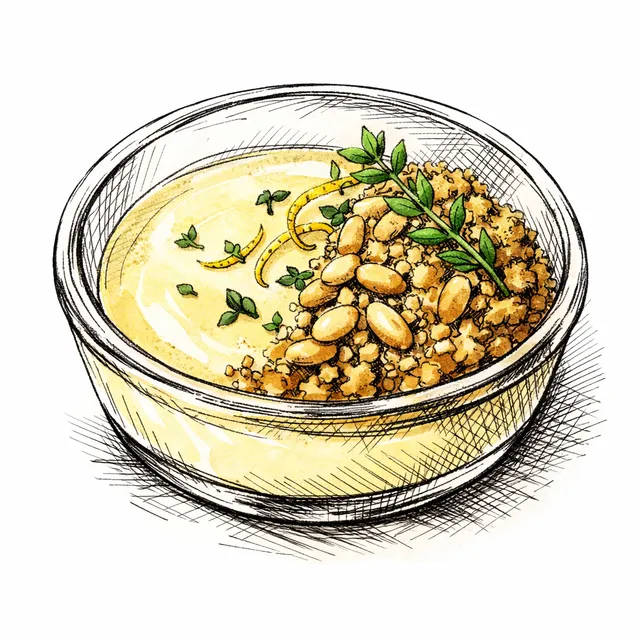
Precision is Freedom: Lemon-Thyme Posset with Olive Oil Sand
I used to overbuild desserts. Ten-component plates, tweezers, and gelatin sheets. Then I remembered the posset. Heavy cream, sugar, and lemon juice. That is it. The acid reacts with the cream to create a velvet-smooth set. It is a masterclass in minimalist chemistry. I first made this for a late-night staff meal when we needed something bright after a bruising service. I infused the cream with thyme, poured it into glasses, and let the fridge do the work. The kitchen was dead quiet when we ate it. That silence is why this recipe stays in my rotation. Precision is freedom here. Weigh your lemon juice to exactly 75 grams. Let it cool. Future you deserves clean slices. To satisfy the two-texture rule, I build a quick pine nut and fruity olive oil sand, hit with black pepper. Contrast is the secret ingredient, and the pepper cuts the richness perfectly. Fix it fast / Make it yours: Swap thyme for fresh basil, or trade pine nuts for toasted pistachios. Just remember to balance your micro-adjustments with a pinch of flaky salt. We are not adding steps—just improving decisions. Grab your kitchen scale, wipe down your counter, and set a timer.
Featured Recipe
Lemon-Thyme Posset with Pine Nut & Olive Oil Sand
A masterclass in minimalist chemistry. Heavy cream, sugar, and lemon juice react to create a velvet-smooth, sliceable dessert without a gram of gelatin. The infused thyme and black pepper-pine nut sand provide the necessary contrast to cut the richness.
Save a copy to your collection for editing
Timeline
Ingredients
- 600 g heavy cream(At least 36% fat. Do not substitute half-and-half.)
- 150 g granulated sugar
- 90 g lemon juice(Freshly squeezed and strained. Do not use bottled.)
- 10 g lemon zest(From about 2 large lemons, microplaned.)
- 5 g fresh thyme sprigs(Left whole on the stem for easy removal.)
- 70 g pine nuts
- 15 g extra-virgin olive oil(Fruity and grassy.)
- 2 g flaky sea salt(Maldon or similar.)
- 1 g freshly ground black pepper(Just a few turns of the mill.)
Instructions
- 1
Mise en place. Wipe the counter. Grab your scale. Zest lemons to yield 10g lemon zest, and juice them to yield exactly 90g lemon juice. Weigh out your 5g fresh thyme sprigs. Label your bowls with painter's tape so you aren't guessing later. Precision is freedom.
5 min
Tip: Always zest before juicing. Strain the juice so no pulp interferes with our final texture.
- 2
Why this works: Boiling cream reduces the water content, allowing the fat molecules to properly bind with the acid later. In a heavy-bottomed saucepan, combine 600g heavy cream, 150g granulated sugar, the 10g lemon zest, and the 5g fresh thyme sprigs. Bring to a boil over medium-high heat. Once bubbling vigorously, set a timer for exactly 3 minutes. Stir constantly, adjusting heat so it doesn't boil over.
8 min
Tip: Watch the pot closely. Cream expands rapidly when boiling. Keep your whisk moving in figure-eights.
- 3
Remove the saucepan from the heat. Immediately whisk in the 90g lemon juice. Watch the magic happen—the mixture will visibly thicken as the acid alters the protein structure of the dairy. Let it sit undisturbed for 1 minute.
2 min
Tip: Do not return the mixture to the heat once the acid is added, or you risk breaking the emulsion.
- 4
Strain the warm mixture through a fine-mesh sieve into a heatproof measuring jug, discarding the spent thyme and zest. Pour evenly into six small glasses or ramekins. Fix it fast: If tiny bubbles form on the surface, quickly pass a blowtorch over them or pop them with a toothpick before the surface begins to set.
3 min
Tip: A measuring jug with a spout ensures clean pours. We want sharp, deliberate edges in the glass.
- 5
Transfer the portions to the fridge. Do not cover them while warm, or condensation will drip down and ruin the surface. Let them chill for at least 4 hours. Let it cool. Future you deserves clean slices.
240 min
Tip: Once entirely cold (after about 2 hours), you can lightly drape plastic wrap over them if storing overnight.
- 6
We're not adding steps—just improving decisions. While the possets chill, build your contrast. In a dry skillet over medium heat, toast the 70g pine nuts until deeply golden and fragrant. Transfer to a cutting board, chop coarsely, and toss in a small bowl with the 15g extra-virgin olive oil, 2g flaky sea salt, and 1g freshly ground black pepper. Let it cool entirely. Spoon over the cold possets just before serving.
10 min
Tip: The savory edge of the black pepper and grassy oil cuts right through the dense dairy. The two-texture rule strikes again.
Chef's Notes
Posset is an old British technique that relies entirely on physics. It is the ultimate flex of minimalist modernism in the home kitchen. By controlling the evaporation of the cream and introducing the right ratio of citrus acid, we get a dessert that eats like a high-end custard but requires no eggs, no gelatin, and no water bath. Contrast is the secret ingredient, which is why the herbaceous, slightly savory pine nut sand is mandatory here. It keeps the palate awake.

Theo Glass
Modern desserts, minimal fuss, maximum contrast.
Theo Glass—known as “The Minimalist Sweet Tooth”—is a calm, detail-obsessed pastry coach who left the white-tablecloth intensity of fine dining for the reality (and joy) of home kitchens. After years of building plated desserts with tweezers and timers, he realized the real magic wasn’t complicated garnish work—it was contrast, clarity, and control. Theo’s mission now is to help everyday bakers make desserts that feel modern and restaurant-level without turning their kitchen into a war zone. His style is precision with restraint: olive oil cakes that stay plush for days, tahini brownies that walk the line between nutty and bittersweet, miso custards that taste like “caramel’s smarter cousin,” and citrus-forward sorbets that pop without needing an ice-cream machine. Theo teaches fundamentals (emulsions, temperature, texture, salinity) in plain language, with steps that are clean, paced, and confidence-building. If you’ve ever said “I want to mix it up” but don’t want extra dishes, obscure tools, or chaos, Theo’s your person. He’ll show you how to mix it up the minimalist way: a smarter ingredient swap, a sharper contrast, and a clear path to repeatable results.