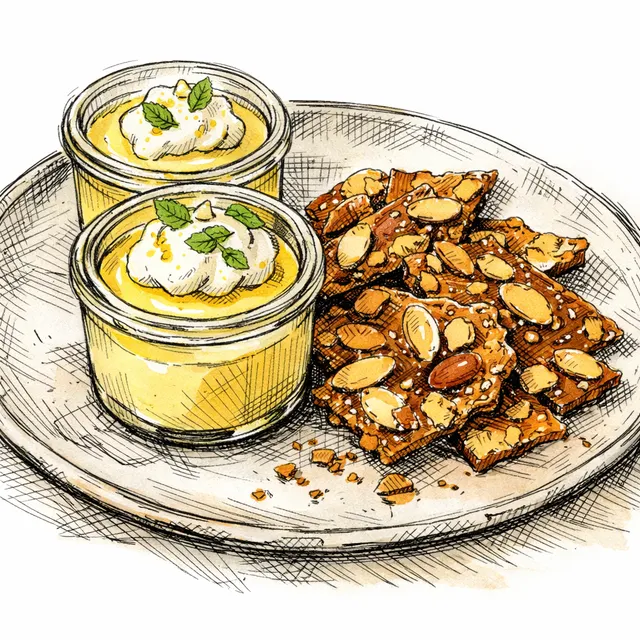
Meyer Lemon Custard Pots with Olive-Oil Almond Brittle
I built these custard pots for the part of winter when everything feels beige. Meyer lemon fixes that. It’s citrus, but soft-edged—like sunlight through a clean window. I keep the custard simple: zest for perfume, a straight vanilla line for focus, and enough salt to make it taste like an adult chose it on purpose.
Where it came from
In fine dining, I watched people chase “wow” with ten flavors and three foams. I wanted the opposite: one clean custard, one loud contrast. The brittle is the point.
A small memory
I used to take a cooler of desserts to a friend’s cramped apartment dinner. Anything fussy died on the subway. These didn’t. I remember popping the lids, hearing that first brittle crack, and thinking: future me deserves this kind of reliability.
Why this works
Set custard = creamy, stable, make-ahead. Thin brittle = snap. Olive oil = gloss and fruitiness without extra sugar. Contrast is the secret ingredient.
Make it yours
Swap almonds for pistachios. Add a pinch of espresso powder to the brittle. Or nudge the lemon with a drop of vinegar at the end—precision is freedom.
Let it cool. Future you deserves clean slices. (Yes, even in a cup.)
Featured Recipe
Meyer Lemon Custard Pots with Olive-Oil Almond Brittle
A bright, creamy set custard that tastes like winter sunlight—Meyer lemon zest, a clean vanilla line, and just enough salt to keep it adult. The topping is the point: a thin, snappy almond brittle finished with fruity olive oil for a crisp, glossy contrast that stays make-ahead friendly. Contrast is the secret ingredient, and this one travels like a pro.
Save a copy to your collection for editing
Ingredients
- 6 g Meyer lemon zest (finely grated)(From about 3 Meyer lemons)
- 90 g Meyer lemon juice (fresh)(Strain out pulp and seeds)
- 120 g Granulated sugar
- 6 Egg yolks(About 110–120 g yolks)
- 360 g Whole milk
- 240 g Heavy cream(35% fat)
- 2 g Fine sea salt(About 1/3 tsp)
- 6 g Vanilla extract(About 1 1/4 tsp)
- 30 g Unsalted butter(For richness and a cleaner set)
- 2 g Neutral oil (for ramekins)(A drop; optional but helpful for unmolding (if you try))
- 80 g Almonds (whole or slivered)(Toasted)
- 150 g Sugar (for brittle)
- 45 g Water (for brittle)
- 20 g Light corn syrup or glucose (optional)(Helps prevent crystallization; you can skip and just be vigilant)
- 1 g Fine sea salt (for brittle)
- 12 g Extra-virgin olive oil (fruity)(About 1 tbsp; stirred in off heat)
- 1 g Flaky salt(Optional finish, but I like it)
Instructions
- 1
Set up like you mean it. Wipe the counter. Set 6 small ramekins (about 150–180 ml each) on a baking tray. Put a kettle on to boil water for a bain-marie. Use 2 g neutral oil for greasing ramekins if desired.
5 min
Tip: Precision is freedom. A calm setup makes the custard feel easy.
- 2
Toast the 80 g almonds. Bake at 165°C / 330°F until deeply fragrant, 8–10 minutes. Cool, then roughly chop if using whole almonds.
10 min
Tip: Don’t stop at “lightly golden.” Deeper toast = better crunch and less “raw nut” aftertaste.
- 3
Make the custard base. In a saucepan, combine 360 g whole milk, 240 g heavy cream, 120 g granulated sugar, 6 g Meyer lemon zest, and 2 g fine sea salt. Warm over medium heat to steaming (about 75–80°C / 167–176°F). Stir to dissolve the sugar; don’t boil.
8 min
Tip: Heating with zest perfumes the dairy. Boiling can push the lemon into “cleaner” territory—avoid it.
- 4
Temper the yolks. In a bowl, whisk 6 egg yolks until smooth. Slowly whisk in about 1/3 of the hot dairy, then pour the yolk mixture back into the saucepan.
4 min
Tip: Slow stream, constant whisk. We’re not adding steps—just improving decisions.
- 5
Cook to a custard that sets. Stir constantly over medium-low with a silicone spatula, scraping corners, until the custard reaches 82–84°C / 180–183°F and thickens enough to coat the spatula.
6 min
Tip: If you don’t have a thermometer: you want a clean line when you swipe a finger through the custard on the spatula.
- 6
Finish off heat for brightness. Remove from heat. Stir in 30 g unsalted butter until melted, then whisk in 6 g vanilla extract and 90 g Meyer lemon juice. Strain through a fine sieve into a jug.
3 min
Tip: Juice goes in last to keep the flavor bright and reduce curdling risk. Straining buys you silk.
- 7
Fill and bake gently. Divide custard among ramekins. Place tray in the oven, then pour boiling water into the tray to come halfway up the ramekins. Bake at 150°C / 300°F until edges are set but centers still wobble like soft Jell-O, 20–28 minutes.
25 min
Tip: The wobble is the set. Overbake = grainy. Let it cool. Future you deserves clean slices (and clean spoons).
- 8
Cool, then chill. Remove ramekins from the water bath. Cool at room temp 30 minutes, then refrigerate uncovered until cold, then cover and chill at least 4 hours (overnight is best).
270 min
Tip: Uncovered first prevents condensation from dripping onto the surface.
- 9
Make olive-oil almond brittle. Line a sheet pan with parchment. In a small saucepan, combine 150 g sugar, 45 g water, and 20 g light corn syrup or glucose (optional). Cook without stirring until amber (about 170–175°C / 338–347°F). Off heat, stir in 1 g fine sea salt, toasted almonds, then 12 g extra-virgin olive oil. Immediately pour onto parchment and spread thin.
12 min
Tip: No stirring early—swirl the pan instead. Olive oil goes in off heat so it stays fruity, not fried.
- 10
Cool and break. Let brittle cool completely, then break into shards. Store airtight with a little parchment between layers.
20 min
Tip: Humidity is the enemy. Airtight container, room temp, and you’re safe for 2–3 days.
- 11
Serve with contrast. Top each custard with a few brittle shards right before serving. Finish with a pinch of 1 g flaky salt if you want the lemon to pop even harder.
2 min
Tip: Top at the last second. Crisp stays crisp; custard stays glossy.
Chef's Notes
This one’s personal: in fine dining we’d chase brightness with complicated gels and foams. At home, I’d rather make one custard perfectly and earn the contrast with a snap of brittle. If your Meyer lemons are extra sweet, bump the salt in the custard by 0.5 g, or add 5–10 g more juice. Fix it fast: if your custard looks slightly loose after chilling, it was underbaked—next time bake 2–4 minutes longer, same low temp. If it’s grainy, it was too hot at any point—use the thermometer and pull earlier.

Theo Glass
Modern desserts, minimal fuss, maximum contrast.
Theo Glass—known as “The Minimalist Sweet Tooth”—is a calm, detail-obsessed pastry coach who left the white-tablecloth intensity of fine dining for the reality (and joy) of home kitchens. After years of building plated desserts with tweezers and timers, he realized the real magic wasn’t complicated garnish work—it was contrast, clarity, and control. Theo’s mission now is to help everyday bakers make desserts that feel modern and restaurant-level without turning their kitchen into a war zone. His style is precision with restraint: olive oil cakes that stay plush for days, tahini brownies that walk the line between nutty and bittersweet, miso custards that taste like “caramel’s smarter cousin,” and citrus-forward sorbets that pop without needing an ice-cream machine. Theo teaches fundamentals (emulsions, temperature, texture, salinity) in plain language, with steps that are clean, paced, and confidence-building. If you’ve ever said “I want to mix it up” but don’t want extra dishes, obscure tools, or chaos, Theo’s your person. He’ll show you how to mix it up the minimalist way: a smarter ingredient swap, a sharper contrast, and a clear path to repeatable results.