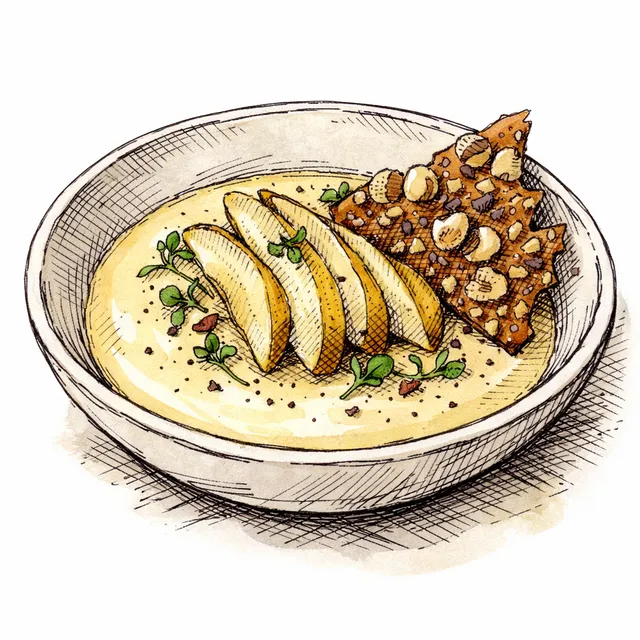
Pear–Earl Grey Set Custard with Rye–Hazelnut Brittle
I built this custard the year I stopped trying to “win” dessert.
A friend invited me to a winter dinner with the kind of menu that already had enough drama. I wanted something that landed softly. I steeped Earl Grey in warm dairy, folded in pear (not loud, just present), and set it into tidy little jars. On the ride over, I remember thinking: this either holds, or I change careers. It held. Future me deserved those clean slices.
Why this works
Pear and Earl Grey share a quiet tannin-and-floral thing. It keeps sweetness honest without citrus fireworks. The custard is pure silk—tempered eggs, controlled heat, then a patient chill. Precision is freedom.
The contrast (always)
The rye–hazelnut brittle is the point. Toasty, faintly bitter, shatters on contact. Two textures. Maximum payoff.
Make it yours
- Swap pear for apple or quince, but keep the fruit gentle.
- Add one-contrast upgrade: a teaspoon of white miso, or a few drops of fruity olive oil.
- If you like sharper edges, finish with flaky salt—or a measured pinch of black tea in the brittle.
We’re not adding steps—just improving decisions.
Featured Recipe
Pear–Earl Grey Set Custard with Rye–Hazelnut Brittle
This is my winter “light after dinner” move: a calm, silky set custard that tastes like poached pears and tea, finished with a shattering rye–hazelnut brittle for clean crunch. No citrus fireworks—just pear, vanilla, and Earl Grey’s quiet tannin keeping the sweetness honest. Contrast is the secret ingredient, and this one travels beautifully for dinners that end at someone else’s table.
Save a copy to your collection for editing
Ingredients
- 2 Ripe but firm pears (Bosc or Anjou)(about 400–500 g total; peeled and diced small)
- 90 g Granulated sugar(divided (30 g for pears, 60 g for custard))
- 60 g Water(for pear syrup)
- 2 g Fine salt(a big pinch; divided)
- 2 Earl Grey tea bags (or loose leaf)(about 4–5 g total tea)
- 360 g Whole milk
- 240 g Heavy cream
- 6 g Vanilla extract (or vanilla bean paste)(about 1 tsp)
- 3 g Gelatin sheets(silver strength; or use 1 tsp (3 g) powdered gelatin)
- 20 g Cold water (if using powdered gelatin)(to bloom; omit if using sheets)
- 120 g Plain Greek yogurt (2–5%)(for gentle tang and lighter finish; not citrus-forward)
- 40 g Rye flour(for the brittle (adds a toasty, almost cocoa-like edge))
- 70 g Hazelnuts(toasted, skins mostly rubbed off, roughly chopped)
- 25 g Unsalted butter(for brittle)
- 80 g Light brown sugar(for brittle)
- 25 g Honey(for brittle sheen and snap)
- 2 g Baking soda(1/2 tsp; aerates the brittle for easier bite)
- 1 g Flaky salt(to finish brittle; optional but smart)
- 30 g Granulated sugar(Used in pear base (30 g) but not listed in ingredients)
Instructions
- 1
Prep like you mean it. Set out 6 small ramekins or glasses (150–180 ml each). Clear a shelf in the fridge so the custards can chill level. Line a small baking sheet with parchment for the brittle.
5 min
Tip: Precision is freedom: level chilling = clean, even set.
- 2
Make the pear base. In a small saucepan, combine diced pears, 30 g sugar, 60 g water, and 2 g fine salt. Cook over medium heat until pears are just tender and glossy, 6–8 minutes. You want ‘spoon-tender,’ not applesauce.
8 min
Tip: Small dice means the pear reads as flavor, not chunks. If it starts drying, add 1–2 tbsp water.
- 3
Blend and cool. Scrape pears and syrup into a blender and blend smooth. Cool to room temp (or warm-but-not-hot). You should have about 200–230 g pear purée.
10 min
Tip: Hot purée + dairy later can split. Let it cool. Future you deserves silky custard.
- 4
Bloom gelatin. If using sheets: soak in cold water 5 minutes. If using powdered: stir 3 g gelatin into 20 g cold water and let stand 5 minutes.
5 min
Tip: No shortcuts here. Proper bloom = no grainy set.
- 5
Infuse the dairy. In a saucepan, warm 360 g whole milk, 240 g heavy cream, 60 g granulated sugar, remaining salt, and 6 g vanilla extract until steaming and the sugar dissolves (about 70–75°C). Turn off heat, add 2 Earl Grey tea bags, cover, and steep 6 minutes.
10 min
Tip: Don’t boil. Boiling tastes like regret and cooked milk.
- 6
Strain and dissolve gelatin. Strain the tea-infused dairy back into the warm pan. Squeeze excess water from gelatin sheets (if using) and whisk into the warm dairy until fully dissolved. If using powdered gelatin, add the bloomed gel and whisk smooth.
2 min
Tip: If you see any gelatin bits, keep whisking. They dissolve fully when the liquid is warm, not hot.
- 7
Build the custard: pear + yogurt + dairy. In a bowl, whisk the 120 g plain Greek yogurt until smooth. Whisk in the pear purée. Then slowly whisk in the warm tea-dairy in a thin stream until homogeneous.
4 min
Tip: This order prevents yogurt from curdling. We’re not adding steps—just improving decisions.
- 8
Portion and set. Divide into ramekins. Chill uncovered 30 minutes, then cover and chill until fully set, 3–4 hours (or overnight).
240 min
Tip: Uncovered first prevents condensation drips. After that, cover to protect the tea aroma.
- 9
Make the rye–hazelnut brittle. Heat oven to 175°C. In a small saucepan, melt 25 g unsalted butter, 80 g light brown sugar, 25 g honey, and 1 g salt. Bring to a simmer for 45–60 seconds. Off heat, whisk in 40 g rye flour until smooth, then fold in 70 g hazelnuts. Spread thin on the parchment-lined sheet.
10 min
Tip: Spread thin = elegant snap. Thick = tooth risk. I prefer the former.
- 10
Bake and finish brittle. Bake 10–12 minutes until deeply amber and bubbling. Remove, immediately sprinkle 1 g flaky salt (optional), and let cool completely. Break into shards.
15 min
Tip: Color is flavor here. Pale brittle tastes like sugar; amber tastes like toast.
- 11
Serve with contrast. Top each custard with a generous shard pile of brittle right before serving.
2 min
Tip: Brittle stays crisp if it meets custard at the last second. Let the custard do the creamy job; let the brittle do the loud job.
Chef's Notes
This one’s personal: I used to end staff meals with fruit and tea because pastry all day makes you crave something quiet at night. Pear + Earl Grey is that quiet—soft, perfumed, not loud. The rye brittle is the deliberate interruption. Why this works: - Pear brings sweetness without acidity, so the dessert reads ‘light’ instead of sharp. - Earl Grey adds tannin and aroma, which keeps a dairy custard from feeling heavy. - Yogurt gives a gentle lift (not citrus-forward) and improves the melt. - Rye + hazelnut brittle follows my two-texture rule: creamy set + clean snap. Fix it fast: - Custard not setting: your gelatin was under-measured or the dairy was too hot/too cool when dissolving. Next time, weigh 3 g precisely and dissolve in warm (not boiling) dairy. - Brittle sticky: it needed more color (bake longer) or it absorbed humidity. Re-crisp 3 minutes at 160°C. Make-ahead + travel: - Custards hold 3 days, covered. - Brittle holds 5–7 days airtight with a silica packet if you’re serious. - Transport custards cold; carry brittle separately and top on arrival. Clean slices? Different dessert. Same principle.

Theo Glass
Modern desserts, minimal fuss, maximum contrast.
Theo Glass—known as “The Minimalist Sweet Tooth”—is a calm, detail-obsessed pastry coach who left the white-tablecloth intensity of fine dining for the reality (and joy) of home kitchens. After years of building plated desserts with tweezers and timers, he realized the real magic wasn’t complicated garnish work—it was contrast, clarity, and control. Theo’s mission now is to help everyday bakers make desserts that feel modern and restaurant-level without turning their kitchen into a war zone. His style is precision with restraint: olive oil cakes that stay plush for days, tahini brownies that walk the line between nutty and bittersweet, miso custards that taste like “caramel’s smarter cousin,” and citrus-forward sorbets that pop without needing an ice-cream machine. Theo teaches fundamentals (emulsions, temperature, texture, salinity) in plain language, with steps that are clean, paced, and confidence-building. If you’ve ever said “I want to mix it up” but don’t want extra dishes, obscure tools, or chaos, Theo’s your person. He’ll show you how to mix it up the minimalist way: a smarter ingredient swap, a sharper contrast, and a clear path to repeatable results.