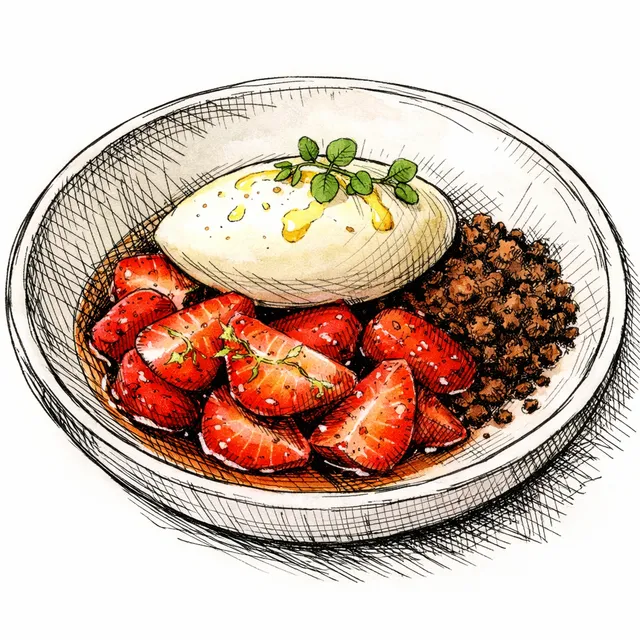
Physics, Not Gelatin: Cold-Macerated Strawberries & Iced Olive Oil Cream
Summer in my fine-dining days meant one thing: anxiety. Elaborate towers of mousse melting on the pass before they hit the dining room. I wanted out. I wanted a dessert that actually thrived in the heat.
That's where this recipe came from. I remember wiping down my stainless station—sweating through my whites—and realizing that physics, not gelatin, was the answer.
This dessert is special to me because it relies entirely on osmotic pressure and severe temperature contrast. We macerate strawberries with lime zest and sugar, pulling out a raw, vibrant syrup. We serve it over a fruity olive oil cream, chilled exactly to the brink of freezing. Then, a bitter espresso sand. Two textures. One contrast upgrade. Maximum payoff.
Why this works The bitterness of the espresso sand acts as a guardrail. It keeps the sweetness firmly in check, so you don't experience palate fatigue. Contrast is the secret ingredient.
Fix it fast: Make it yours We're not adding steps—just improving decisions. Don't like lime? Swap in yuzu or grapefruit zest. Want a different crunch? Toasted black sesame works beautifully.
Just remember: weigh your sugar (grams matter here for the maceration), and respect the chill time. Let it cool. Future you deserves clean slices.
Featured Recipe
Cold-Macerated Lime Strawberries with Iced Olive Oil Cream & Espresso Sand
Summer desserts usually try too hard. This one relies on osmotic pressure and severe temperature contrast: juicy, lime-spiked strawberries swimming in a raw syrup, served over an olive oil cream chilled to the brink of freezing. Finished with a bitter espresso crunch to keep the sweetness firmly in check.
Save a copy to your collection for editing
Timeline
Ingredients
- 400 g fresh strawberries(Hulled and quartered)
- 50 g cane sugar(Divided if you want, but used entirely for maceration here)
- 1 whole lime(Zested and juiced)
- 1 g kosher salt(Crucial for pulling moisture from the berries)
- 200 g heavy cream(Straight from the fridge)
- 40 g fruity extra virgin olive oil(Use the good stuff; it acts as a flavor backbone)
- 20 g powdered sugar(For stabilizing the cream)
- 50 g blanched almond flour(Creates a crisp, delicate sand)
- 10 g finely ground espresso(Actual coffee grounds, not instant powder)
- 20 g unsalted butter(Melted for the sand)
- 2 g flaky sea salt(For finishing the crunch)
Instructions
- 1
### Why this works: The Crunch Heat 20g unsalted butter in a small skillet over medium heat until foamy. Add 50g blanched almond flour, 10g finely ground espresso, and 2g flaky sea salt. Stir constantly for 4 minutes until the mixture smells intensely toasted and feels sandy. The bitter espresso will be the anchor that stops this dessert from being overly sweet.
4 min
Tip: Don't walk away; almond flour goes from toasted to bitter ash in about 15 seconds.
- 2
Transfer the hot espresso sand to a plate, spreading it out into a thin layer. Let it cool completely. Future you deserves a crisp garnish, and resting guarantees the crunch.
1 min
Tip: Residual heat in the pan will burn the sand if you leave it there. Move it immediately.
- 3
Wipe your counter. Hull and quarter 400g fresh strawberries. Place them into a medium mixing bowl. We want pieces small enough to release liquid quickly, but large enough to retain structural integrity on the spoon.
5 min
Tip: Always weigh your fruit after trimming to ensure the sugar ratio is accurate.
- 4
### Why this works: Osmotic Pressure To the berries, add 50g cane sugar, the zest and juice of 1 whole lime, and 1g kosher salt. Toss well. The salt is non-negotiable—it amplifies the fruit and kickstarts osmosis, pulling water out of the cells to create a raw syrup without touching a stove. Set aside at room temperature.
2 min
Tip: Set a timer for 20 minutes. That's the minimum time needed for a proper syrup to form.
- 5
In a chilled bowl, whisk 200g heavy cream and 20g powdered sugar until soft, floppy peaks form. Do not over-whip; we want a lush, spoonable texture, not butter.
4 min
Tip: Whisking by hand gives you absolute control over the texture.
- 6
Slowly stream 40g fruity extra virgin olive oil into the softly whipped cream while whisking gently to combine. Transfer the bowl directly to the freezer. We want this aggressively cold to contrast the room-temperature fruit.
1 min
Tip: Olive oil provides a grassy, peppery note that bridges the gap between the dairy and the lime.
- 7
### Fix it fast: The Plating Once the 20-minute maceration timer is up, your berries should be swimming in a bright red syrup and your cream should be ice-cold. Swipe a generous spoonful of the firm olive oil cream across a shallow bowl. Spoon the macerated berries and their syrup directly over the cream, and heavily dust the entire dish with the cooled espresso sand.
3 min
Tip: Serve immediately. The beauty of this dish is the fleeting moment where the freezing cream hits the juicy berries.
Chef's Notes
Contrast is the secret ingredient. We’re not adding steps—just improving decisions. Maceration isn't just sugaring fruit; it's a physical reaction that yields a flawless raw syrup. By chilling the olive oil cream in the freezer, you create a temperature shock on the palate that makes a simple bowl of strawberries feel like a plated restaurant dessert. Precision is freedom: weigh your sugar, respect the resting time, and don't skip the salt in the fruit.

Theo Glass
Modern desserts, minimal fuss, maximum contrast.
Theo Glass—known as “The Minimalist Sweet Tooth”—is a calm, detail-obsessed pastry coach who left the white-tablecloth intensity of fine dining for the reality (and joy) of home kitchens. After years of building plated desserts with tweezers and timers, he realized the real magic wasn’t complicated garnish work—it was contrast, clarity, and control. Theo’s mission now is to help everyday bakers make desserts that feel modern and restaurant-level without turning their kitchen into a war zone. His style is precision with restraint: olive oil cakes that stay plush for days, tahini brownies that walk the line between nutty and bittersweet, miso custards that taste like “caramel’s smarter cousin,” and citrus-forward sorbets that pop without needing an ice-cream machine. Theo teaches fundamentals (emulsions, temperature, texture, salinity) in plain language, with steps that are clean, paced, and confidence-building. If you’ve ever said “I want to mix it up” but don’t want extra dishes, obscure tools, or chaos, Theo’s your person. He’ll show you how to mix it up the minimalist way: a smarter ingredient swap, a sharper contrast, and a clear path to repeatable results.