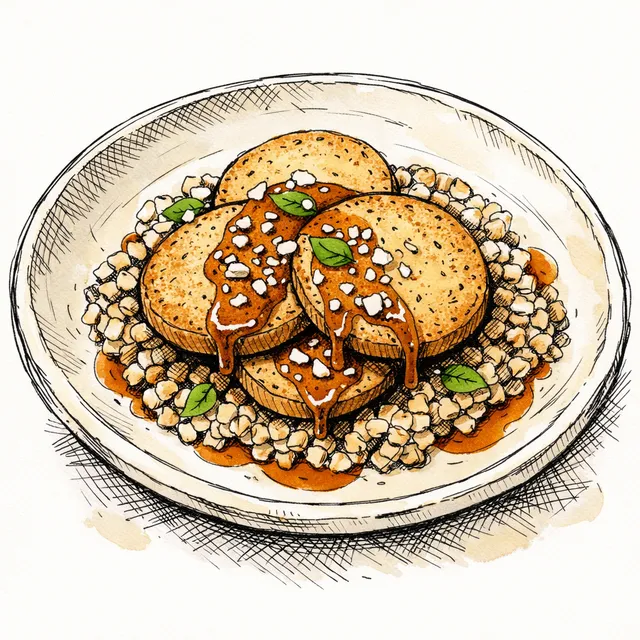
Rested Buckwheat & Brown Butter Sablés with Miso Caramel
The Inspiration Years ago on a cramped pastry line, I burned out on overbuilt, twelve-component desserts. I wanted one perfect, transportable bite. I remembered eating a simple, gritty buckwheat galette in Brittany and thought: that earthy crunch belongs in a cookie. Why this works A sablé isn't just a cookie; it is an exercise in moisture control. We use buckwheat for texture and browned butter for depth. The filling is a sharp, savory miso caramel. It is a one-contrast upgrade that cuts straight through the richness. Fix it fast If your dough crumbles, you skipped the hydration. Resting the dough is non-negotiable. It lets the flours absorb the moisture, while deliberate chilling guarantees surgical cuts. Let it cool. Future you deserves clean slices. Make it yours Precision is freedom, but you can pivot within the guardrails. Swap the miso for tahini or add a heavy pinch of toasted black sesame to the dough. Just respect the two-texture rule: keep the cookie sandy and the caramel chewy. Set your timer, weigh your flours down to the gram, and trust the process. We're not adding steps, just improving decisions.
Featured Recipe
Rested Buckwheat & Brown Butter Sablés with Miso Caramel
A sablé isn’t just a cookie; it’s an exercise in moisture control. We use buckwheat for earthy crunch and browned butter for depth, pairing it with a sharp, savory miso caramel. Resting the dough hydrates the flours, while deliberate chilling ensures surgical cuts. Precision is freedom, and future you deserves a dessert that travels flawlessly.
Save a copy to your collection for editing
Timeline
Ingredients
- 145 g Unsalted butter(Divided: 130g for browning, 15g for caramel)
- 100 g Granulated sugar(For the caramel)
- 50 g Toasted sugar(Or plain granulated sugar if unavailable)
- 30 g Powdered sugar(For texture management)
- 1 large Egg yolk(Approximately 18g, room temperature)
- 100 g All-purpose flour(Sifted)
- 40 g Buckwheat flour(Brings the nutty, earthy contrast)
- 3 g Kosher salt(Diamond Crystal preferred)
- 45 g Heavy cream(Room temperature or slightly warmed)
- 30 g White miso(Our one-contrast upgrade)
- 10 g Roasted cacao nibs(For bitter crunch)
- 15g unsalted butter(mentioned in step 2 for caramel)
Instructions
- 1
Set a timer. Brown 130g unsalted butter in a light-colored saucepan over medium heat until it foams and the milk solids turn a deep amber. Immediately transfer to a heatproof bowl set over an ice bath. Stir occasionally until it solidifies to the texture of soft room-temperature butter.
15 min
Tip: Why this works: Cooling the brown butter back to a malleable solid is non-negotiable for proper creaming. Liquid fat leads to a dense, greasy sablé.
- 2
While the butter cools, build the caramel. Melt 100g granulated sugar in a dry saucepan over medium heat. Once it reaches a deep amber color, remove from heat and carefully whisk in 45g heavy cream followed by 15g unsalted butter. Whisk in 30g white miso until emulsified. Pour into a shallow container and chill.
10 min
Tip: Fix it fast: If your caramel seizes when adding cream, place it back on low heat and whisk gently until it melts back together.
- 3
Wipe your counter. In a stand mixer fitted with the paddle attachment, cream the cooled, solidified brown butter with 50g toasted sugar and 30g powdered sugar on medium speed until smooth but not overly aerated.
5 min
Tip: We aren't making cake. Avoid whipping too much air into the fat, which causes the sablés to lose their sharp edges in the oven.
- 4
Add 1 large egg yolk to the butter mixture and beat on low speed just until absorbed.
2 min
Tip: The yolk provides just enough water and fat to bind the dough without activating gluten development.
- 5
Add 100g all-purpose flour, 40g buckwheat flour, and 3g kosher salt. Pulse the mixer on its lowest setting until the dough looks like damp sand and just begins to clump together. Do not overmix.
3 min
Tip: Buckwheat lacks gluten, which acts as a built-in guardrail against tough cookies.
- 6
Turn the dough out onto a sheet of parchment paper. Top with a second sheet of parchment and roll exactly to a 1/4-inch thickness. Slide the flat dough onto a baking sheet, label it with a piece of painter's tape, and chill in the refrigerator.
60 min
Tip: Resting the dough hydrates the flours evenly. Cold dough means surgical, clean cuts later.
- 7
Preheat your oven to 325°F (165°C). Remove the chilled dough from the fridge. Using a sharp knife and a ruler, trim the edges and cut the dough into 1x3 inch rectangles. Place them 1 inch apart on a parchment-lined baking sheet. Press a few 10g roasted cacao nibs lightly into the top of each sablé.
10 min
Tip: Precision pays off here. Uniform cuts mean uniform baking.
- 8
Bake the sablés until the edges are deeply golden and the centers are set.
15 min
Tip: Rotate the pan halfway through. Because of the buckwheat and brown butter, the dough will look dark—trust your timer and the firm edges.
- 9
Remove from the oven and let the sablés cool completely on the baking sheet. They will crisp as they come down to room temperature.
20 min
Tip: Let it cool. Hot sablés are fragile and will crumble if you rush this.
- 10
Transfer the cooled miso caramel to a piping bag. Pipe a neat, 2-inch continuous line down the center of each fully cooled sablé.
10 min
Tip: The two-texture rule in action: the brittle snap of the sablé anchoring the chewy, savory-sweet drag of the caramel.
Chef's Notes
Contrast is the secret ingredient. Here, the deep, toasty notes of buckwheat and browned butter build the foundation, while the miso caramel provides an unexpected hit of savory umami and chew. The cacao nibs act as tiny bitter circuit-breakers. These sablés travel exceptionally well and keep their texture in an airtight container for up to five days. We're not adding steps, just improving decisions.

Theo Glass
Modern desserts, minimal fuss, maximum contrast.
Theo Glass—known as “The Minimalist Sweet Tooth”—is a calm, detail-obsessed pastry coach who left the white-tablecloth intensity of fine dining for the reality (and joy) of home kitchens. After years of building plated desserts with tweezers and timers, he realized the real magic wasn’t complicated garnish work—it was contrast, clarity, and control. Theo’s mission now is to help everyday bakers make desserts that feel modern and restaurant-level without turning their kitchen into a war zone. His style is precision with restraint: olive oil cakes that stay plush for days, tahini brownies that walk the line between nutty and bittersweet, miso custards that taste like “caramel’s smarter cousin,” and citrus-forward sorbets that pop without needing an ice-cream machine. Theo teaches fundamentals (emulsions, temperature, texture, salinity) in plain language, with steps that are clean, paced, and confidence-building. If you’ve ever said “I want to mix it up” but don’t want extra dishes, obscure tools, or chaos, Theo’s your person. He’ll show you how to mix it up the minimalist way: a smarter ingredient swap, a sharper contrast, and a clear path to repeatable results.