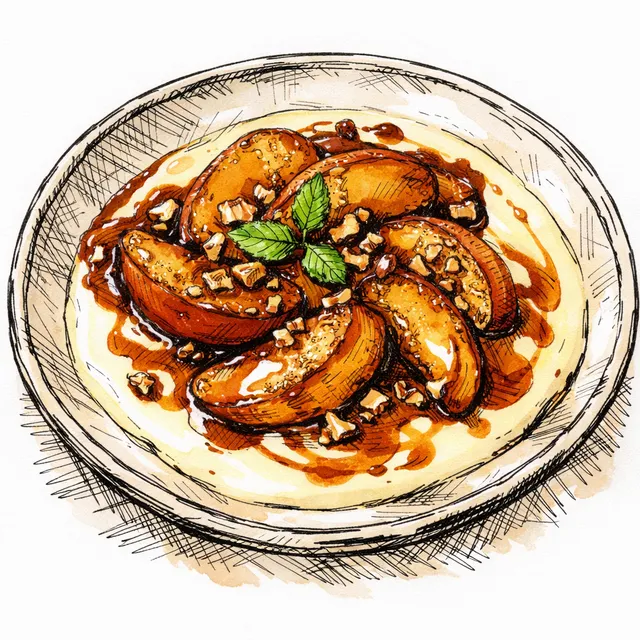
Roasted Apple & Brown-Butter Skillet Caramel (Plus the Fastest Crème Anglaise I Trust)
Winter taught me this dessert. Not a romantic “snowy cabin” winter—more like “dark at 4pm, I need something warm and competent.” I wanted baked apples, but I wanted them sharper, glossier, and less… politely soft.
Where it came from
In fine dining, we’d build apple desserts like architecture. Layers, gels, crunches, stress. At home, I missed the flavor, not the scaffolding. So I stole the best parts: hard heat for jammy edges, brown butter for depth, and a cold sauce for contrast.
The memory
The first time I made this after leaving restaurant work, I ate it standing up at the counter—timer still in my hand. It felt like a tiny win. Fancy, but understandable.
Why this works
Roast the apples aggressively. You’re concentrating sugar and driving off water so the caramel clings. Brown butter brings toasted-nut notes without adding ingredients. Then the quick crème anglaise cools the top and softens the caramel’s intensity. Contrast is the secret ingredient.
Make it yours
Add miso (3–5 g) to the caramel for edge. Swap apples for pears. Finish with flaky salt and lemon zest. And let it cool. Future you deserves clean slices.
Featured Recipe
Roasted Apple & Brown-Butter Skillet Caramel with Quick Crème Anglaise
This is my winter-night comfort move: apples roasted hard for jammy edges, then glazed in a brown-butter skillet caramel that tastes like warm toffee and toasted nuts. You pour a fast, stovetop crème anglaise over the top for a hot–cool contrast that feels restaurant-level, but it’s just temperature management and a timer. Contrast is the secret ingredient—soft apples, glossy caramel, and a tiny hit of salt to keep it sharp.
Save a copy to your collection for editing
Ingredients
- 900 g Apples (Honeycrisp or Pink Lady), peeled, cored, cut into 2.5 cm / 1 in wedges(About 5–6 medium apples)
- 120 g Granulated sugar(For roasting and caramel)
- 35 g Light brown sugar(Rounds the caramel; optional but recommended)
- 70 g Unsalted butter(You’ll brown it in the skillet)
- 60 g Heavy cream (for caramel)(Warm it slightly so it doesn’t seize the caramel)
- 3 g Fine sea salt(Plus more to taste)
- 6 g Vanilla extract(About 1 1/2 tsp)
- 1 tsp Ground cinnamon(Warm background, not a candle)
- 1 g Espresso powder (optional)(About 1/2 tsp; adds measured bitterness)
- 10 g Apple cider vinegar(About 2 tsp; the “brightness” switch)
- 250 g Whole milk (for custard)(You can use 2% in a pinch)
- 150 g Heavy cream (for custard)(Keeps it silky)
- 4 Egg yolks(About 70–80 g yolks)
- 50 g Granulated sugar (for custard)
- 1 g Fine sea salt (for custard)(A pinch, but weigh it if you can)
- 4 g Vanilla extract (for custard)(About 1 tsp)
- 60 g Toasted walnuts or pecans, roughly chopped (optional crunch)(My two-texture rule likes this)
- 1 pinch Flaky salt (finishing)(Non-negotiable if you have it)
Instructions
- 1
Heat the oven to 220°C / 425°F. Line a rimmed sheet pan with parchment. Wipe your counter, clear space for a hot pan, and set two timers (roast + custard). We’re not adding steps—just improving decisions.
5 min
Tip: High heat = caramelized edges without turning the apples to sauce.
- 2
Roast the apples: Toss 900 g Apples (Honeycrisp or Pink Lady), peeled, cored, cut into 2.5 cm / 1 in wedges with 35 g granulated sugar, 1 tsp Ground cinnamon, and 2 g of the fine salt. Spread in a single layer. Roast until edges bronze and the centers are just tender, flipping once halfway.
22 min
Tip: Crowding steams. Single layer is texture engineering.
- 3
Start the quick crème anglaise (custard): In a saucepan, heat 250 g Whole milk + 150 g Heavy cream (for custard) to steaming (not boiling), about 75–80°C / 167–176°F. Meanwhile, whisk 4 Egg yolks with 50 g Granulated sugar (for custard) and 1 g Fine sea salt (for custard) until smooth.
8 min
Tip: Hot dairy should look steamy with tiny bubbles at the edges. Boiling makes scrambled-egg roulette.
- 4
Temper and thicken: Slowly whisk about 1/3 of the hot dairy into the yolks. Pour the yolk mixture back into the saucepan. Cook over medium-low, stirring constantly with a silicone spatula, until it lightly coats the spatula and reaches 82–84°C / 180–183°F. Remove from heat, stir in 4 g Vanilla extract (for custard). Strain into a bowl.
6 min
Tip: Precision is freedom here. If you don’t have a thermometer: it’s done when a finger drawn through the sauce on the spatula leaves a clean line.
- 5
Hold warm, not hot: Cover the custard with plastic wrap pressed directly on the surface. Keep it warm near the stove (or in a 60°C / 140°F oven) while you finish the caramel.
1 min
Tip: Direct contact prevents a skin. Warm custard pours better and feels plush.
- 6
Make brown-butter skillet caramel: In a 25–30 cm (10–12 in) skillet, melt 70 g Unsalted butter over medium heat and cook until it smells nutty and the milk solids are deep golden (not black). Add 85 g Granulated sugar + 35 g Light brown sugar and cook, swirling, until fully melted and amber.
6 min
Tip: If the butter solids are going too fast, pull the pan off heat for 20 seconds. Temperature management is the whole game.
- 7
Finish the caramel: Lower the heat. Carefully whisk in 60 g Heavy cream (for caramel) (it will bubble up). Stir in 6 g Vanilla extract, 1 g Espresso powder (optional), and 10 g Apple cider vinegar. Taste. Add a pinch more 3 g Fine sea salt if it reads flat.
3 min
Tip: Vinegar doesn’t make it sour—it makes it taste more like apples.
- 8
Glaze the apples: Add the roasted apples (and any pan juices) to the skillet caramel. Toss gently for 1–2 minutes until glossy and coated. Turn off the heat.
2 min
Tip: You’re glazing, not cooking them to mush. Let the roast do the heavy lifting.
- 9
Serve with contrast: Spoon hot caramel apples into bowls. Pour warm crème anglaise around (or over). Finish with 60 g Toasted walnuts or pecans, roughly chopped (optional crunch) if using, plus 1 pinch Flaky salt (finishing).
2 min
Tip: Let it cool for 2 minutes before serving. Future you deserves clean bites, not molten chaos.
Chef's Notes
This one’s personal: it’s the dessert I made for myself after my last fine-dining holiday season—when I wanted something warm, fast, and actually restful. The trick is the split technique: roast for structure, then glaze for shine. If you want to travel with it, pack apples and custard separately; rewarm the apples in the skillet, and keep the custard warm in a thermos. Contrast is the secret ingredient—don’t skip the flaky salt.

Theo Glass
Modern desserts, minimal fuss, maximum contrast.
Theo Glass—known as “The Minimalist Sweet Tooth”—is a calm, detail-obsessed pastry coach who left the white-tablecloth intensity of fine dining for the reality (and joy) of home kitchens. After years of building plated desserts with tweezers and timers, he realized the real magic wasn’t complicated garnish work—it was contrast, clarity, and control. Theo’s mission now is to help everyday bakers make desserts that feel modern and restaurant-level without turning their kitchen into a war zone. His style is precision with restraint: olive oil cakes that stay plush for days, tahini brownies that walk the line between nutty and bittersweet, miso custards that taste like “caramel’s smarter cousin,” and citrus-forward sorbets that pop without needing an ice-cream machine. Theo teaches fundamentals (emulsions, temperature, texture, salinity) in plain language, with steps that are clean, paced, and confidence-building. If you’ve ever said “I want to mix it up” but don’t want extra dishes, obscure tools, or chaos, Theo’s your person. He’ll show you how to mix it up the minimalist way: a smarter ingredient swap, a sharper contrast, and a clear path to repeatable results.