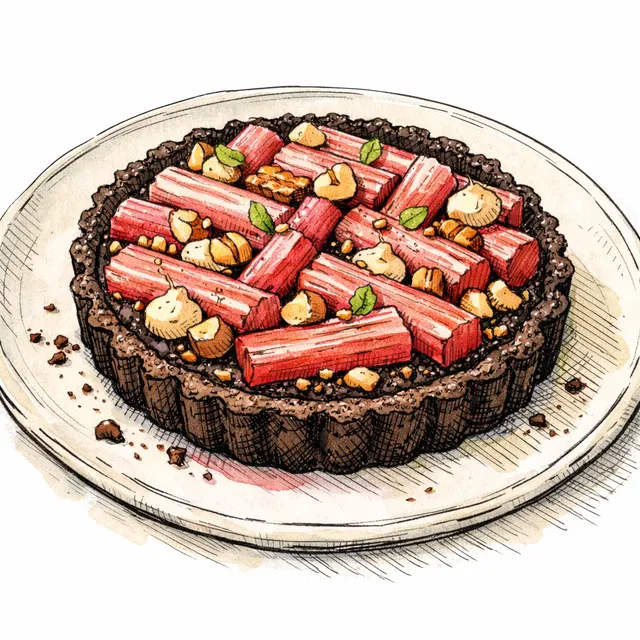
Structured Rhubarb & Hazelnut Tart: A Study in Spring Contrast
I used to dread spring menus in fine dining. Everyone wanted thirteen components on a plate. The inspiration for this tart came on a busy Tuesday when a prep cook handed me a baton of raw rhubarb simply dipped in sugar. Sharp, aggressive, perfect. This Structured Rhubarb & Hazelnut Tart is my answer to that memory. We are not adding steps—just improving decisions. Why this works: The tart rhubarb batons bake directly into a rich hazelnut-brown butter frangipane. That filling is sweet and dense, so we ground it with a bitter, earth-forward cocoa-buckwheat crust. A final sharp yuzu glaze wakes the whole thing up. Contrast is the secret ingredient. Make it yours: If you do not have hazelnuts, toasted walnuts work beautifully (weigh them, exactly 150g). If yuzu is out of reach, heavy lemon zest and a few drops of white balsamic vinegar bring the right acid. Fix it fast: If your rhubarb weeps too much water, your oven was too cool. Respect the temperatures and bake bold. Once it is out, walk away. Grab your painter's tape, label it, and set a timer for two hours. Let it cool. Future you deserves clean slices.
Featured Recipe
Structured Rhubarb & Hazelnut Tart with Dark Cocoa Crust
A study in spring contrast. Tart rhubarb batons are baked directly into a rich hazelnut-brown butter frangipane, all held within a bitter, earth-forward cocoa-buckwheat crust. We finish with a sharp yuzu glaze to wake everything up.
Save a copy to your collection for editing
Timeline
Ingredients
- 100 g All-purpose flour(For the crust)
- 50 g Buckwheat flour(Adds an earthy depth that bridges the cocoa and hazelnut)
- 20 g Dark cocoa powder(Dutch-processed, for bitterness and color)
- 50 g Powdered sugar(Dissolves cleanly into the crust)
- 4 g Fine sea salt(Divided (2g for crust, 2g for filling))
- 180 g Unsalted butter(Divided (100g cold for crust, 80g for browning in the filling))
- 2 Eggs(Divided (1 yolk for crust, 1 whole egg for filling))
- 100 g Hazelnut flour(Toasted almond flour works if hazelnut is unavailable)
- 100 g Granulated sugar(Divided (70g for filling, 30g for glaze))
- 300 g Fresh rhubarb stalks(Look for uniform width to make structural cuts easier)
- 30 g Yuzu juice(Lemon juice is an acceptable substitute)
- 1 pinch Flaky sea salt(For finishing)
- 1 egg yolk(egg yolk from one of the eggs)
Instructions
- 1
Prep your crust's dry foundation. In a bowl, whisk together 100g all-purpose flour, 50g buckwheat flour, 20g dark cocoa powder, 50g powdered sugar, and 2g fine sea salt until uniform in color. Label the bowl with tape if you're stepping away.
5 min
Tip: Why this works: Buckwheat and dark cocoa share an earthy, bitter profile. This crust isn't meant to be sweet; it's the structural guardrail for the fruit.
- 2
Cut in 100g cold unsalted butter using your fingers or a pastry blender until the mixture resembles damp sand. Add 1 egg yolk and gently knead just until the dough holds together.
5 min
Tip: Precision is freedom: Weigh your butter, keep it cold. No shaming if you use a food processor, just pulse carefully.
- 3
Press the dough evenly into the bottom and up the sides of a 9-inch tart pan with a removable bottom. Use the flat bottom of a measuring cup to level it. Place the pan in the freezer to set.
10 min
Tip: Pressing rather than rolling saves time and prevents tough gluten development.
- 4
Preheat your oven to 350°F (175°C). Set a timer.
0 - 5
Brown 80g unsalted butter in a small saucepan over medium heat until the milk solids turn dark amber and smell nutty. Immediately pour into a cool bowl to stop the cooking.
5 min
Tip: Wipe the counter while the butter browns, but don't take your eyes off the pan.
- 6
Whisk together 100g hazelnut flour, 70g granulated sugar, 1 whole egg, 2g fine sea salt, and the cooled brown butter until a thick paste forms. This is your frangipane filling.
5 min
Tip: The two-texture rule applies here: we want the rich, slightly grainy bite of the hazelnut to anchor the wet rhubarb.
- 7
Trim your 300g fresh rhubarb stalks into exact 2-inch batons. A ruler and a sharp knife make this deeply satisfying.
10 min
Tip: We're not adding steps—just improving decisions. Uniform cuts mean uniform baking.
- 8
Retrieve the frozen tart shell. Spread the hazelnut filling evenly across the bottom. Arrange the rhubarb batons on top in a tight, parallel, or chevron pattern, pressing them slightly into the filling.
5 min
Tip: Pack the rhubarb tightly; it will shrink slightly as it releases water during baking.
- 9
Bake the tart for 40 minutes, or until the frangipane is puffed and deeply golden, and the rhubarb is tender when pierced with a paring knife.
40 min
- 10
While the tart bakes, make the yuzu glaze. In a small pot, simmer 30g yuzu juice and 30g granulated sugar for 2-3 minutes until slightly syrupy. Set aside.
5 min
Tip: Yuzu provides a floral acid punch that cuts right through the brown butter.
- 11
Remove the tart from the oven. While it is still hot, brush the rhubarb heavily with the yuzu glaze. Sprinkle with 1 pinch flaky sea salt. Let it cool completely in the pan before removing the ring.
5 min
Tip: Let it cool. Future you deserves clean slices. The glaze will set into a brilliant lacquer.
Chef's Notes
Contrast is the secret ingredient. The success of this dessert hinges on the micro-adjustments: the 2g of salt in the crust to tame the cocoa, the bright flash of yuzu against the dense hazelnut, and the strict geometric structure of the rhubarb. It holds beautifully for up to two days at room temperature. Use a hot, sharp knife for service.

Theo Glass
Modern desserts, minimal fuss, maximum contrast.
Theo Glass—known as “The Minimalist Sweet Tooth”—is a calm, detail-obsessed pastry coach who left the white-tablecloth intensity of fine dining for the reality (and joy) of home kitchens. After years of building plated desserts with tweezers and timers, he realized the real magic wasn’t complicated garnish work—it was contrast, clarity, and control. Theo’s mission now is to help everyday bakers make desserts that feel modern and restaurant-level without turning their kitchen into a war zone. His style is precision with restraint: olive oil cakes that stay plush for days, tahini brownies that walk the line between nutty and bittersweet, miso custards that taste like “caramel’s smarter cousin,” and citrus-forward sorbets that pop without needing an ice-cream machine. Theo teaches fundamentals (emulsions, temperature, texture, salinity) in plain language, with steps that are clean, paced, and confidence-building. If you’ve ever said “I want to mix it up” but don’t want extra dishes, obscure tools, or chaos, Theo’s your person. He’ll show you how to mix it up the minimalist way: a smarter ingredient swap, a sharper contrast, and a clear path to repeatable results.