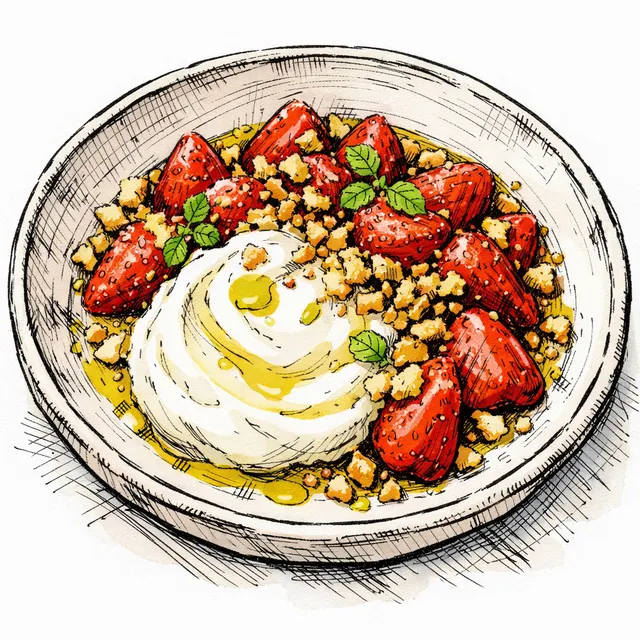
Spring Contrast: Yuzu Strawberries & Cold Labneh
I built this dessert during my fine-dining years when I was entirely burned out on overbuilt plates. I wanted a dish that tasted like spring but asked almost nothing of me after a fourteen-hour shift. The memory that anchors it? Sitting on my cramped apartment fire escape, eating strawberries straight from a deli container. They had macerated in sugar and leftover yuzu juice while I worked. The resulting syrup was cold, sharp, and perfect. What makes this recipe special is its strict adherence to the two-texture rule and reliance on temperature management. We pair soft, yielding fruit with a shattering olive oil pan-crunch. Precision is freedom here. Weigh your sugar—exactly 15g per 200g of berries—and set a timer. Let time do the heavy lifting. Why this works: The yuzu’s floral acid balances the fruit’s sweetness, while the cold, tangy labneh provides a fatty, thermal contrast to the room-temperature berries. Contrast is the secret ingredient. Make it yours: Swap yuzu for lemon zest and a drop of white balsamic. No labneh? Use strained, full-fat Greek yogurt. We're not adding steps—just improving decisions. Wipe down your counter, chill your bowls, and enjoy the payoff.
Featured Recipe
Yuzu-Macerated Strawberries with Cold Labneh & Olive Oil Pan-Crunch
A study in spring contrast. We rely on time, not heat, to build flavor. Maceration draws out the strawberries' natural syrup, amplified by yuzu's floral acid. Anchored by cold, tangy labneh and finished with a quick skillet crunch, this is minimal fuss with maximum payoff.
Save a copy to your collection for editing
Timeline
Ingredients
- 400 g Strawberries (hulled and quartered)(Look for ripe, deep red berries. Size matters less than aroma.)
- 30 g Caster sugar(Dissolves faster than granulated during maceration.)
- 15 g Yuzu juice (or fresh Meyer lemon juice)(Adds a floral, acidic backbone to balance the sugar.)
- 250 g Labneh (plain, whole milk)(Keep strictly in the fridge until the exact moment of plating.)
- 45 g Extra virgin olive oil (fruity, high quality)(Divided into 15g for the crumb, 30g for finishing. Do not skimp on quality here.)
- 40 g Almond flour(Provides a buttery, nutty base for our quick crunch.)
- 30 g Polenta (or fine cornmeal)(The secret to an instant, shattering texture without turning on the oven.)
- 3 g Flaky sea salt(Divided. Essential for micro-adjustments and contrast.)
- 15 g extra virgin olive oil(for the pan-crunch)
- 1 g flaky sea salt(for the pan-crunch)
- 30 g extra virgin olive oil(for finishing)
- 2 g flaky sea salt(for finishing)
Instructions
- 1
Macerate the berries. Place 400g strawberries into a mixing bowl. Add 30g caster sugar and 15g yuzu juice. Toss well to coat. Set a timer for 15 minutes. We are letting osmotic pressure do the heavy lifting, drawing out the natural juices to create a bright, glossy syrup. Let it sit at room temperature.
5 min
Tip: Wipe down your counter while they sit. Precision is freedom, and a clean station keeps you focused.
- 2
Build the pan-crunch. Place a dry skillet over medium heat. Add 40g almond flour and 30g polenta. Toast for 3 to 4 minutes, stirring constantly, until it smells like toasted nuts. Turn off the heat. Immediately stir in 15g extra virgin olive oil and 1g flaky sea salt until the mixture clumps together slightly. Spread it flat on a plate to cool instantly.
7 min
Tip: Residual heat will burn almond flour fast. Get it out of the hot pan immediately.
- 3
Plate the labneh. Pull the 250g labneh straight from the fridge. Temperature contrast is non-negotiable here. Divide it between four chilled, shallow bowls. Use the back of a spoon to swoop the labneh, creating deep craters. You want these divots to catch the strawberry syrup later.
3 min
Tip: Keep the dairy cold until the very last second. Room temperature labneh ruins the contrast against the room temperature berries.
- 4
Assemble and finish. Spoon the macerated strawberries, along with every drop of their accumulated yuzu syrup, directly into the labneh craters. Scatter the completely cooled polenta crumb over the top to satisfy the two-texture rule. Finally, generously pool the remaining 30g extra virgin olive oil over the dish and finish with 2g flaky sea salt.
5 min
Tip: Do not assemble until you are ready to eat. We want the crumb to stay dry and the olive oil to sit beautifully on top of the juices.
Chef's Notes
Contrast is the secret ingredient here. The grassy olive oil fights the sweet strawberry syrup, the cold labneh soothes the bright yuzu acid, and the quick pan-crumb provides the necessary shatter. We're not adding steps—just improving decisions.

Theo Glass
Modern desserts, minimal fuss, maximum contrast.
Theo Glass—known as “The Minimalist Sweet Tooth”—is a calm, detail-obsessed pastry coach who left the white-tablecloth intensity of fine dining for the reality (and joy) of home kitchens. After years of building plated desserts with tweezers and timers, he realized the real magic wasn’t complicated garnish work—it was contrast, clarity, and control. Theo’s mission now is to help everyday bakers make desserts that feel modern and restaurant-level without turning their kitchen into a war zone. His style is precision with restraint: olive oil cakes that stay plush for days, tahini brownies that walk the line between nutty and bittersweet, miso custards that taste like “caramel’s smarter cousin,” and citrus-forward sorbets that pop without needing an ice-cream machine. Theo teaches fundamentals (emulsions, temperature, texture, salinity) in plain language, with steps that are clean, paced, and confidence-building. If you’ve ever said “I want to mix it up” but don’t want extra dishes, obscure tools, or chaos, Theo’s your person. He’ll show you how to mix it up the minimalist way: a smarter ingredient swap, a sharper contrast, and a clear path to repeatable results.