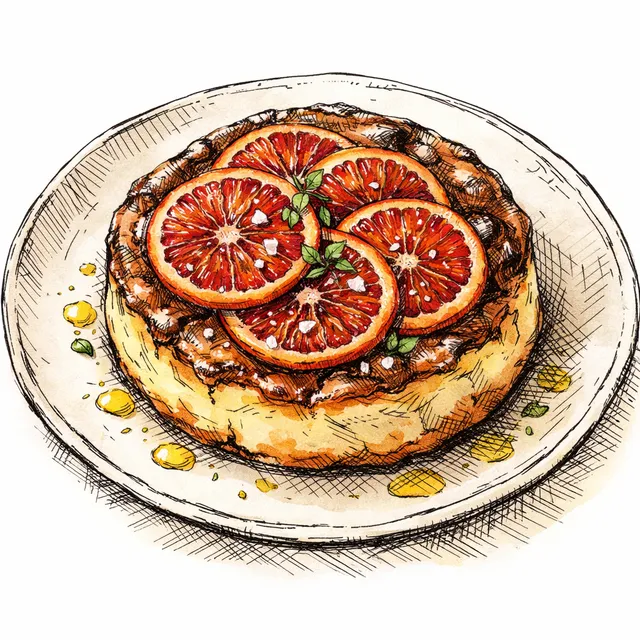
Cold-Infused Blood Orange Basque Cheesecake with Olive Oil & Flaky Salt
A deeply caramelized Basque cheesecake perfumed by blood orange zest cold-infused directly into heavy cream. The bitter scorched exterior meets an unctuous, citrus-bright molten center, finished with peppery olive oil and flaky sea salt.

Save a copy to your collection for editing
Timeline
Ingredients
- 3 large Blood oranges(Firm and heavy for their size; 2 for zesting into cream, 1 for fresh segments)
- 240 g Heavy cream(36-40% butterfat, chilled)
- 680 g Full-fat cream cheese(3 standard blocks, completely softened to room temperature (around 21°C/70°F))
- 200 g Granulated sugar
- 4 g Fine sea salt(Divided use: 3 g in batter, 1 g to season citrus segments)
- 4 Large eggs(About 200 g out of shell, brought to room temperature)
- 15 g All-purpose flour(About 2 level tablespoons, sifted)
- 15 ml Extra virgin olive oil(1 tablespoon; choose a robust, peppery oil)
- 2 g Flaky sea salt(Maldon or similar pyramid salt for finishing)
- 2 large blood orange zest(used in step 1)
- 1 large blood orange segment(used in step 7)
Instructions
- 1
Using a microplane, grate the zest of 2 large blood oranges directly into 240 g heavy cream. Stir gently, press the zest with a spoon to release surface oils, cover, and chill for at least 30 minutes (or overnight) to cold-infuse without heat.
5 min
Tip: Cold-infusing pulls the fragile limonene and floral aldehydes from the peel without cooking off top notes or extracting bitterness from the white pith.
- 2
Position a rack in the center of the oven and preheat to 425°F (220°C). Press two overlapping sheets of parchment paper into an 8-inch (20 cm) springform pan, pleating the sides so the paper extends at least 2 inches above the rim.
5 min
Tip: Crumple the parchment into a tight ball first, then flatten it out. It will conform to the pan corners effortlessly.
- 3
In a stand mixer fitted with the paddle attachment (or a large bowl with a hand mixer), paddle 680 g cream cheese, 200 g granulated sugar, and 3 g fine sea salt on medium-low speed for 2 minutes until silky, glossy, and lump-free. Scrape the bowl completely.
5 min
Tip: Keep the speed low. We want complete emulsification, not trapped air bubbles, which cause cracks.
- 4
With the mixer running on low speed, incorporate 4 large eggs one at a time, allowing each egg to fully blend before adding the next. Stop and scrape down the sides and paddle halfway through.
4 min
Tip: Room temperature eggs are non-negotiable. Cold eggs will seize the cream cheese fat and create micro-curds.
- 5
Pour the cold-infused cream through a fine-mesh sieve into the batter, pressing the zest firmly with a flexible spatula to extract every drop of aromatic oil; discard the spent zest. Sift in 15 g all-purpose flour and mix on low for 30 seconds until just unified.
5 min
Tip: The tiny measure of flour provides just enough starch network to support the custardy center without dulling flavor.
- 6
Pour the batter into the lined pan and rap it gently on the counter twice to eliminate large pockets. Bake at 425°F (220°C) for 38 to 42 minutes until the top is deeply burnished and mahogany, the edges are puffed and set, but the center 3 inches still wobbles like loose set custard.
40 min
Tip: Do not fear the dark color. That scorch provides necessary bitterness to cut through the heavy dairy and sweet citrus.
- 7
While the cake bakes, slice the top and bottom off the remaining 1 large blood orange. Stand it upright and cut away the peel and white pith following the contour of the fruit. Slice between membranes to release clean segments into a small bowl, then toss gently with 15 ml extra virgin olive oil and 1 g fine sea salt.
10 min
Tip: Salting raw citrus amplifies sweetness while taming aggressive acid. Keep this bowl at room temperature until serving.
- 8
Transfer the cheesecake in its pan to a wire rack. Cool completely to room temperature (about 2 hours), then refrigerate for at least 4 hours to firm the center. Slice with a chef's knife dipped in hot water and wiped dry between cuts. Top each wedge with a dressed blood orange segment and a pinch of 2 g flaky sea salt.
5 min
Tip: Let it cool. Future you deserves clean slices. Cutting it warm will yield soup; chilling sets the emulsion into velvet.
Chef's Notes
Why this works: Boiling citrus zest cooks off volatile floral notes and extracts bitter limonoids from residual pith. Cold-infusing raw blood orange zest directly in cold cream extracts only the pure, perfume-like essential oils through lipid absorption. When paired with high-heat Maillard browning from the Basque bake, you get an intense contrast of scorched caramel and bright, uncanned citrus. Fix it fast: If your oven browns the top before minute 30, leave it alone—it is meant to be dark. If the center feels stiff when you tap the pan, pull it immediately; carryover heat will finish the set.
Frequently Asked Questions
How long does Cold-Infused Blood Orange Basque Cheesecake with Olive Oil & Flaky Salt take to make?
Cold-Infused Blood Orange Basque Cheesecake with Olive Oil & Flaky Salt takes about 1 hour 5 minutes total. That includes 25 minutes of prep and 40 minutes of cooking.
How many servings does this recipe make?
This recipe makes 8 servings.
What skill level is needed for Cold-Infused Blood Orange Basque Cheesecake with Olive Oil & Flaky Salt?
This recipe is rated medium — it's intermediate, requiring some cooking experience.
What ingredients do I need for Cold-Infused Blood Orange Basque Cheesecake with Olive Oil & Flaky Salt?
The main ingredients are: Blood oranges, Heavy cream, Full-fat cream cheese, Granulated sugar, Fine sea salt, Large eggs, All-purpose flour, Extra virgin olive oil, Flaky sea salt, blood orange zest, blood orange segment.
What type of meal is Cold-Infused Blood Orange Basque Cheesecake with Olive Oil & Flaky Salt?
Cold-Infused Blood Orange Basque Cheesecake with Olive Oil & Flaky Salt is categorized as: dessert.
Ask Theo Glass a question
Sign in to chat about this recipe, get cooking tips, and ask for substitutions.
Sign in to chat